


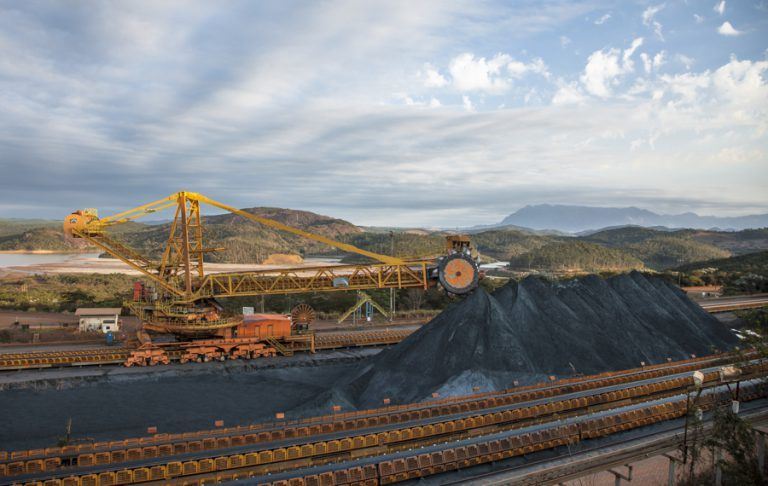
Indian ore prices take a cue from globally traded rates. At the same time, demand from domestic steelmakers is the most important factor influencing prices, as most of India's ore production is used domestically.
Indian ore prices take a cue from globally traded rates. At the same time, demand from domestic steelmakers is the most important factor influencing prices, as most of India's ore production is used domestically. For example, 57.22 million tons of 203.92 million tons of ore production was exported in the 2020-21 period, with the rest either processed locally or left in stock.
World prices have fallen nearly 40% since May; most important is how far China will go to curb steel industry production in the second half of this year in line with its decarbonisation move. With the softness prevailing in the global ore market, NMDC took the opportunity to lower its prices.
NMDC chairman Sumit Deb expresses his belief in the continued good work of Indian steel companies, expansion programs that will result in increased ore demand, and the country's focus on executing infrastructure projects that will increasingly require steel. How NMDC will perform in the remainder of 2021-22 will only affect the behavior of ore prices in the world market, which will depend on Chinese imports.
Why is China critical to ore prices? The answer lies in the fact that this country has a 56.5% share of 1.864 billion tons of global steel production in 2020, of which it accounts for 56.2% of world steel consumption.
In the last six years, China has eliminated at least 150 million tons of steel capacity. The aim is to move the industry towards improving quality rather than building new capacity.
An Odisha-based iron ore producer-exporter says: “Miners here are making a significant profit as China accelerates its ore imports, in line with crude steel production rising from 803.8 million tons in 2015 to 1.053 billion tons in 2020. 60 percent of Australia's Chinese imports. However, as political differences with Canberra increase, and also in line with a well-thought-out strategy to accelerate purchasing from other ore producing countries, we can increase our exports to China from 23.8 million tons in 2019 to 44 million tons in 2020. Don't forget. Almost two-thirds of our exports to China had less than 58% iron content, with little domestic demand.”
The imperative to rein in steel production to combat pollution – steel alone accounts for more than 15% of the country's total carbon emissions – seeks to prove that China is in the business of dumping excess ferrous metal onto the world market.
China steel exports may fall further this year after higher tariffs are imposed on foreign shipments. Last year, steel exports decreased by 16.5 percent year on year to 53,671 million tons, while imports, which were 20.23 million tons, increased by 64.4% compared to 2019.
Trade officials also noted the possibility that the U.S. Federal Reserve and central banks in many other countries may end strong stimulus programs that have boosted industrial commodities in general, including in China.




Comments
No comment yet.