


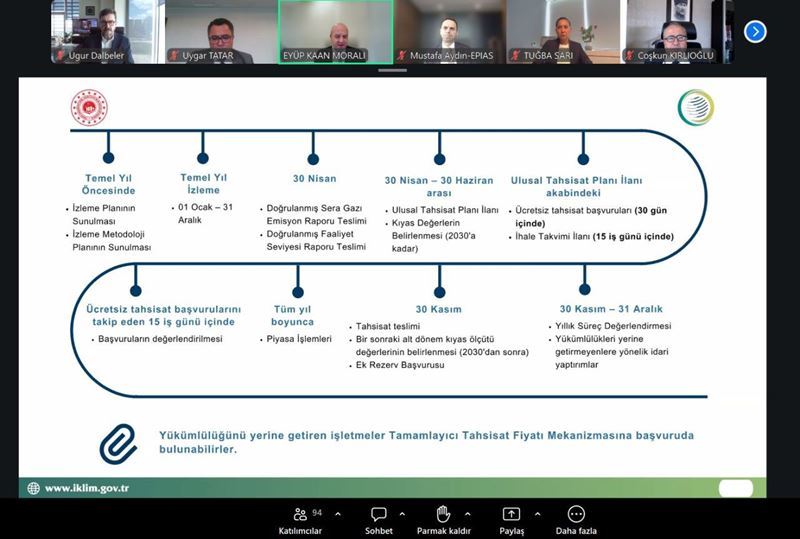
In his opening speech at the webinar, Steel Exporters’ Association Chairman of the Board Uğur Dalbeler emphasized that climate change has now gone beyond its environmental protection dimension and has become a key factor shaping investments, financing, and international trade. Drawing attention to the fact that the steel sector is responsible for 7% of global carbon emissions, Dalbeler noted that 70% of steel production in Türkiye is based on recycling (scrap-based) methods, which provides a significant advantage compared to the global average. He stated that the more consciously the sector acts in response to new legislation and regulations, the stronger its future will be built.
Eyüp Kağan Moralı, Head of the Carbon Pricing Department at the Climate Change Directorate, stated that with the entry into force of the Climate Law, efforts toward Türkiye’s Emission Trading System (TL-ETS) have accelerated. Reminding that the 31st Conference of the Parties will be held in Ankara this year, Moralı shared details regarding the pilot implementation period covering 2026 and 2027. He explained that during the pilot phase, monitoring and reporting activities will gain financial value and will appear as a “carbon bill” obligation for companies. He added that the system will initially start with 178 high-emission facilities and will expand to 384 facilities by 2028, when the full implementation phase will begin. Moralı stated that Türkiye’s system will use an intensity-based benchmark approach that does not suppress production, and that low-emission facilities will gain an advantage. He also noted that with the Complementary Allocation Pricing Mechanism (TTFM), carbon costs for exporters will be balanced and revenues will be used for green transformation.
Dr. Okan Yardımcı, Head of Environmental Markets and Alternative Fuels Group at the Energy Market Regulatory Authority (EPDK), referred to ongoing regulatory work and stated that the ETS Market Operation Regulation draft will be finalized following public consultations. He announced that the regulation on transparency and market misconduct will enter into force on January 1, 2027. He also addressed the European Union’s Carbon Border Adjustment Mechanism (CBAM). He stated that in the steel sector, only direct emissions are currently subject to financial obligations, but indirect emissions are also increasingly becoming important in trade decisions. He noted that intensive diplomacy is being conducted under the coordination of the Ministry of Trade to ensure that renewable energy investments made by industrial facilities in Türkiye for self-consumption are correctly accounted for by the EU, and that objections continue against the EU’s unfair “default value” approach in calculations, in order to protect the competitiveness of Turkish exporters.
Mustafa Aydın, Deputy General Manager of Environmental and Commodity Markets at EPİAŞ, stated that after many years of experience in electricity and natural gas markets, the institution has been designated as the market operator in the emissions trading system. He noted that EPİAŞ began preparations for ETS in 2023 and that as of July 2025, the technical infrastructure has been largely completed. He stated that once the regulations are finalized, the system will be ready to operate at 99% readiness.
Tuğba Sarı, Head of ATP GreenX Unit, delivered a presentation on correct carbon management in the steel sector and global carbon market price dynamics. She noted that exporting companies in the field, even though payment obligations appear to be on the importer side, are trying to manage and offset these costs commercially through contract clauses or tax-sharing mechanisms. She emphasized that the carbon tax to be paid in Türkiye will be deductible from the total obligation. Referring to global market price trends, she highlighted that EUA spot prices have risen to around 80 euros following new EU regulations. Based on ATP GreenX’s analyses, she stated that average EUA price forecasts for 2026 are at the level of 85 euros, taking into account free allocation levels provided by countries, and that these dynamics will also determine price projections toward 2030.
The webinar concluded after answering questions from participants following the presentations.




Comments
No comment yet.