


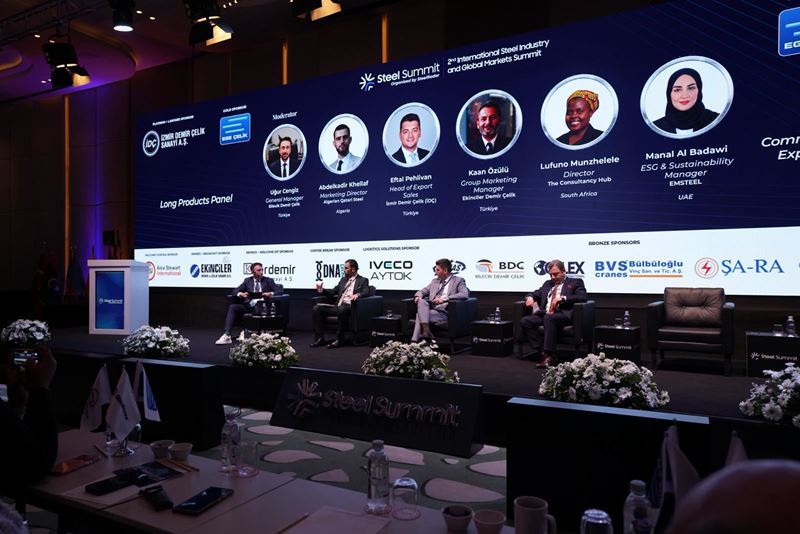
SteelRadar’s summit, organized at Swissôtel Resort & Spa in Çeşme, İzmir, continued on its second day with critical sessions shaping the future of the industry. The session titled “Commercial Obligations, Market Balance and Export Competitiveness in Long Products” was moderated by Bilecik Demir Çelik General Manager Uğur Cengiz.
The panel, which attracted strong interest from the sector and offered simultaneous translation services for foreign participants, featured Algerian Qatari Steel (AQS) Marketing Director Abdelkader Khellaf from Algeria, İzmir Demir Çelik Export Sales Manager Eftal Pehlivan and Ekinciler Demir Çelik Group Marketing Manager Kaan Özülü as speakers. Due to geopolitical developments in the Middle East, The Consultancy Hub Director Lufuno Munzhelele from South Africa and EMSTEEL ESG and Sustainability Manager Manal Al Badawi from the United Arab Emirates, who could not physically attend the summit, joined the session via live connection and video messages through digital platforms.
“The Industry Is Managing Both Excess Supply and Access Problems at the Same Time”
Opening the panel, moderator Uğur Cengiz stated that the long products market has been facing a rapidly changing and increasingly difficult cost-margin equation unlike anything seen in recent years. Noting that supply chain disruptions and logistical access problems are being experienced simultaneously in a global market already discussing excess capacity, Cengiz made the following remarks:
“The industry is trying to manage both excess supply and access problems at the same time. This situation complicates pricing. Türkiye has a strong industrial infrastructure in long products production, but the structure of competition is changing radically. While our traditional markets are shrinking, new opportunities and new areas of competition are emerging in regions such as Africa, the Middle East and North Africa. We are no longer talking only about price competition. Delivery times, supply security, productivity, commercial flexibility, access to finance and even customer relations have become part of competitive advantage. In addition, protectionist policies are strengthening worldwide. Carbon regulations, low-emission production, ESG criteria and the concept of green steel are now real parameters in purchasing decisions. We will discuss how long products producers can maintain their competitiveness in this changing new global order.”
Algeria-Origin AQS Stands Out with Technical Flexibility and Logistics
Referring to the transformation in the North African market and the strong competition from Turkish and Asian-origin semi-finished products, Algerian Qatari Steel (AQS) Marketing Director Abdelkader Khellaf emphasized that they stand out in fierce market competition with their quality. Stating that they continuously update their production processes and certifications in order to provide assurance to customers, Khellaf said:
“The biggest factor that differentiates us in the market is the technical flexibility we offer not only in quality standards but also in grades, standards, sections and lengths. This flexibility takes us beyond being an ordinary player and makes us the first supplier that comes to mind for special orders. Compared to Asian-origin producers, we have a serious advantage in delivery times. We remain loyal to our delivery schedules and fully fulfill our commitments. Thanks to this, we have managed to enter a total of 46 countries since 2022, including our latest 27,000-ton shipment to the Dominican Republic. In addition, being located just half an hour from Algeria’s largest port, Jendouba Port, and at most 3.5 hours away from the other two main ports enables us to conduct simultaneous export operations. With our annual production capacity of 2 million tons of rebar and wire rod, we reflect the cost advantage brought by our modern facilities to the market.”
Khellaf also pointed out that the EU’s implementation of CBAM, “Made in EU” steel practices and protectionist policies are creating uncertainty in the market, adding that through the special CBAM commission established within the company, they monitor emission data across the supply chain and provide proactive solutions to customers.
Pressure from “Inward Processing” Billet Imports in Türkiye and the Necessity of Added Value
Sharing data on imported billet usage rates and cost pressures in Türkiye’s construction steel production, Ekinciler Demir Çelik Group Marketing Manager Kaan Özülü stated that the Turkish steel sector is at a serious crossroads. Explaining that Türkiye exported approximately 4.15 million tons of rebar while importing 4.43 million tons of billet according to 2025 data, Özülü shared the following striking figures:
“Seventy-five percent of our billet imports are carried out under the Inward Processing Regime (IPR). The worrying situation is that while the share of imports under IPR was 67 percent in 2025, it has risen to 89 percent in the first quarter of 2026. While Türkiye’s total rebar exports amounted to 1.065 million tons, billet imports under IPR reached 1.92 million tons. The figures clearly show that we are losing market share in rebar, which is our largest steel export product. The shares of China and Iran in imports are steadily increasing. Capacity utilization rates at our electric arc furnaces are around 55 percent. While the global average is around 74 percent, Türkiye has fallen below even 60 percent.”
Arguing that structural steps must be taken to overcome the current problems, Özülü warned:
“Türkiye has a massive rebar production capacity of 25 million tons. Of this, 10 million tons are for domestic consumption, around 4 million tons for exports, and the remaining 10 million tons are idle capacity. The solution is to shift this capacity toward higher value-added and qualified special steel products. Some companies that switched to special steel production may have returned to the old system due to setbacks, but we must remain determined and persistent on this new route. We must continue nonstop to catch up with the world’s leading producers. In addition, China dominates the African market with a 60 percent share, while Türkiye’s share has declined to 10 percent. With current energy costs, it is impossible to fight the pressure created by China through traditional methods.”
Lost Markets and the Strategy of Logistical Flexibility
İzmir Demir Çelik Export Sales Manager Eftal Pehlivan shared the latest contractions in export markets and the company’s flexibility-focused strategies. Stating that there was no significant volume change in rebar exports compared to the same period last year, Pehlivan referred to geopolitical losses:
“After losing Israel, which was a huge market of approximately 700,000 tons for us, we had to turn toward alternative markets. However, since rebar is a localized product with local capacity in every country, creating alternatives is quite difficult. Over the last two years, we have focused on markets such as Yemen, Romania, Albania, the TRNC, Syria, Peru and Ecuador. While Section 232 restrictions in the US and CBAM quotas in Europe make trade more difficult, we still see opportunities in the African and Middle Eastern markets. In particular, developments and production cuts in Iran directly affect semi-finished trade and freight costs.”
Stating that İzmir Demir Çelik balances the difficulties in rebar through semi-finished (billet) exports, Pehlivan said:
“In 2025, Türkiye’s long semi-finished product exports increased by 189 percent to 319,000 tons, and we alone accounted for 270,000 tons of these exports. Thanks to the strong reputation we have built as a company, we are trying to remain active in European markets. The most critical issue for the Turkish steel sector is accelerating structural steps that will reduce energy costs, strengthening supply security in scrap and speeding up the CBAM compliance process. Customers no longer ask only about prices; they request CBAM documents and emission data. Sales decisions have now completely turned into risk management decisions.”
The New Route of Global Steel: The African Market and China’s Expansion
In the final part of the panel, The Consultancy Hub Director Lufuno Munzhelele shared market dynamics in South Africa and neighboring countries through a video message, stating that the global center of steel production and investment is shifting from mature markets toward the African continent. Emphasizing that Africa may not yet be a dominant steel producer but is the world’s largest untapped industrial growth frontier, Munzhelele shared the following analysis:
“While annual per capita steel consumption worldwide averages 240 kilograms, this figure ranges between 30 and 50 kilograms in Sub-Saharan Africa and stands at 70 kilograms in South Africa. This indicates enormous industrial potential. In the region, the influence of China and India has evolved beyond trade into long-term strategic investments. Following raw material supply and infrastructure investments under the Belt and Road Initiative, China has now moved to the third phase. They are now establishing local steel production and industrial ecosystems in Africa. Tsingshan Holdings’ integrated facility in Zimbabwe and steel investments in Nigeria are the biggest examples of this. India, on the other hand, is expanding mainly through the private sector in mining and automotive industries.”
Munzhelele noted that the fastest-growing segment increasing steel demand across Africa is infrastructure, energy transmission lines and urban transformation projects. He stressed that 600 million people across the continent still lack access to electricity, and that renewable energy transformation together with rapid population growth will multiply demand for galvanized steel, structural sections and wire rod products in the coming period, emphasizing that producers must position themselves according to this transformation.




Comments
No comment yet.