


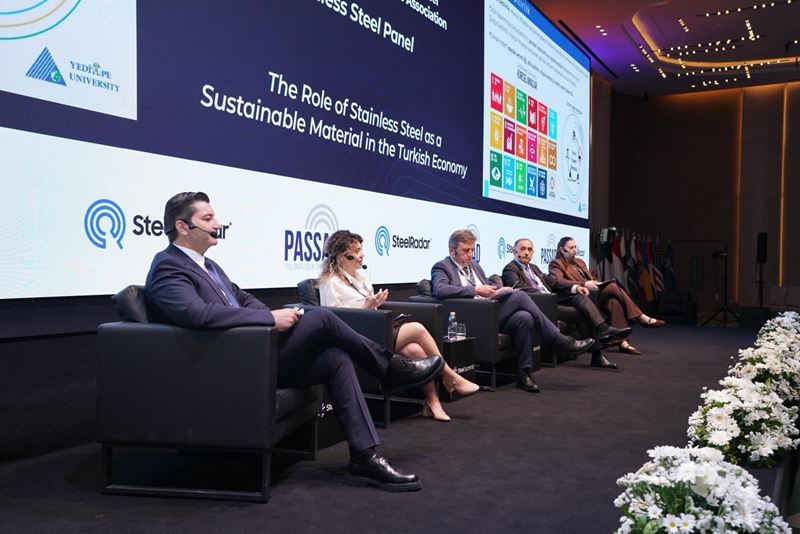
The 6th session was moderated by PASSAD Communication and External Relations Commission Chairman Ufuk Özdemir and addressed Türkiye’s stainless steel ecosystem, production capacity, recycling and export potential, as well as sustainability targets within the framework of the Carbon Border Adjustment Mechanism (CBAM / SKDM).
“We Handle 60–70% of Stainless Steel Scrap in Türkiye”
CRONIMET Turkey Metal Trading Inc. Trade and Logistics Manager Zeynep Fındık stated that approximately 12,000 to 15,000 tons of stainless steel scrap are generated monthly in Türkiye, and that Cronimet processes 6,000 to 7,000 tons of this volume. She noted that the company handles around 60–70% of the stainless steel scrap in the Turkish market and recovers 50,000 to 70,000 tons of stainless steel annually into the economy, playing a significant role as an exporter.
Fındık emphasized that quality, accurate analysis and traceability are more important than tonnage in the process. She stated that scrap in Türkiye originates from sectors such as household appliances, automotive manufacturing, machining industries, defense and arms industries, as well as ship dismantling activities in Aliağa. She highlighted that high-value scrap types such as 316, duplex and so-called “baffon” grades contain significant levels of chromium, copper and nickel. Recalling that the separation of stainless steel from carbon steel in Türkiye dates back to 1975–1980, she stressed that proper segregation at the source prevents value loss and directly contributes to the national economy.
“We Use Charcoal from Our Own Forests in Our Integrated Plant in Brazil”
APERAM Stainless Steel CEO/COO Ercüment Ulusay described Aperam as a global player focused on green transformation, producing stainless steel, electrical steel and specialty alloys. He noted that the company operates 14 steel service centers across Europe and maintains a wide distribution network. He also announced recent acquisitions, including the Germany-based recycling company “Ian Schrade” and “Universal,” which produces specialty steels for the aerospace industry in the United States.
Regarding sustainability, Ulusay stated that Aperam owns FSC-certified forests and uses charcoal (biomass) derived from these forests in its integrated Timóteo plant in Brazil, which operates from ore to finished product. He added that the group obtained ResponsibleSteel certification in 2023 and has committed to its 2030 targets, including a 10% reduction in energy consumption, 20% reduction in CO₂ emissions, 50% reduction in dust emissions, 40% reduction in water consumption, and increasing recycling rates above 97% based on 2021 levels. He also noted the company’s goal of achieving carbon neutrality in Europe by 2050.
Ulusay reported that Aperam produced 2.2 million tons in 2025 and stated that Aperam Türkiye, established in Gebze Organized Industrial Zone in 1998, operates five production lines, two sheet cutting lines and one polishing line, and has achieved “Bronze” level in the World Class Manufacturing (WCM) system.
“Electric Arc Furnaces Are an Advantage, But Electricity Must Be Decarbonized”
Yeditepe University faculty member Dr. Kübra Akben stated that approximately 70% of steel production in Türkiye is carried out via electric arc furnaces (EAF), compared to around 30% in Germany, highlighting this as a structural advantage for Türkiye. However, she stressed that electricity production in Türkiye is still carbon-intensive, noting that “without increasing renewable energy use, true green transformation is not possible. Decarbonization and cost reduction of electricity are critical.”
Sharing survey results from the sector, Akben stated that most participants already measure corporate carbon footprints and expect CBAM compliance and sustainability alignment to be the biggest challenge in the next five years. She noted that Türkiye’s Climate Law has been enacted and that the Emissions Trading System (ETS) will begin in 2026, with financial obligations gradually starting from 2028 and free allowances being allocated in the 2026–2027 period.
She also highlighted hydrogen-based decarbonization pathways and Carbon Capture, Utilization and Storage (CCUS) technologies in the steel industry roadmap, adding that her institution is working on converting CO₂ into high-value carbon monoxide and aims to establish Türkiye’s first Direct Air Capture pilot unit. She also announced the launch of an AI-based “Carbon Bot” (yukarbon.yildiz.edu.tr) designed to support SMEs in green and digital transformation processes.
Abiş: “If the Eiffel Tower Had Been Built with Stainless Steel, There Would Be No Heavy Maintenance Costs”
Aca Metal General Manager Ahmet Cemil Abiş stated that per capita stainless steel consumption in Türkiye ranges between 5 and 8 kilograms, compared to around 25 kilograms in Europe, emphasizing the need to increase usage. He highlighted stainless steel as a high-performance, long-life material and noted its use in corrosion-sensitive components of the Osmangazi Bridge.
Abiş emphasized that industrial shutdowns due to corrosion and repainting requirements cause significant economic losses, arguing that stainless steel should be considered not a costly material but an “investment asset” with a circular lifecycle and long-term economic advantages.
Referring to a historical example, Abiş stated: “When the Eiffel Tower was built, stainless steel did not exist, and its lifespan was initially estimated at 20 years. Today, it is maintained through very heavy painting and maintenance cycles every seven years, lasting about 1.5 years. If it had been built with stainless steel, none of these enormous maintenance costs would exist, and it would have been far more economical.”
The panel concluded with closing remarks emphasizing sustainable production, human-rights-aligned green transformation and the expansion of recycling practices, followed by participants transitioning to a workshop session for further technical discussions.



Comments
No comment yet.