


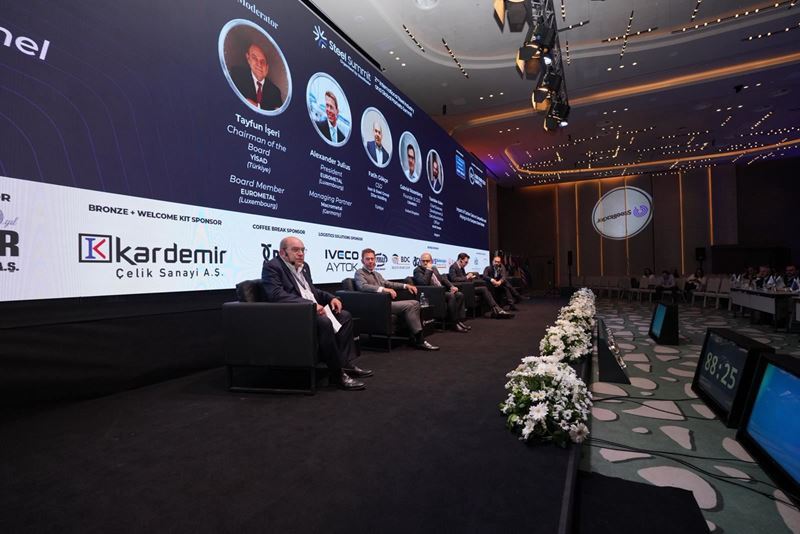
Within the scope of the 2nd International Steel Industry and Global Markets Summit held in Çeşme, the “Carbon Economy Panel” addressed carbon costs— which have become a key factor determining pricing and trade flows in the European steel market as of 2026— and the sector’s competitiveness outlook for 2026–2027.
The session, moderated by YİSAD Chairman of the Board and EUROMETAL Board Member Tayfun İşeri, featured EUROMETAL President and Macrometal Managing Partner Alexander Julius, Diler Holding Iron and Steel Group CSO Fatih Gökçe, CBAMBOO Founder and CEO Gabriel Rozenberg, and NLMK Europe Business Development and Decarbonization Director Tsanislav Kolev as panelists. The panel discussed the effects of CBAM (Carbon Border Adjustment Mechanism), ETS, and quota mechanisms on the steel industry, as well as cost analyses based on assumed and actual emission data.
Julius: "The Tax Gap in Derivative Products Poses a Threat to 13 Million Workers"
Highlighting the protection of European manufacturing and competitiveness issues, EUROMETAL President Alexander Julius stated that the European Commission, due to strong lobbying pressures, focuses only on steel production, while the fragmented manufacturing sector remains vulnerable. He noted that without a level playing field, industrial relocation and bankruptcies would be inevitable. Julius also said that they have launched an “action call” signed by more than 460 steel producers and users, aiming to reduce costs and cap electricity prices at a maximum of 5 cents.
Emphasizing the serious gap in taxation for steel-based derivative products, Julius said:
“The Commission expects European producers to bring their prices down to CBAM-inclusive imported steel levels, which increases overall costs. Countries like China can bypass tariffs by making minor modifications—such as drilling a hole in a pipe or changing its shape—and exporting it under a different HS code without paying duties. This represents a major threat to 13 million workers in the manufacturing sector.”
Gökçe: "Hydrogen Will Take 50–60 Years, Default Values Can Lead to Company Closures"
Fatih Gökçe, CSO of Diler Holding Iron and Steel Group, stressed the need for realism regarding the timeline of green transformation technologies. He noted that hydrogen technology is still at the laboratory stage and that scaling it to global steel production of 2 billion tons would take at least 50–60 years. He stated that supporting existing blast furnace capacities with carbon capture is the only viable solution in the short to medium term.
He warned that being forced to rely on default emission values instead of real verified data would create additional costs exceeding 100 euros per ton, especially for low-margin products such as rebar, potentially leading to company closures. Regarding verification processes, he added:
“Customers now demand certainty. For mandatory verification in 2027, it is essential to establish monitoring plans and systems in advance. Otherwise, delays until September revisions may result in a lack of data, pushing companies into default values. Moreover, most countries supplying pig iron and HRI still do not know how to report carbon emissions, meaning we will have to bear the cost of default values for the first 2–3 years.”
Rozenberg: "The Era of Back-of-the-Napkin Calculations Is Over"
CBAMBOO Founder and CEO Gabriel Rozenberg stated that CBAM is now a complex but legally binding reality and that the European Commission has formalized detailed cost calculation rules. He emphasized that companies should no longer calculate obligations informally, saying:
“Since payments for 2026 imports will be made in September 2027, there is currently a false sense of security in the market. However, CBAM is now central to the EU’s global stance, and revising these values this year is not realistic.”
Rozenberg also noted that the default value set for stainless steel billet imports from Türkiye is €367 per ton, making it the fourth highest in the world.
Kolev: "Customers Do Not Want to Pay a Premium for Green Steel"
NLMK Europe Business Development and Decarbonization Director Tsanislav Kolev stated that customers are generally unwilling to pay an additional premium for green steel. He explained that ETS and CBAM mechanisms are effectively designed to increase blast furnace costs to the level of electric arc furnace (EAF) production.
He added that importers are currently more concerned about “Can I trust my supplier’s data?” than cost, which is shifting risk management toward new trade models such as DDP (Delivered Duty Paid). Kolev also highlighted global capacity risks:
“Europe has the highest labor and transformation costs in the world. Meanwhile, half of the 500 million tons of new global capacity is being built based on blast furnace technology, especially in India. This leaves the question of how carbon leakage will be prevented unresolved.”
İşeri: "Turkey and the US Have the Same EAF Share, Why Is the Default Value Three Times Higher?"
Emphasizing fairness and competitiveness, moderator Tayfun İşeri stressed that Türkiye must defend its rights. He said:
“Both Türkiye and the United States use electric arc furnace (EAF) technology at a rate of 75%. Yet Türkiye’s default emission value is three times higher than that of the US. This issue must be questioned in Brussels. If we remain silent, we will effectively accept this injustice.”
Highlighting the problem of uncontrolled derivative products, İşeri added:
“When a shock absorber manufacturer in Türkiye imports pipes from China, processes them slightly, and exports them to Europe, it pays no tax. This directly harms established European producers such as Monroe. If the system is not urgently expanded to cover all derivative products, European industrial competitiveness will be severely undermined,” and concluded the session.



Comments
No comment yet.