


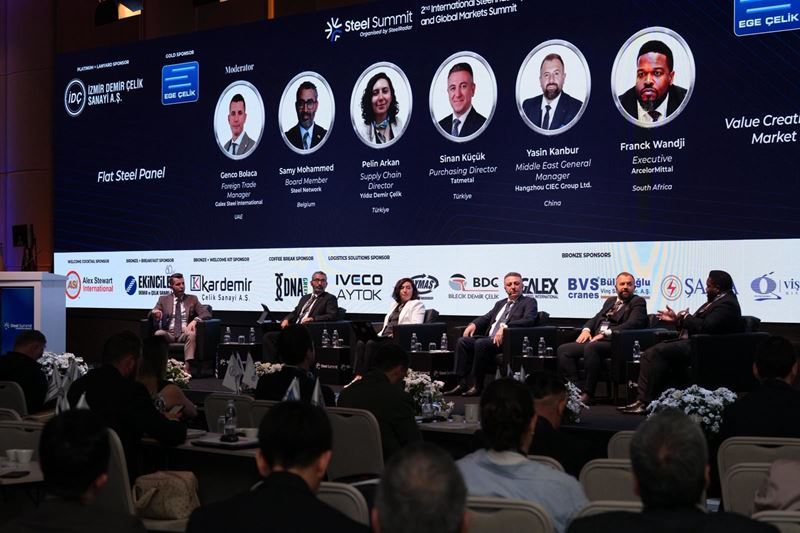
In the 7th Session moderated by Galex Steel International Foreign Trade Manager Genco Bolaca, the supply-demand balance in global flat steel markets, price pressures, protectionist measures, carbon border regulations and structural transformation processes in global markets were comprehensively evaluated.
Mohammed: “The Current Situation Is Not a Temporary Cycle, but a Structural Change”
Evaluating excess supply and price pressures in global flat steel markets during the panel, Steel Network Board Member Samy Mohammed stated that he does not define the current market conditions as a temporary cycle. Emphasizing that price fluctuations in steel will always continue, but the pressure in the flat steel segment has now become structural, Mohammed said:
“For many years, competition was shaped only by volume and price, meaning how much quantity you could buy and at what price. However, today this is no longer enough. Global capacity is still very high and demand is not growing at the pace we want. Buyers are acting much more cautiously in their purchasing decisions by considering factors such as working capital and inventory management. The winners of the future will not simply be large buyers; they will be producers that focus on customer requirements, validations and certifications, and that can remain within the market while offering high added value.”
Mohammed also noted that the role of service centers and distributors in the European market is becoming increasingly critical, adding that the relationship between producers and distributors is evolving from a traditional transaction model into a strategic partnership model. He stated that service centers are closer to end users, can process small-tonnage orders and, with services such as cut-to-length and slitting, have effectively become market access partners for producers.
Arkan: “Ninety-Eight Percent of Hot Rolled Coil Imports Come Under the Inward Processing Permit Scheme”
Yıldız Demir Çelik Supply Chain Director Pelin Arkan stated that price and supply pressure in the market should be divided into cyclical and structural factors. Arkan explained that global liquid steel capacity had reached 2.55 billion tons as of 2025, while excess capacity stood at 640 million tons and is expected to rise to 721 million tons by 2027. She also pointed out that global demand has contracted by 2 percent for four consecutive years.
Stating that China has turned toward exports due to weak domestic demand and that Chinese facilities supported by state subsidies operate with profitability levels of around 1 percent, Arkan added that India reached 168.4 million tons with growth of 10.7 percent and is expected to increase this figure to 300 million tons by 2030, creating serious excess supply.
Arkan stated that protectionist measures and regionalization are increasing and announced that the European Union quota, Türkiye’s main market, will decline by 47 percent to 18.3 million tons as of July 1, 2026. Referring to the new “melt and pour” rules of origin planned to enter into force on October 1, 2026, Arkan emphasized that the regulation will focus not on where the steel is processed but where it is melted, completely reshaping trade flows and supply chains.
Evaluating the effects of Türkiye’s import protection measures on downstream industries, Arkan said:
“If imports are not truly intended for exports and weaken the competitiveness of domestic producers, justified measures should be taken. However, the steel sector is dependent on foreign sources for scrap, iron ore and coal. When energy, financing and high labor costs are added, competing with Asia becomes impossible. Looking at hot rolled coil (HRC) imports in Türkiye, 98 percent of imports from third countries are carried out under the Inward Processing Permit Certificate (IIPPC). This shows that imports are entirely export-oriented. Due to the 25 percent domestic and 75 percent foreign usage rule introduced in September 2025, 25 percent of the USD 80 gap between domestic and imported prices directly increases the costs of exporting companies and harms downstream industries.”
Küçük: “Using Imported Sources Is Not an Option for Us, but a Necessity”
Tatmetal Purchasing Director Sinan Küçük stated that the flat steel sector is entering a structurally more challenging period rather than a classical and temporary cycle. Küçük said that China is facing uncontrolled growth and excess supply problems, while Europe is under pressure from demand weakness and regulations, and Türkiye is caught between these two regions.
Predicting that price pressure will remain for a long time due to geopolitical risks in an environment where global growth is slowing, populations in developed economies are aging and manufacturing industries are weakening, Küçük said:
“We sometimes see differences of between USD 70 and USD 100 between hot rolled coil prices in Türkiye and China. Therefore, in order to maintain our competitiveness in export markets, using imported sources is not an option for us but a necessity. Following the regulation introduced in September 2025 requiring 25 percent domestic usage, our import figures declined at similar rates, but we are trying to manage the process by making maximum use of the opportunities provided by the inward processing regime.”
Kanbur: “One Ton out of Every Three Tons of Steel Produced Is Excess Capacity”
Hangzhou CIEC Group Ltd. Middle East General Manager Yasin Kanbur stated that there is approximately 700 million tons of idle capacity worldwide, meaning that one ton out of every three tons of steel produced represents excess capacity. Kanbur said that with the increase in excessive protectionist measures worldwide, trade is evolving from an international dimension toward a local one.
He noted that although capacity utilization rates in China have declined due to unfinished large-scale construction projects and lack of motivation in the domestic market, the country has still not escaped the excess supply cycle.
Kanbur also shared that the Chinese government has imposed export taxes of between 30 percent and 50 percent on flat steel and billet products and is now focusing on the export of value-added products. He explained that Chinese organizations, supported by fast deliveries and strong Chinese financing opportunities in the Turkish and Middle Eastern markets, are no longer acting merely as traditional suppliers but are positioning themselves as long-term “solution partners” in finished products.
Kanbur further stated that trillion-dollar mega infrastructure projects in Gulf countries will accelerate with China’s major contracting and joint production strategies once the war environment comes to an end.
Wandji: “The African Continent Has the Greatest Growth Potential”
ArcelorMittal South Africa Executive Franck Wandji stated that ArcelorMittal has a global structure with production operations in 15 countries, trade activities in 104 countries, annual iron ore mining of approximately 50 million tons and annual steel production of 50 million tons.
Wandji explained that in South African operations, they shut down one blast furnace last year due to pressure on rebar and wire rod prices, but continue full-spectrum production with two blast furnaces in the flat steel segment, focusing on automotive and high-value industries.
Stating that current steel demand across Africa is around 40 million tons, half of which is supplied by China, Wandji emphasized that the continent holds the greatest growth potential globally. He pointed out that while steel consumption has reached saturation levels in developed regions, per capita steel consumption stands at 440 kilograms in Türkiye and 900 kilograms in South Korea, whereas the figure across Africa is only 25 kilograms. According to Wandji, under normal conditions the continent should be consuming 200 million tons of steel annually.
Wandji also noted that the continent is focusing on local transformation rather than raw material exports, adding that South Africa has the potential to become a global export hub for finished and value-added products in sectors such as automotive, renewable energy equipment and shipbuilding.
The panel concluded with an emphasis on the importance of shifting from commercial product groups toward value-added production, customer-oriented strategies and a solution partnership model in the flat steel sector.



Comments
No comment yet.