


The European Council and the European Parliament have reached a provisional agreement on a new regulation aimed at protecting the EU steel industry from the adverse effects of global overcapacity. The compromise reached between the Council presidency and the European Parliament seeks to address trade-related pressures stemming from global overcapacity on the EU steel market.
New regulation to replace existing measures
According to the agreement, the forthcoming regulation will establish a new framework to protect the EU steel sector against global overproduction and trade diversion. At the same time, it aims to remain consistent with the EU’s international trade obligations while ensuring sufficient flexibility for economic operators, including downstream sectors. The regulation will replace the current EU steel safeguard measures set to expire on June 30, 2026, thereby preventing any regulatory gap in the EU steel market.
Stricter import control through TRQ system
Under the new rules, a revised tariff-rate quota (TRQ) system will be introduced to more effectively address the structural global overcapacity in the steel sector. The system предусматривает a significant reduction in import quotas, along with higher tariffs for volumes exceeding those quotas.
Emphasizing the strategic importance of the European steel industry for the economy, security, and green transition, Cyprus Minister of Energy, Commerce and Industry Michael Damianos stated:
“Europe’s steel industry is a strategic sector for our economy, our security, and our green transition. Today’s agreement provides the EU with a stronger and more effective tool to address global overcapacity, while maintaining a rules-based approach and ensuring fair competition and long-term resilience for Europe’s steel producers and value chains.”
Based on Commission proposal
The provisional agreement preserves the core structure of the European Commission’s proposal, while introducing several adjustments aimed at ensuring the stability of EU supply chains and addressing structural overcapacity in global steel production.
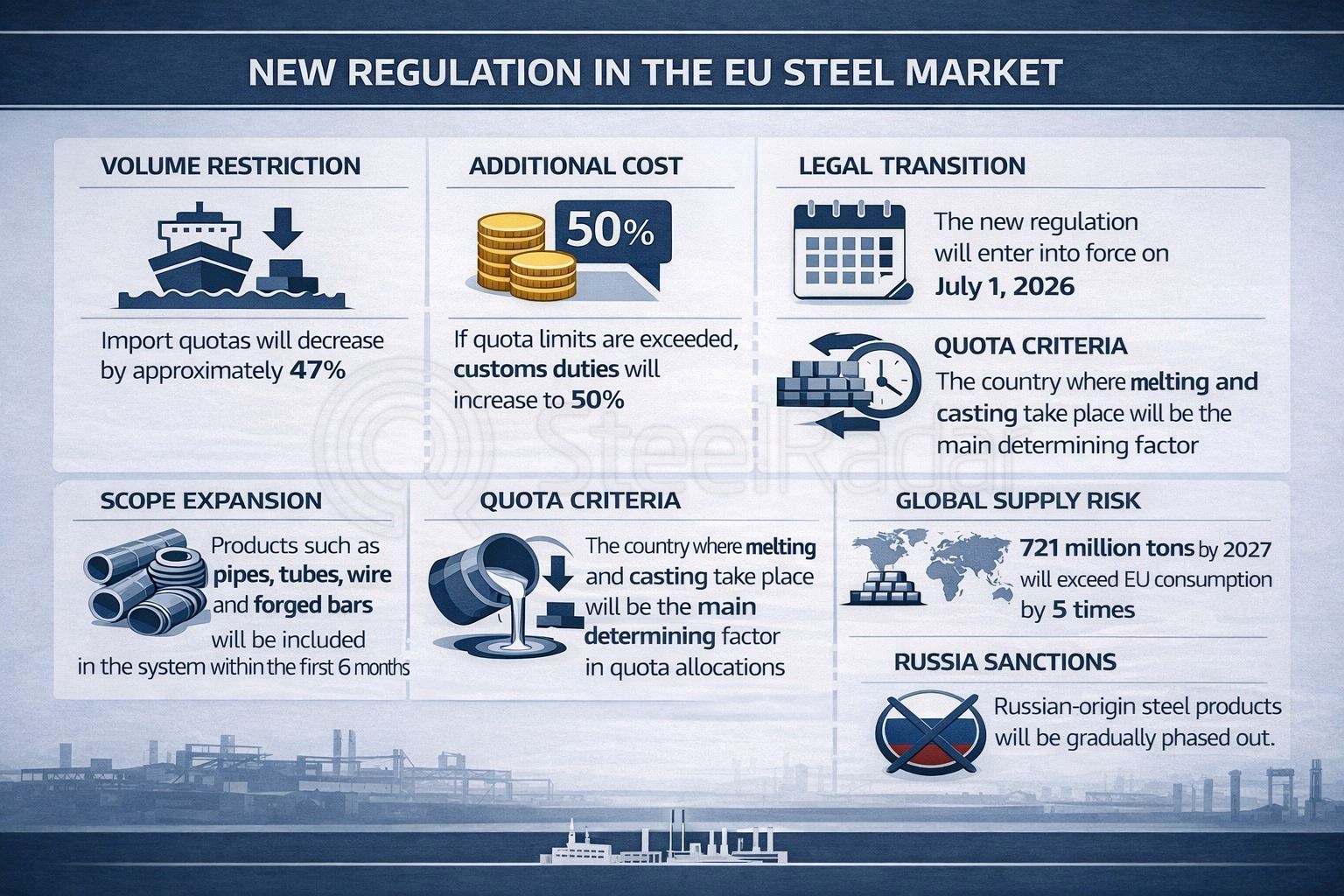
47% cut in quotas, 50% tariff
With the new regulation, a revised TRQ system will govern steel imports into the EU. Compared to the 2024 safeguard quotas corresponding to an annual import volume of 18.3 million tonnes, total import quotas will be reduced by approximately 47%. The tariff on out-of-quota imports will be increased to 50%. These measures aim to deter excessive imports while maintaining controlled market access for traditional suppliers.
Quota management and flexibility mechanism
The agreement also clarifies rules on quota management and allocation among exporting countries. To provide flexibility for economic operators and support supply chains, unused quotas in the first year can be carried over from one quarter to another across all product categories.
From the second year onward, the European Commission will decide whether to allow such quarterly carry-overs for specific product categories based on criteria such as import pressure, quota utilization rates, and supply conditions in downstream sectors. The objective is to prevent market distortions while ensuring sufficient supply.
Introduction of the “melt and pour” rule
The regulation also introduces the “melt and pour” principle to prevent circumvention and enhance supply chain transparency. This principle requires identifying the country where the steel was first melted and poured. According to the agreement, this information will be one of the factors considered when allocating quotas to third countries. The approach aims to remain compatible with existing rules of origin and the EU’s obligations under the World Trade Organization and free trade agreements.
Within two years, the European Commission will assess whether the country of melt and pour should become a primary criterion for country-specific TRQ allocations and, if necessary, propose new legislation.
Possible expansion of product scope
In terms of product coverage, the regulation largely aligns with existing EU steel safeguard measures to ensure legal certainty and administrative manageability. However, lawmakers have agreed on time-bound review mechanisms to potentially expand the scope.
Within six months of entry into force, the Commission will assess whether additional steel products—such as pipes and tubes, certain wire products, and forged bars—should be included, and may propose legislative changes if deemed necessary.
Second review within 12 months
A second review will be conducted within 12 months, focusing on products containing significant amounts of steel or made from steel, taking into account market developments and risks of circumvention. These reviews will continue on a regular biennial basis.
The regulation also includes monitoring, reporting, and review provisions to ensure the instrument remains effective and proportionate over time. The European Commission will regularly assess its functioning in light of market developments and changes in global overcapacity conditions and may propose adjustments if needed.
A joint statement accompanying the regulation reaffirmed the commitment of lawmakers and the Commission to reduce economic dependence on Russia. In this context, efforts will continue to phase out Russian steel products and diversify steel imports.
Entry into force on July 1, 2026
The provisional agreement will now be submitted to member state representatives in the Council and to the European Parliament for formal approval. If adopted by both institutions, the regulation will enter into force on July 1, 2026.
Background
Steel plays a critical role in the EU economy, serving as an essential material for strategic sectors such as the green transition and defense. The EU is the world’s third-largest steel producer, with the sector directly employing around 300,000 people and making a significant contribution to regional economies across member states.
However, the sector is under severe pressure due to unsustainable levels of global overcapacity, which is expected to reach 721 million tonnes by 2027—more than five times the EU’s annual steel consumption. Combined with trade restrictions in third countries, the EU market has become a primary destination for excess global steel.
This situation, coupled with rising imports, a capacity utilization rate of just 67% in 2024, and high production costs, poses a serious threat to long-term decarbonization investments in the sector.
These challenges have already led to a loss of around 65 million tonnes of capacity and up to 100,000 jobs since 2007. In response, the European Commission announced in March 2025 its intention to prepare a new steel regulation.




Comments
No comment yet.