


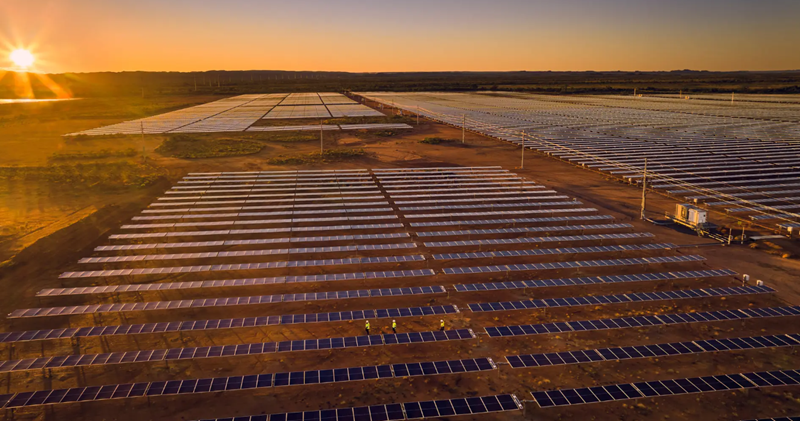
Construction has begun on the Turner River Solar Farm, one of the largest off-grid solar energy projects to be built in Australia. The project is being developed together with a large-scale battery system in the Turner River region of Western Australia.
Iron ore miner Fortescue is accelerating its green infrastructure investments as it aims to achieve its “real zero” emissions target by 2030. The Turner River project represents the company’s largest solar energy investment to date.
The Turner River Solar Farm will have an installed capacity of 690 megawatts (MW) and is expected to become the largest solar power plant in Western Australia. In terms of capacity, it will rank behind only Acen Renewables’ 720 MW New England Solar Farm in New South Wales.
Fortescue is also building an integrated battery system with a capacity of 74 MW and 650 MWh, providing eight hours of storage. The system is expected to operate in conjunction with the existing 190 MW solar facility at the Cloudbreak mine in Mulga Downs.
Renewable energy investments and grid transformation
According to data from the Clean Energy Council, wind and solar energy continue to account for an increasing share of Australia’s electricity generation, while slow approval processes and declining investment levels are affecting the pace of the transition.
It was reported that financing was completed for only 2.3 GW of new renewable energy capacity in 2025, representing a 46% decline compared to the previous year. Clean Energy Council CEO Jackie Trad stated that the energy system is undergoing its most significant transformation in the past 50 years.
Trad noted that the share of renewable energy in electricity generation is increasing and that Australia is among the world leaders in large-scale battery storage capacity, but emphasized that the slowdown in investment activity is noteworthy.
Digital twin technology gains importance in energy grids
It was noted that digital twin technology is being increasingly adopted in next-generation energy grids, with these systems creating digital replicas of substations and transmission lines to support operational decision-making processes.
Paul King, Industry Strategy Director at Bentley Systems, stated that digital twin technology has significant potential but that there is considerable misunderstanding and hype surrounding the concept in the market.
It was reported that some energy companies in Australia have achieved approximately 50% reductions in design costs and up to 80% reductions in site visits through the use of digital twin applications. The technology has also been cited as playing an important role in the transition from reactive maintenance to predictive maintenance models.






Comments
No comment yet.