


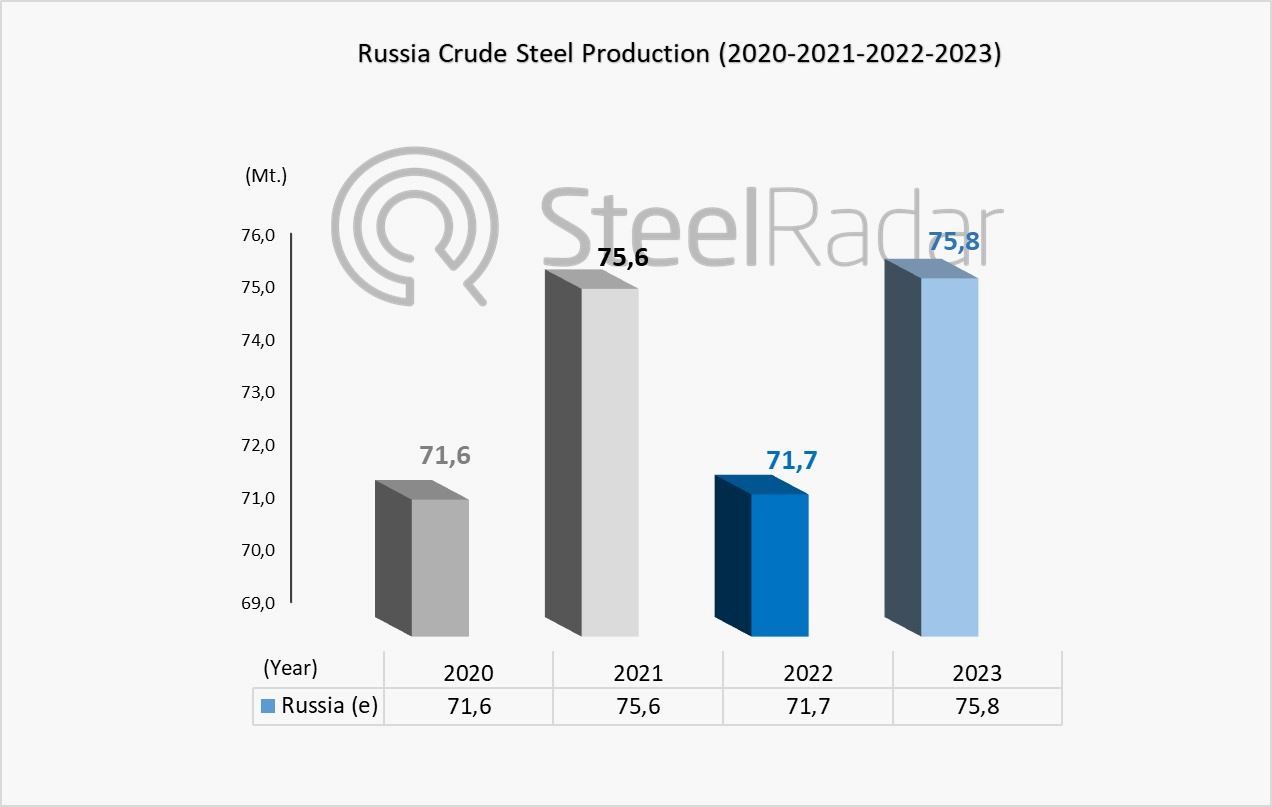
Steel production on the domestic market in 2023 returned to the levels of the record year 2021 and amounted to 75.8 million tons. This was reported by the World Steel Association (WSA).
At the end of 2023, 75.8 million tons of steel were produced in Russia. This figure has almost reached the level of 2021, when 76 million tons were produced. Thus, metallurgists began to produce 5.6% more than in 2022.
According to the association, Russia is among the five largest global steel producers. China is in first place, followed by India, followed by Japan and the USA.
The domestic metal market in Russia has also grown. Severstal General Director Alexander Shevelev told that in 2024, demand for steel in the domestic market is expected to grow by about 1-2%.
Russian steel production surges by 5.6% in 2023, driven by robust domestic demand.
The surge in output has been attributed to the flourishing domestic demand for metal in various sectors, particularly driven by the booming housing construction industry.
The steel production boost was fueled by the substantial growth in domestic metal consumption, primarily attributed to the surge in housing construction. The Russian government's provision of preferential mortgages played a pivotal role in fostering a rapid expansion of the housing sector. Over the period of 2020-2023, the volume of construction work in Russia soared by nearly 23%.
Notably, the construction industry in Russia continues its active expansion, with more than 387 million square meters of housing introduced since 2020, surpassing 110 million square meters in 2023 alone—an absolute record. This surge in construction has significantly improved living conditions for more than 15.7 million families over the past four years.
Despite facing Western sanctions, Russia's overall economy has thrived, with the GDP growth reaching approximately 4% last year. The sanctions seem to have had a positive impact on the Russian economy, prompting increased domestic production to substitute imports from abroad.
This surge in steel production and the overall economic growth signify a resilient and self-sufficient trajectory for Russia, showcasing its ability to navigate challenges and capitalize on domestic opportunities. The positive momentum in key sectors, particularly housing and construction, is expected to contribute to the continued expansion of the Russian economy in the coming years.





Comments
No comment yet.