


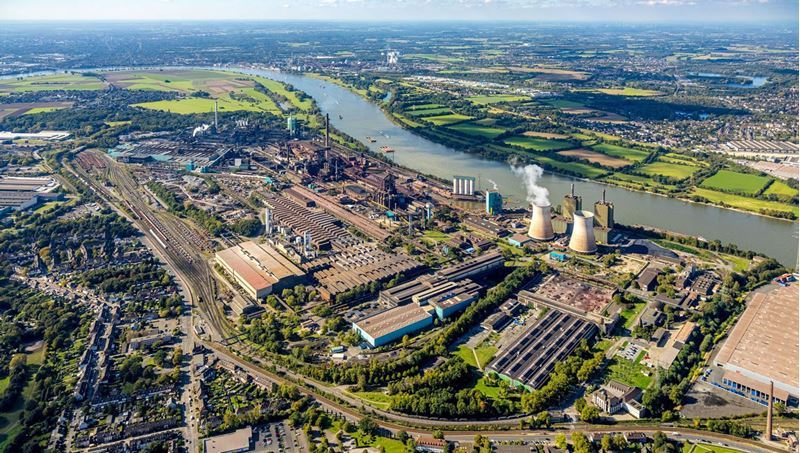
On 28 July 2026, the contract was signed, covering the supply, installation, and joint commissioning of the electric arc furnace, as well as all required auxiliary facilities. The implementation phase is scheduled to begin in August 2026, with the plant expected to be completed in 2029.
New EAF to have 2.5 million tonnes of annual capacity
The new facility, with a 285-metric-ton tap weight and an annual production capacity of 2.5 million tonnes, will become Germany's largest and the European Union's second-largest electric arc furnace. The plant is expected to produce approximately 2 million tonnes of crude steel per year.
The project has been awarded EUR 200 million in funding under the German Federal Government and the State of North Rhine-Westphalia's Federal Funding for Industry and Climate Action programme.
Salzgitter AG CEO Gunnar Groebler stated that commissioning the electric arc furnace will directly integrate HKM into the group's low-carbon steel production strategy while securing the long-term future of the Duisburg site. He emphasized that the company is consistently implementing its decarbonisation strategy and taking concrete steps toward green steel production in Duisburg.
HKM Management Spokesperson Andreas Betzler described the contract as a major milestone for the company, noting that, following an intensive preparation phase, the project is now entering the implementation stage. He added that the public funding sends a strong signal in support of Germany's industrial transformation.
Dr. Markus Dorndorf, Managing Director of Tenova Projects GmbH, expressed his appreciation for the confidence placed in Tenova by HKM and Salzgitter AG. He stated that the new electric arc furnace will be one of the most powerful and energy-efficient facilities in Germany and described the project as one of the most significant decarbonisation initiatives in the European steel industry.
Consteel® technology to be implemented
The new electric arc furnace will be equipped with Tenova's Consteel® technology. The system enables the continuous charging of steel scrap into the furnace via a conveyor belt, while waste heat generated during the process is used to preheat the scrap, significantly improving energy efficiency.
Compared with the conventional basket charging method, the continuous charging system reduces power fluctuations, enhances grid stability, and improves production efficiency. The furnace will also be capable of flexibly using various raw materials, including steel scrap and direct reduced iron (DRI/HBI), enabling the production of a broad range of steel grades.
The contract also includes the installation of all key auxiliary systems required for EAF operation, including a conveyor-based scrap charging system, furnace transformer, water management system, and off-gas cleaning system.
Following the full integration of HKM into the Salzgitter Group, the company emphasized that this investment represents a major milestone in implementing its decarbonisation strategy and advancing the transition to low-carbon steel production.



Comments
No comment yet.