


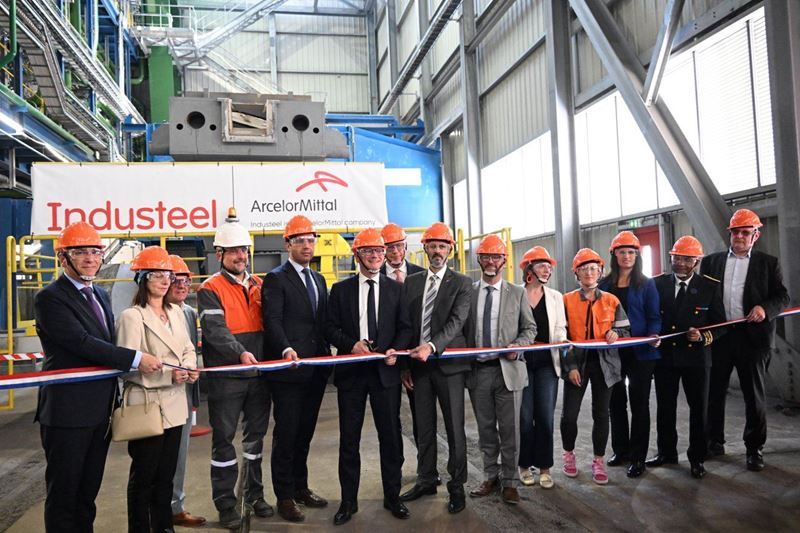
The project was implemented with EUR 12 million in public funding provided under the France 2030 program, and the inauguration ceremony was attended by Deputy Minister for Industry Sébastien Martin.
The investment, which began construction in February 2024, stands out as one of the largest modernization projects carried out at ArcelorMittal Industeel’s Le Creusot facility. The new structure, developed through the expansion of the existing steel plant, enables the production of thin steel plates using a vertical continuous casting method.
Among the main objectives of the project are the elimination of the intermediate rolling stage in production, thereby reducing energy consumption and CO₂ emissions, as well as shortening production times. Initial annual production is targeted at 15,000 tons, with plans to increase capacity to 25,000 tons in the future. This transformation is expected to reduce CO₂ emissions at the Le Creusot site by approximately 10%.
Previously, production at the facility was carried out only through direct casting in ingot molds. With the new investment, the site now has two separate casting lines in order to enhance its competitiveness.
The new system aims to combine performance, quality, competitiveness, and decarbonization, creating new market opportunities particularly in industrial sectors such as energy, energy transition, carbon steels, stainless steels, and nickel-based alloys.
Deputy Minister for Industry Sébastien Martin stated that the steel sector is critical for France’s industrial sovereignty, adding that the state continues to support ArcelorMittal projects and that the DecarbIND program under France 2030 will be relaunched in 2026.
Rudy Daubechies described the investment as an important milestone for the company, stating that the new system will contribute to decarbonization and support expansion into new markets. Alain Le Grix de la Salle also noted that the project is a significant example of state-supported industrial transformation, highlighting that the facility has been modernized while reducing its carbon footprint.
The project represents a total investment of EUR 52 million, of which EUR 12.3 million was provided through the France 2030 program. The facility is 45 meters high, and the construction process lasted more than two years, involving over 175,000 working hours. In the long term, the plant aims to reach an annual production capacity of 25,000 tons.
With the new system, a 10% reduction in carbon emissions is expected, and the Le Creusot facility now operates with two different casting lines.
Industeel, part of ArcelorMittal, produces heavy plates, sheets, and forged components for the energy, defense, and automotive sectors while reducing its carbon footprint through recycled steel and an electric arc furnace-based production process.



Comments
No comment yet.