


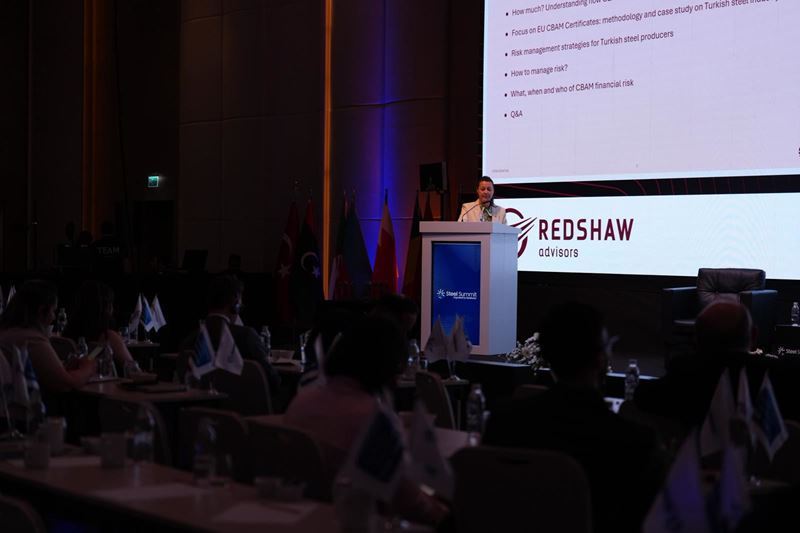
Akalın: "Companies Failing to Comply Face Heavy Penalties of up to 500 EUR per Ton"
Presenting on behalf of Redshaw Advisors Limited, Anıl Akalın shared insights based on more than 24 years of market experience and over 5 billion EUR in carbon certificate trading volume, highlighting the deep impact of the EU’s new carbon regulations on the Turkish steel industry. He noted that the CBAM (Carbon Border Adjustment Mechanism) directly covers iron and steel, aluminum, cement, fertilizers, electricity, and hydrogen sectors, while exemptions are limited to shipments under 50 tons per year, personal belongings, and certain military goods.
Recalling that the compliance process consists of four main steps—measurement, reporting, verification, and supply and delivery—Akalın emphasized the penalties for non-compliance, stating:
“As of 2026, emission data will need to be verified by independent bodies, and from 2027 onward, CBAM certificates will become mandatory for purchase and submission. Failure to comply will result in a penalty of 100 EUR per ton of CO₂e not surrendered, while unauthorized imports may face fines of up to 500 EUR per ton. Therefore, proper management of volume and price risk is critical.”
CBAM Certificate Prices Expected to Reach 155 EUR by 2034
Akalın noted that CBAM certificate prices are directly indexed to EU Emissions Allowance (EUA) auction prices. He explained that in 2026, prices will be set quarterly based on the weighted average of EUA auction prices, while from 2027 onward, prices will be updated weekly at the beginning of each week based on the previous week’s auction prices. He added that carbon prices are expected to rise to 87 EUR in 2026, 129 EUR in 2030, and 155 EUR by 2034.
Critical Case Studies for the Steel Sector: Verified Data Reduces Costs
Case 1 (Alloy Steel Semi-Finished Products – CN7228 30 20): For a 50,000-ton import, using the EU’s default high emission values (6.919 tCO₂e/t) results in a cost of 21.6 million EUR, whereas using verified plant data (0.331 tCO₂e/t) reduces the cost to 0.8 million EUR.
Case 2 (Flat Products – CN7210 49 00): By integrating hedging strategies and a local carbon price (T-ETS), companies can achieve up to 45% gross savings over a 10-year period.
“Virtual CBAM Certificate” (VCC®) Era in Risk Management
Stating that CBAM is not a tax but a market-based mechanism, Akalın emphasized that companies must manage both quantity (emission intensity) and price (volatility) risks. He explained that from Q1 2027, declarants will be required to hold 50% of their annual emission obligation in their accounts up to that point in the year. He added that the first certificate surrender will take place in September 2027, while in October 2027 companies will be allowed to resell up to one-third of purchased certificates.
Akalın also stated that the Virtual CBAM Certificate (VCC®) solution developed by Redshaw Advisors enables steel producers to lock in future costs, preserve liquidity, and manage their 2026 exposure.
“Financial Risk Ultimately Lies with Producers”
Warning that commercial contracts must clearly define which party bears the risk, Akalın stressed that financial risk ultimately remains with producers. He concluded by noting that, with the right procurement strategy, Turkish steel producers could achieve additional savings of between 1.00 EUR and 2.40 EUR per ton depending on product category. The session ended after a Q&A segment with participants.




Comments
No comment yet.