


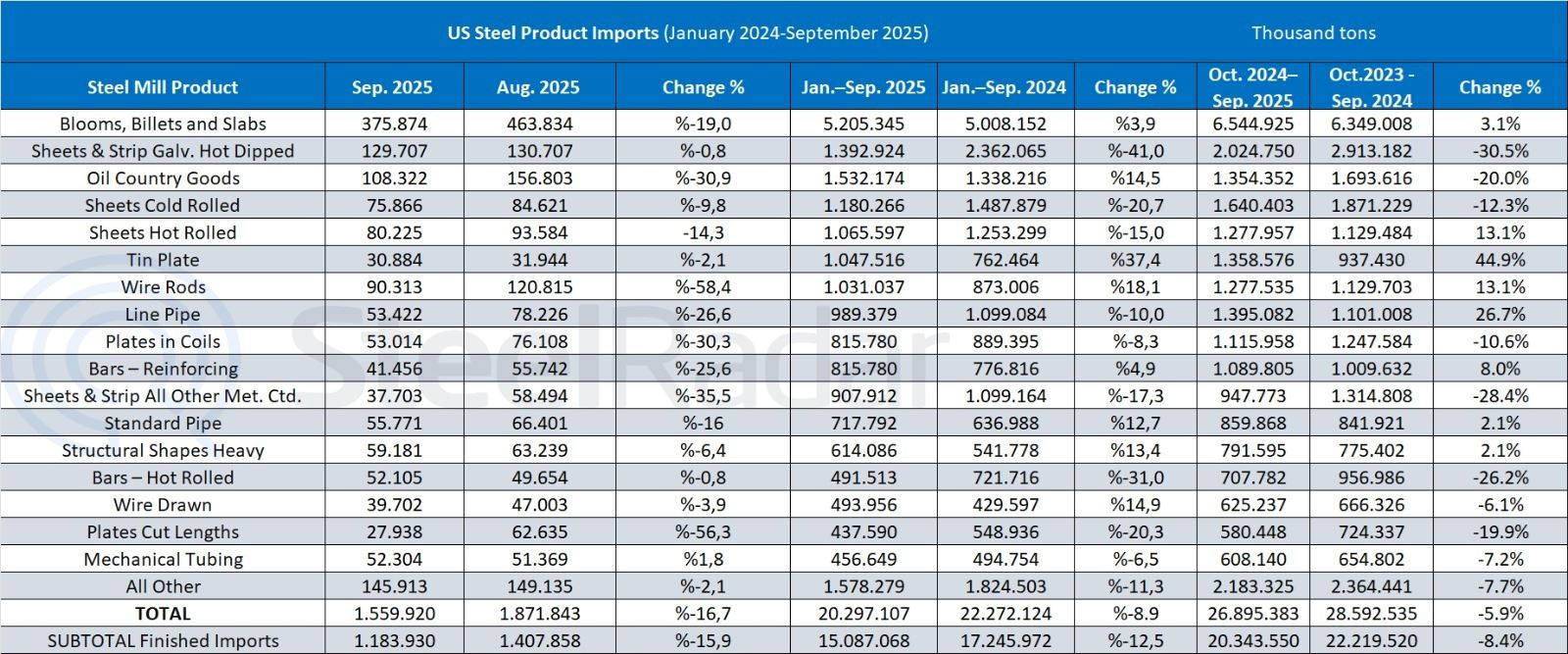
The American Iron and Steel Institute (AISI) announced that the country imported a total of 1.56 million net tons (NT) of steel in September 2025, based on final data from the U.S. Census Bureau. Of this amount, 1.184 million net tons consisted of processed steel, while the figure represented a 16.7% decrease in total imports and a 15.9% decrease in processed steel compared to August 2025.
Looking at the year-to-date figures, total steel imports decreased by 8.9% compared to the same period in 2024, falling from 22.3 million net tons to 20.3 million net tons. Processed steel imports contracted by 12.5% during this period. According to the 12-month table covering the period from October 2024 to September 2025, total imports declined by 5.9%, while processed steel imports fell by 8.4%. AISI stated that the market share of processed steel imports is expected to be 14% in September and 19% in the first nine months of 2025.
The product group that recorded the most notable increase in September compared to the previous month was line pipe. Imports in this category increased by 27%. In the annual comparison for the period October 2024 – September 2025, three products stood out: sheet metal imports increased by 45%, line pipe imports by 14%, and film imports by 13%.
On the supplier side, Canada's exports to the US in September increased by 2% compared to the previous month, reaching 310,000 net tons. South Korea's steel shipments reached 244,000 net tons, recording a strong increase of 38%. In contrast, Brazil's steel exports fell by 35% to 175,000 net tons. Steel imports from Mexico declined by 25% to 147,000 net tons. Germany, on the other hand, recorded a 30% increase to 98,000 net tons.
Looking at the performance of the same countries in the October 2024 – September 2025 period, Canada's steel exports to the US fell by 21%, Brazil's by 9%, Mexico's by 2%, and South Korea's by 3%. Germany, on the other hand, achieved a remarkable 17% increase on an annual basis. This picture reveals that regional supply balances in US steel imports are being reshaped, with Germany and South Korea increasing their shares while Canada, Brazil, and Mexico are experiencing declines.







Comments
No comment yet.