


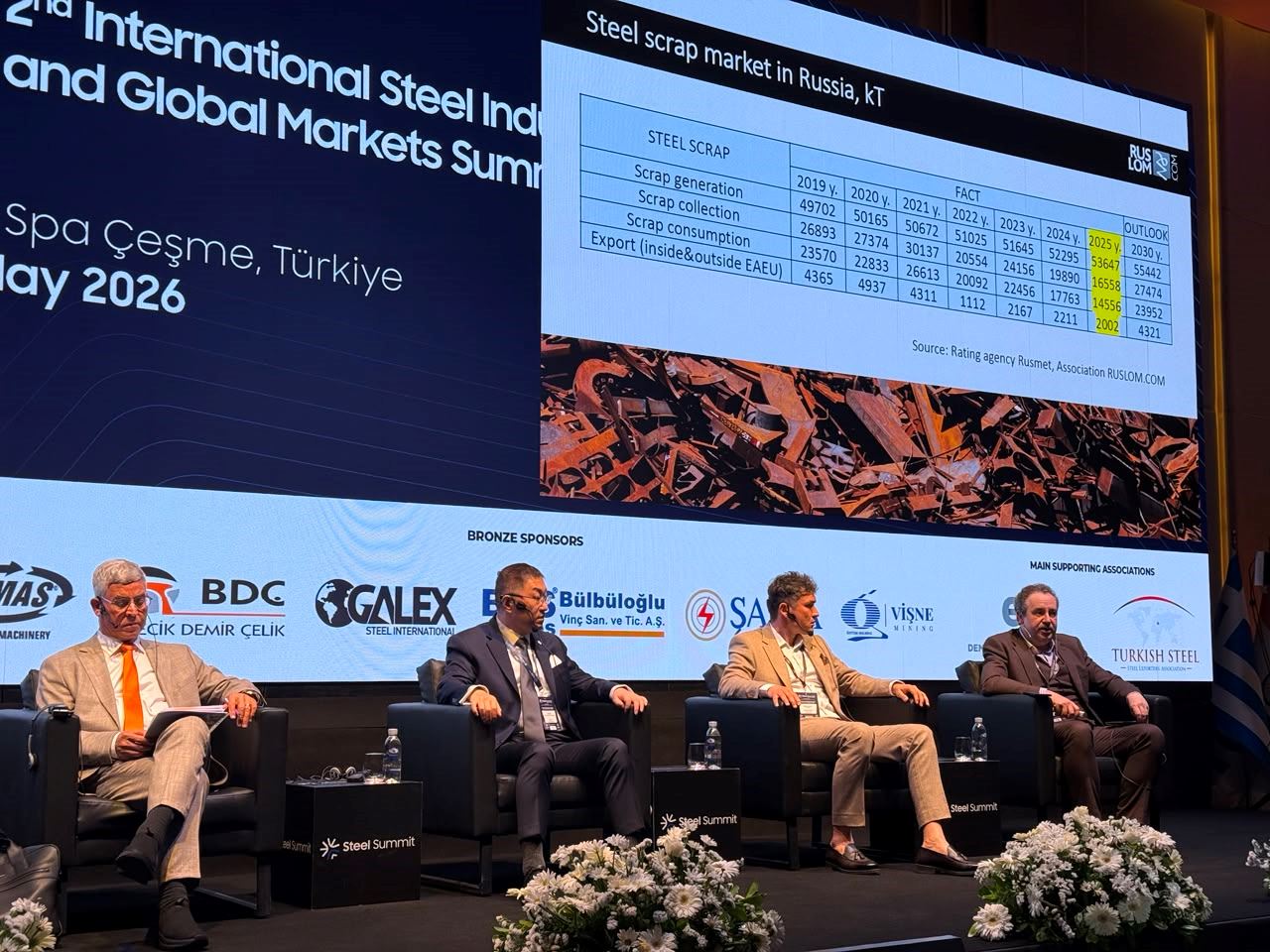
Russia’s scrap and semi-finished steel sectors are undergoing a deep structural transformation as sanctions, export restrictions, weak domestic demand and rising costs continue to pressure the industry, Victor Kovshevny, co-founder of Rusmet and director of the National Recycling Association, said during his speech at the 2nd Steel Summit 2026 held in İzmir on May 13-15.
According to Kovshevny, Russia’s steel scrap collection industry is currently operating at less than 50% of its historical capacity. He stated that scrap collection volumes, which peaked at around 30.6 million mt in 2021, have fallen sharply to nearly 16.5 million mt in 2026 as export barriers, liquidity problems and shrinking sales channels continue to limit market activity.
Kovshevny noted that Russian ferrous scrap exports have declined dramatically over the last two decades. While exports exceeded 9-11 million mt/y during the open market period of 2004-2007, volumes have dropped to nearly 1.3 million mt/y in the current sanctions era. He emphasized that the contraction was not caused by weak commodity prices, but mainly by structural barriers including quotas, tariffs, sanctions-related banking restrictions and logistics disruptions.
He added that Türkiye has become the dominant destination for Russian scrap exports, accounting for more than 90% of total shipments in 2025. According to Kovshevny, this level of concentration creates strategic dependence on Turkish market conditions, import regulations and currency dynamics.
Discussing the broader steel sector, Kovshevny said Russia remains one of the world’s largest exporters of semi-finished steel products despite the recent downturn. He indicated that billet exports reached around 10.4 million mt in 2024, although export volumes were down by approximately 28% compared to 2022 levels.
During his presentation, Kovshevny repeatedly stressed that Russia is gradually shifting away from a raw scrap export model toward a broader “Eurasian metallics platform” focused on higher value-added products such as billet, slab and DRI/HBI. He argued that billet exports provide stronger pricing stability, easier financing conditions and more efficient logistics compared to raw scrap shipments.
Kovshevny also highlighted Türkiye’s growing role in Russian billet trade, describing the country as the main hub for Russian semi-finished steel flows. He noted that Türkiye’s share in Russian billet exports has increased significantly as trade routes continue to shift toward MENA and Asian markets.
On the stainless steel side, he said the Russian market has also experienced severe contraction since 2022. Stainless scrap collection and exports have fallen sharply due to logistical complications and weaker demand, although Kovshevny emphasized that stainless scrap remains strategically important because of its high unit value and alloy content.
According to Kovshevny, the future of the Russian metallics sector will depend on long-term industrial partnerships rather than short-term spot transactions. He stated that cooperation with Türkiye, Asia and MENA countries could play a key role in building more stable and integrated metallics supply chains in the coming years.




Comments
No comment yet.