


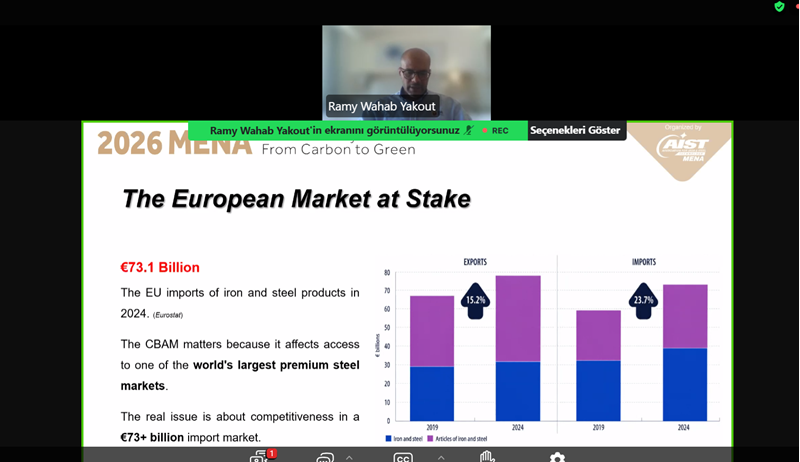
Yakout stressed that the Carbon Border Adjustment Mechanism (CBAM) is no longer merely an environmental regulation but has become a strategic factor that will determine competitiveness.
He noted that the European Union's imports of iron and steel products reached €73.1 billion in 2024, emphasizing that CBAM will directly affect access to one of the world's largest high-value steel markets. Referring to the growth in the EU's iron and steel exports and imports between 2019 and 2024, Yakout said the mechanism will play a decisive role in competition within this market, which exceeds €73 billion.
CBAM will not affect every country equally
Yakout stated that CBAM will not have the same impact on all exporters across the MENA region, creating both winners and losers. He explained that two key factors determine a country's level of CBAM exposure: its dependence on the European Union market and the carbon intensity of its production compared with competitors.
According to his assessment, Türkiye faces very high exposure due to its substantial steel exports to the EU, while Egypt falls into the high exposure category because of its strong dependence on the European market. Algeria has moderate exposure owing to its growing steel and DRI exports, Morocco has low exposure thanks to its relatively low carbon intensity, and the Gulf Cooperation Council (GCC) countries also fall into the low exposure category due to their limited direct steel exports to Europe.
Türkiye has the highest CBAM exposure among MENA countries
Yakout said that Türkiye produced 38.1 million mt of crude steel in 2025, making it the largest producer in both Europe and the MENA region and the world's seventh-largest producer.
He noted that approximately 72% of Türkiye's crude steel output is produced via electric arc furnace (EAF) technology, while the remaining 28% comes from integrated blast furnace-basic oxygen furnace (BF-BOF) facilities.
Although Türkiye's EAF-dominated production structure provides it with a relatively lower carbon footprint, Yakout said the country's strong trade integration with the European Union makes it the MENA economy most exposed to the impact of CBAM. He added that Türkiye's annual steel exports to the EU amount to approximately $7.5 billion.
Egypt, Saudi Arabia and Algeria each have distinct advantages
Yakout stated that Egypt produced 10.6 million mt of crude steel in 2025, making it the fourth-largest producer in the MENA region and the world's nineteenth-largest producer. He noted that the country has a fully EAF-based steel industry and one of the region's largest natural gas-based direct reduced iron (DRI) sectors.
Due to its significant exports to the European Union, Egypt is among the MENA economies expected to be most affected by CBAM. Exports to the EU covered by CBAM account for approximately 42% of the country's total CBAM-covered exports, he added.
Regarding Saudi Arabia, Yakout said the country produced around 10.8 million mt of crude steel in 2025, ranking as the third-largest producer in the MENA region. Thanks to its natural gas-based DRI-EAF production route, Saudi Arabia operates one of the region's lowest-carbon steel production systems. While its current exposure to CBAM remains limited because of its relatively low dependence on direct steel exports to Europe, he noted that the mechanism will become increasingly important for future access to the European market.
Yakout also said Algeria produced approximately 5.5 million mt of crude steel in 2025, making it the fifth-largest producer in the MENA region. He highlighted that the country's natural gas-based DRI-EAF production route and abundant natural gas resources provide a significant advantage for low-carbon steelmaking. As steel exports to Europe continue to grow, Algeria's CBAM exposure is considered moderate, while its future competitiveness will depend on its ability to demonstrate verifiable low-carbon production performance.
Verifiable emissions data will provide a competitive advantage
Yakout emphasized that producing low-carbon steel alone will not be sufficient. Under the European Commission's CBAM regulations, emissions must be measurable, reportable and independently verifiable. Facility-level monitoring, product-specific emissions calculations and third-party verification will become the key requirements under the new framework.
He added that, as CBAM enters its full implementation phase, verification capacity will become a strategic competitive advantage. Demand for accredited verifiers is expected to increase rapidly, while limited verification capacity could emerge as a major bottleneck. Companies that prepare early, he concluded, will gain priority in the verification process and strengthen their competitive position in the European market.




Comments
No comment yet.