


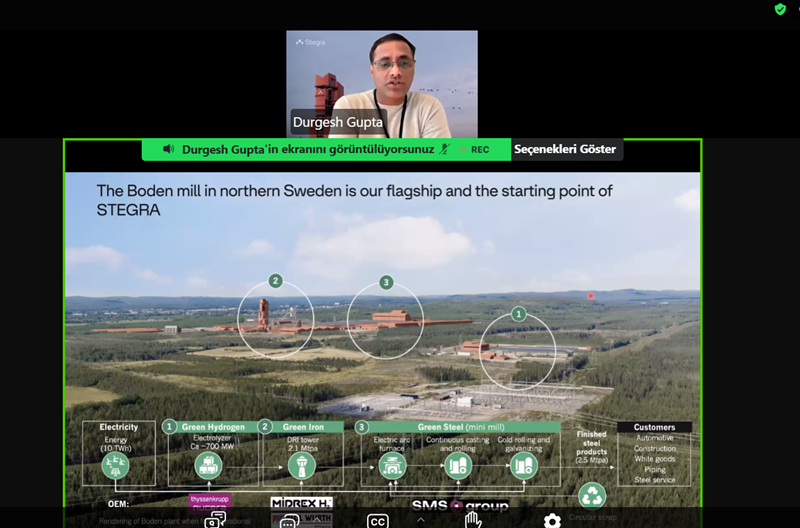
During the webinar, Stegra's Chief Technology Officer – Green Iron | Hydrogen & DRI, Durgesh Gupta, shared technical insights into the company's hydrogen-based direct reduced iron (H₂-DRI) technology and its green steel plant currently under construction in Boden, Sweden.
In his presentation, Gupta compared the three main steelmaking routes: the conventional blast furnace-basic oxygen furnace (BF-BOF) route, the scrap-based electric arc furnace (EAF) route, and the direct reduced iron-electric arc furnace (DRI-EAF) route. According to the comparison, carbon emission intensity stands at 2,000-2,300 kg CO₂ per tonne of crude steel for the BF-BOF route, 600-670 kg CO₂ per tonne for scrap-based EAF production, and 1,300-1,650 kg CO₂ per tonne for the DRI-EAF route.
Boden plant to produce 2.5 million tonnes of green steel annually
Gupta described the facility under construction in Boden, northern Sweden, as Stegra's flagship investment. According to the presentation, the plant will require approximately 10 TWh of electricity, feature a 700 MW electrolyzer, and have an annual production capacity of 2.1 million tonnes of green direct reduced iron (DRI) and 2.5 million tonnes of green steel.
He explained that green hydrogen produced via electrolysis will be used in the MIDREX H₂ direct reduction process. The resulting DRI will then be melted in an electric arc furnace before being processed through continuous casting, cold rolling, and galvanizing lines to produce finished steel products.
Technical features of the hydrogen-based DRI plant
Gupta stated that Stegra's DRI plant has been designed as one of the pioneering facilities utilizing green hydrogen as the primary reducing agent.
According to the presentation, the plant will have an annual capacity of 2.1 million tonnes and will be capable of producing hot DRI (HDRI) as well as commercial-grade hot briquetted iron (HBI). The HBI can either be sold to external customers or consumed internally.
The presentation noted that the reducing gas used for producing DRI containing approximately 1.3% carbon consists of around 85% hydrogen, while emphasizing that the system has been designed to operate with 100% hydrogen. The facility will also rely on electric heaters instead of fossil fuels, incorporating 15 electric heaters together with a Pressure Swing Adsorption (PSA) system for hydrogen recovery.
Hydrogen-based production requires new engineering solutions
Gupta explained that existing shaft furnace technology can accommodate a wide range of hydrogen concentrations without requiring fundamental design modifications, adding that higher hydrogen ratios improve reduction kinetics.
However, he noted that hydrogen reduction requires a higher heat input, making higher reducing gas temperatures and increased gas flow rates essential for efficient operation.
The presentation also highlighted that hydrogen-based DRI production necessitates engineering modifications to process gas compressors, the Top Gas Scrubber, electric heaters, and gas recovery systems.
PSA system enables high-purity hydrogen recovery
Gupta stated that the PSA system installed at the plant will recover hydrogen at a purity level of 99.5%.
According to the presentation, the system will help reduce fresh hydrogen consumption while allowing the recovered gas to be reused in different parts of the process. It also provides operational flexibility by enabling adjustments according to the carbon requirements of the DRI product.
Hot DRI charging improves efficiency and reduces energy consumption
Gupta highlighted the operational advantages of charging hot DRI (HDRI) into the electric arc furnace at temperatures above approximately 600°C.
According to the data presented, hot DRI charging can deliver the following benefits:
- Specific energy savings of 130-150 kWh per tonne of liquid steel.
- A reduction in electrode consumption by 0.5-0.6 kg per tonne.
- A decrease in refractory consumption by 1.8-2.0 kg per tonne.
- Shorter tap-to-tap times, increasing productivity by up to 20%.
- Further reductions in carbon emissions from electric arc furnace steelmaking.
The webinar also featured technical sessions covering sustainability in steel production, turquoise hydrogen, the Carbon Border Adjustment Mechanism (CBAM), and the transformation and competitiveness of the steel industry in the Middle East and North Africa (MENA) region.



Comments
No comment yet.