


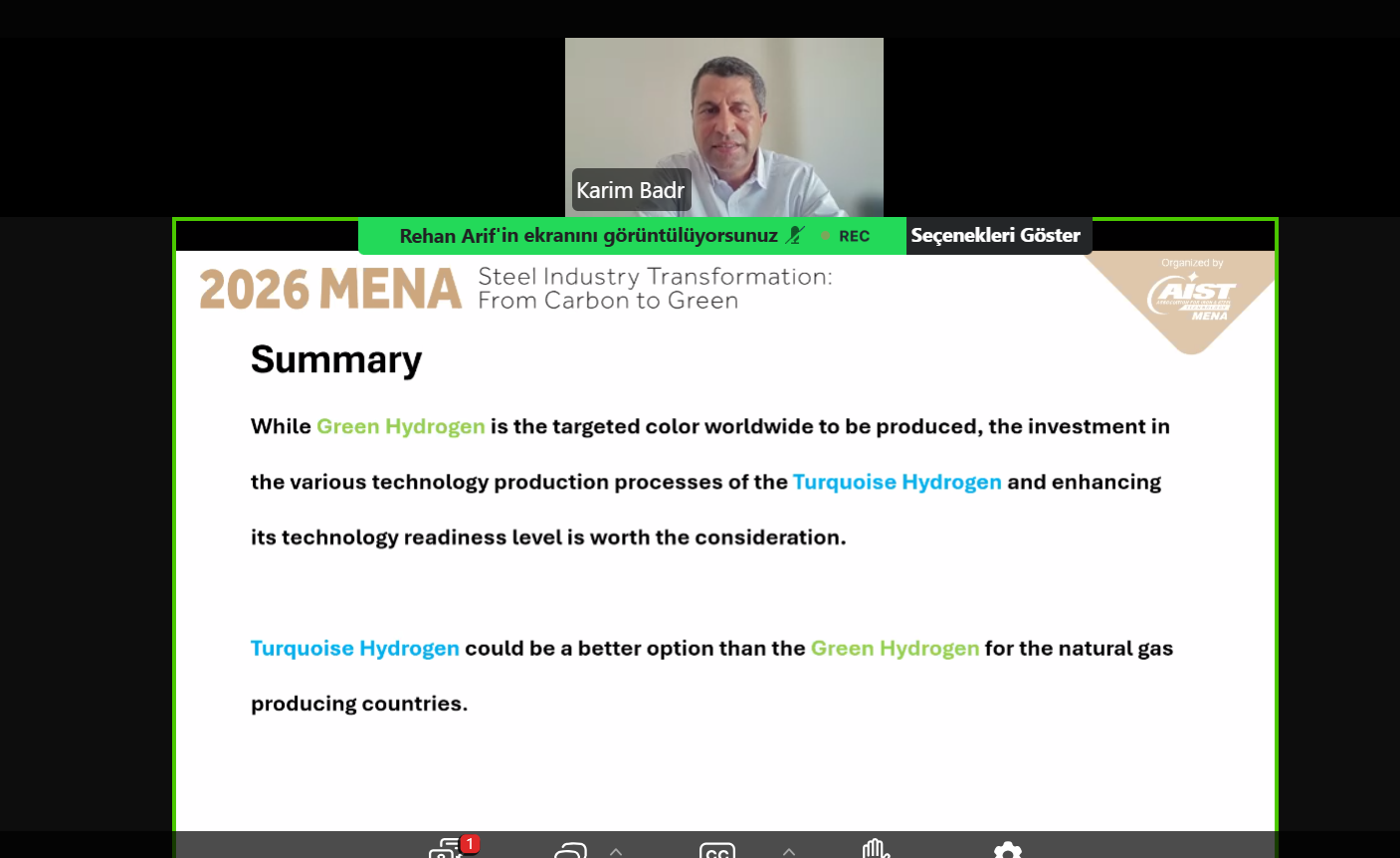
Badr stated that hydrogen production methods are classified according to their carbon intensity as grey, blue, turquoise, and green hydrogen. He noted that grey hydrogen is produced from natural gas or coal via steam methane reforming or gasification, which results in carbon dioxide emissions. In blue hydrogen, carbon capture technologies are added to the same production process.
He explained that turquoise hydrogen is based on the production of hydrogen and solid carbon through methane pyrolysis of natural gas, while green hydrogen is produced via electrolysis using renewable electricity.
Badr noted that methane pyrolysis is one of the emerging methods for low-carbon hydrogen production and said that this technology includes three main approaches: thermal cracking, molten salt or molten metal baths, and plasma cracking. He added that plasma technology can be used both as a heat source and as a way to generate reactive species that accelerate the reaction, and that it is among the most technologically mature solutions.
Regarding hydrogen production costs, Badr stated that both low-temperature and high-temperature water electrolysis are still high-cost methods today, whereas carbon-capture-based reforming and especially methane splitting technologies offer lower cost potential. He also noted that hydrogen production from biomass and from non-biological waste are among the methods with moderate cost reduction potential.
In his presentation, Badr also referred to global investments in methane pyrolysis, stating that numerous pilot and commercial projects at different levels of technological maturity are being carried out in the United States, Canada, Finland, Austria, France, Germany, the United Kingdom, and Australia. He said that companies such as Monolith, Hazer Group, C-Zero, Modern Hydrogen, H2Quest, Hycamite, HiiROC Hydrogen, Plenesys, and Graforce are among the leading initiatives in this field.
Badr also evaluated three different production models in which turquoise hydrogen could be integrated into iron and steel production. The first, SuSteel hydrogen plasma smelting technology, offers the highest technological synergy and enables the direct use of hydrogen in iron ore reduction. The second model, HYFOR + Hy4Smelt technology, allows the use of fine ores, eliminates the need for pelletizing, and provides lower electricity consumption compared to plasma methods. The third model, hydrogen-based DRI (MIDREX/Energiron) technology, is the most commercially mature solution, has low technical risk, and could form the first large-scale market for turquoise hydrogen.
At the end of his speech, Badr emphasized that green hydrogen remains a long-term global target, but investments in turquoise hydrogen technologies and the improvement of their maturity level present a significant opportunity. He stated that for countries with natural gas resources, turquoise hydrogen could be a more feasible and competitive option compared to green hydrogen, and that this technology could play an important role in the low-carbon transformation of the steel industry.



Comments
No comment yet.