


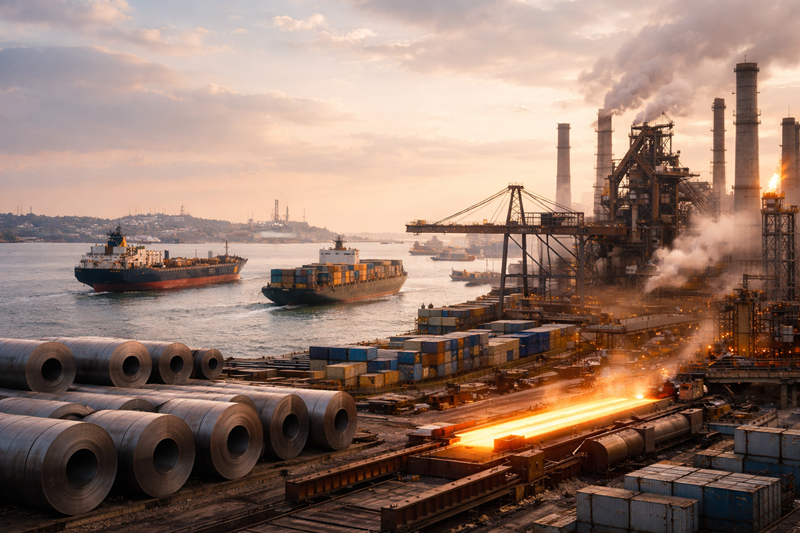
The upward expectations in oil and natural gas prices pose a risk of increasing production costs, while disruptions in maritime transportation are pushing freight rates higher and extending delivery times. According to experts, if tensions persist, supply constraints in the sector, difficulties in sourcing raw materials, and increases in finished product prices could become inevitable.
The escalating military tensions between Iran, the United States, and Israel, along with the de facto transit restrictions in the Strait of Hormuz, have triggered a new fracture in global energy and logistics chains. Rising risks around the Strait of Hormuz, through which approximately 20% of global oil trade passes, have led to renewed upward pricing in energy markets and serious disruptions in maritime transport, bringing cost and supply pressures to the forefront of the iron and steel sector.
The Russia–Iran axis and the energy impact
According to market sources, Iran is one of Russia’s key trading partners, with bilateral trade volume of approximately $5 billion. Fertilizers, grain, industrial equipment, and steel pipes stand out among the main trade items between the two countries, while contacts in the energy field are also ongoing. It is noted that in the event of supply disruptions in oil exports from Iran, Qatar, and Kuwait, crude prices could rise to the $100 per barrel level. Such a scenario could accelerate the redirection of Russian oil toward markets such as China, India, and Türkiye. Any potential increase in energy prices is expected to directly affect iron and steel production costs through higher natural gas and electricity prices.
Experts emphasize that energy costs remain particularly decisive for facilities operating with electric arc furnaces (EAF). If tensions in the Strait of Hormuz persist, sustained high energy prices could push per-ton steel production costs higher.
Logistics tightening and freight pressure
On the maritime side, the situation appears even more complex. Due to security risks in and around the Strait of Hormuz, many shipowners have either suspended voyages or been forced to shift to longer and more costly routes. For steel, a high-tonnage product highly sensitive to freight costs, this development directly affects prices. Rapid increases in freight rates and extended delivery times are being observed, while both buyers and sellers are reportedly reluctant to enter into new contracts amid uncertainty, leading to a short-term contraction in transaction volumes.
Türkiye’s steel industry is known to focus on Europe, the Balkans, and neighboring markets in an effort to balance global volatility. However, disruptions in sea routes and rising insurance premiums may also increase the cost of accessing these markets.
The İskenderun corridor and geopolitical risk perception
Industry representatives note that the growing perception of geopolitical risk in the Eastern Mediterranean is being closely monitored, particularly for the Hatay–Osmaniye–İskenderun production corridor, which serves as Türkiye’s key iron and steel manufacturing hub. The İskenderun-centered production region accounts for a significant share of Türkiye’s steel exports thanks to its port infrastructure and integrated facilities. An increase in regional security risks may affect the sector not through direct physical threats, but via higher insurance costs, tighter financing conditions, and shifts in order behavior.
Risk of supply constraints and price increases
According to expert assessments, if current tensions do not ease in the near term, three main factors will come to the forefront in the iron and steel sector: rising energy costs, risks of disruptions in raw material and semi-finished product supply, and freight-driven price pressure. The combination of these three elements could create supply constraints, particularly for inputs such as scrap and slab, and lead to upward movement in finished product prices.
In the short term, contracting transaction volumes and cautious contract behavior are expected to dominate. In the medium to long term, the duration of the conflict will be decisive. If the closure of the Strait of Hormuz becomes prolonged, cost-based price increases in the iron and steel market are likely to become more pronounced. Conversely, under a diplomatic de-escalation scenario, normalization in freight and energy prices could allow the sector to seek a new equilibrium.



Comments
No comment yet.