


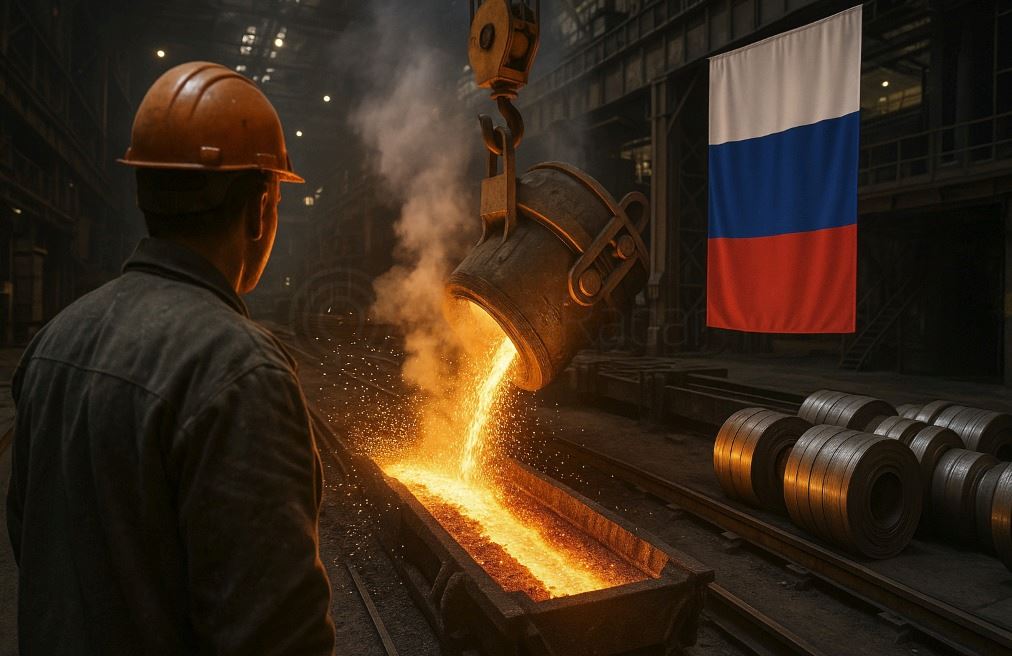
These restrictions have limited export opportunities for Russian steel producers, constrained imports of metallurgical equipment and raw materials, and reduced domestic steel consumption through their impact on key metal-consuming industries. As a result, declining exports and weakening internal demand have intensified the problem of excess production capacity in the steel industry.
By the second half of 2024, steel consumption and prices were decreasing while production costs were rising. Although some sectors demonstrated growth in demand, notably energy, where steel demand increased by 36%, and construction, which accounted for more than 50% of total metal consumption, overall consumption again declined in 2024 after stabilizing in 2023. In 2024, steel consumption fell by 6% in construction and by 10.2% in energy, while automotive production grew by 6.7% and machinery production by 1.7%. This volatility underscores the need to identify new directions for expanding domestic demand.
The study proposes that import substitution of steel-containing products can serve as a key source of potential demand. Real steel consumption includes not only domestic steel use and direct trade in steel products but also indirect imports of steel embedded in machinery and equipment. Before the imposition of sanctions, indirect steel imports accounted for about 17% of real steel consumption in Russia, while net indirect imports made up approximately 13%. Machinery and equipment represented up to 49.2% of Russia’s total import structure prior to 2022, and this structure has largely remained unchanged since then, although import flows have shifted geographically from Western countries to Eastern suppliers, particularly China.
Given the high dependence on imported machinery, equipment, and other steel-containing products, import substitution represents both a short-term response to sanctions and a long-term strategy for restoring domestic production chains. The analysis links categories of imported steel-containing goods with investment projects in metal-consuming industries. Based on the Knowledge Base of the Institute of Economics and Industrial Engineering of the Siberian Branch of the Russian Academy of Sciences, the largest number of investment projects is concentrated in mechanical engineering (793 projects) and metallurgy, including metal products (339 projects). This distribution confirms that mechanical engineering and metallurgy will play a central role in generating future steel demand.
The structure of these projects indicates demand for a broad range of steel grades, including ordinary and special steels. Priority categories include corrosion-resistant alloys for aggressive environments, cold-resistant steels for northern projects, rail steels, shipbuilding steels, electrical and magnetic steels, as well as constructional and tool steels used in machinery and construction. These steel grades require corresponding alloying elements such as manganese, chromium, nickel, titanium, vanadium, niobium, silicon, cobalt, molybdenum, copper, and others.
Based on customs data covering 29 major categories of imported steel-containing products, including engines, machine tools, bearings, agricultural and mining equipment, and taking into account their iron content (ranging from 40% to 100%), the estimated potential annual demand for steel from import substitution amounts to 4.679 million tons. Of this total, 2.63 million tons correspond to constructional steel, 0.084 million tons to tool steel, 0.299 million tons to corrosion-resistant alloys, 0.668 million tons to magnetic and electrical steel, and 0.998 million tons to shipbuilding steel.
Meeting this potential demand would also require additional ferroalloy production. The largest projected increases concern ferromanganese, ferrosilicon, and ferrochrome, with a significant role for ferronickel due to the production of corrosion-resistant steels. Depending on grade composition, estimated additional annual demand may range, for example, from 57.06 to 71.98 thousand tons for ferromanganese, from 18.90 to 94.50 thousand tons for ferrosilicon, and from 76.24 to 111.42 thousand tons for ferrochrome. In most cases, domestic production capacities, including volumes previously exported, are sufficient to cover these additional needs.
However, two important constraints are identified. First, a significant share of ferroalloys in Russia is produced using imported raw materials, some of which are subject to sanctions, including restrictions on manganese ore supplies. Second, despite existing spare metallurgical capacity, production is concentrated in large integrated plants focused mainly on mass production of ordinary steel grades. In 2020, eight major plants accounted for 94% of pig iron, 77% of steel, and 80% of rolled product output. This production structure may limit the efficient manufacturing of small batches of specialized steels and may require modernization of existing facilities or the construction of new electric steelmaking capacities. Environmental considerations also influence technological development in the sector.
In conclusion, sanctions have significantly reduced both export opportunities and domestic consumption of ferrous metals in Russia, exacerbating imbalances in the internal market. Expanding the range of steel products and developing special grades required by machinery, infrastructure, and industrial projects represent a key direction for qualitative development of the industry. Import substitution in steel-containing products could generate approximately 4.7 million tons of additional annual demand. Nevertheless, this volume alone is insufficient to eliminate excess capacity in the Russian steel industry, indicating the need to identify further avenues for expanding steel consumption and diversifying product offerings.






Comments
No comment yet.