


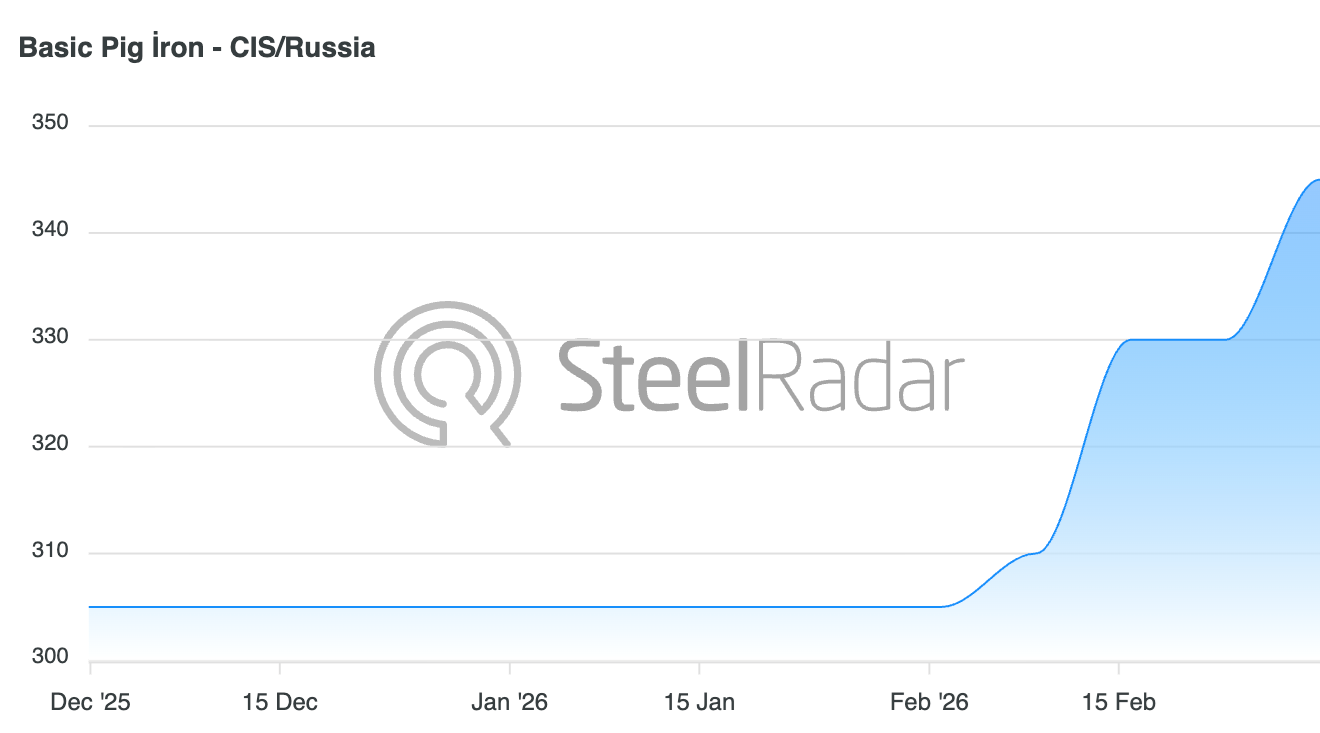
A decline in pig iron availability from Russia, combined with its continued price advantage over scrap, supported higher transaction activity, most notably with buyers from Türkiye. This balance between lower supply and stable demand enabled exporters to raise offer levels and conclude deals at higher prices compared with January.
Additional support for Russian pig iron exporters came indirectly from the United States market. In February, quotations for Brazilian pig iron rose amid stronger demand for finished steel products and higher scrap prices, creating a firmer global pricing environment.
In the European Union, pig iron demand remained weak. However, rising prices in the US encouraged Brazilian suppliers to lift their offer levels to EU buyers as well, helping to limit downward pressure on global pig iron prices.
In Asia, demand for Russian pig iron stayed low. The main factor weighing on activity was reduced steel production during extended holiday periods related to the Chinese New Year, which constrained spot market purchasing.
In the first half of February, Russian exporters concluded contracts with buyers in Türkiye and Egypt, raising working price indications to $335–345/t FOB. Prices for small-volume cargoes increased to $345/t FOB.
During the second half of the month, offer levels climbed further to $340–360/t FOB. Transactions were reported at $340–345/t FOB, equivalent to around $365/t CFR. Quotations for small lots rose to $350/t FOB, or $370–375/t CFR Türkiye.
According to data from the Turkish Statistical Institute (TUIK), Türkiye’s pig iron imports increased by 61.7% year on year to 2.33 million tonnes over the past twelve months. Russia remained the largest supplier, with exports rising by 95.8% to 1.83 million tonnes, reinforcing its dominant position in the Turkish market.
In the United States, prices for Brazilian pig iron increased to $430–435/t FOB in February. Toward the end of the month, buyers resisted further price increases, anticipating a stabilization of scrap prices in March.
Brazilian exporters expected stronger price support from the EU market and raised offer levels to $440/t FOB. However, no new deals were reported at these prices. Earlier contracts had been concluded at $430/t FOB, corresponding to $465–470/t CFR EU.
Overall, February 2026 was marked by moderate price growth in Russian pig iron, driven by reduced supply, strong demand from Türkiye, and supportive global benchmarks, particularly from the US market. While demand conditions remained uneven across regions, Russia’s pricing competitiveness and strong position in key importing markets continued to underpin export performance.



Comments
No comment yet.