


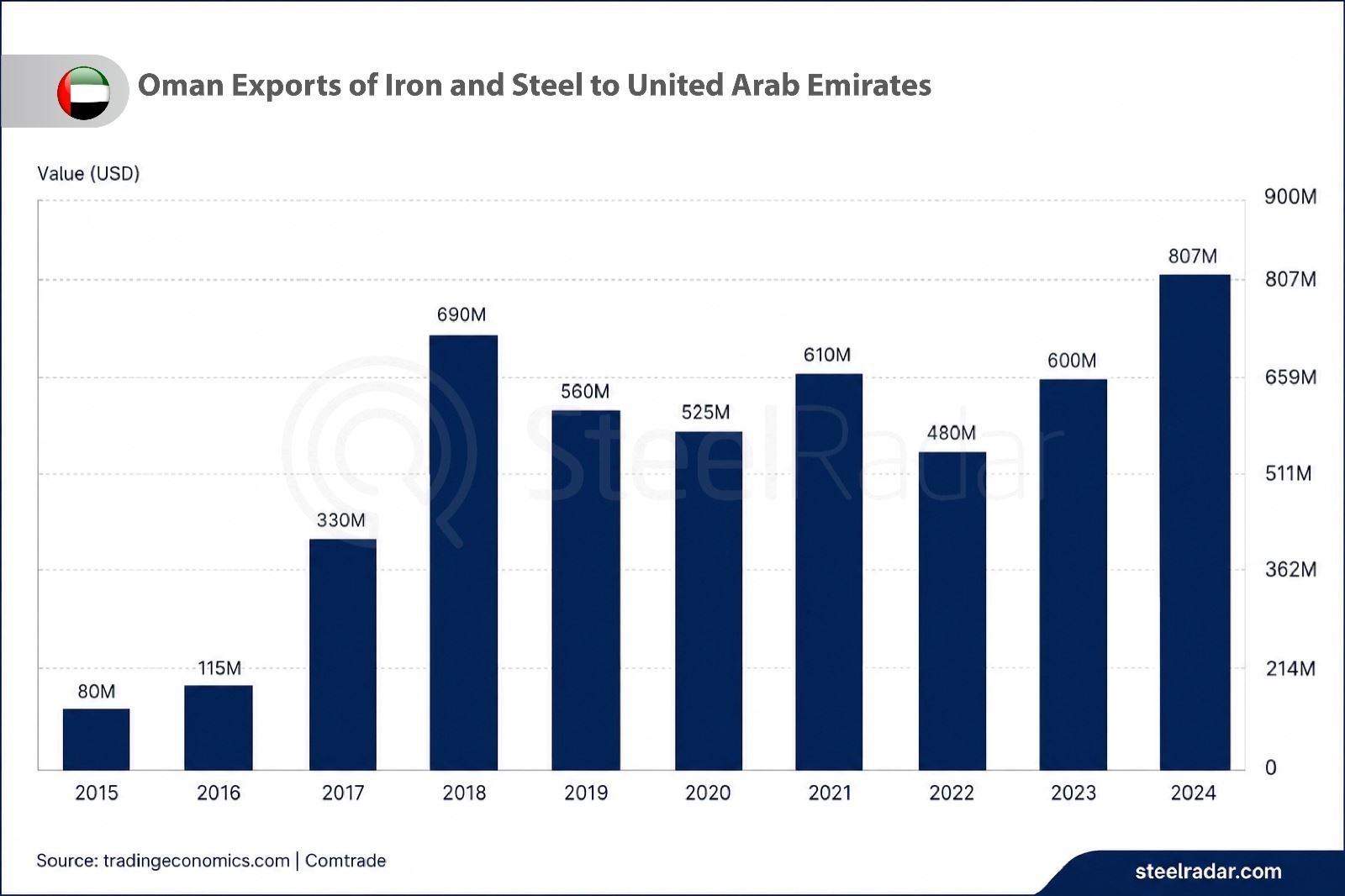
According to SteelRadar's analysis of UN Comtrade data, Oman's iron and steel exports to the United Arab Emirates (UAE) continued their strong upward trajectory in recent years, reaching a historic high in 2024. Exports climbed to approximately $850 million, marking the highest annual value ever recorded.
A product level breakdown shows that Oman's total exports of iron, steel, and steel products to the UAE amounted to $4.20 billion in 2024. The bulk of these shipments consisted of long steel products and semi-finished steel, reflecting robust demand from the UAE's construction and infrastructure sectors.
Long Products Lead Export Growth
By product category, Other Bars and Rods of Iron or Non-alloy Steel, Forged, Hot-rolled accounted for the largest share of exports, totaling $541.02 million.
The second-largest category was Semi-finished Products of Iron or Non-alloy Steel, with exports valued at $181.31 million. Meanwhile, exports of angles, shapes, and sections reached $56.99 million, underscoring continued demand for structural steel products in the UAE market.
Other notable export categories included:
Hot-rolled flat products under 600 mm in width: $46.08 million
Hot-rolled bars and rods: $37.88 million
Iron and steel wire: $17.64 million
In contrast, exports of stainless steel, ferro-alloys, scrap, coated flat products, and other specialty steel products accounted for only a limited share of total trade.
A Decade of Sustained Growth
Data covering the 2015-2024 period highlights Oman's steadily strengthening position in the UAE steel market.
According to the historical trend, exports stood at approximately $100 million in 2015 and remained at similar levels in 2016. Growth accelerated in 2017 before surging to around $750 million in 2018, marking a major milestone in bilateral steel trade.
Although exports eased slightly in 2019, trade volumes remained at historically elevated levels. During the 2020-2023 period, shaped by the pandemic and global market volatility, exports fluctuated within the $450-600 million range.
In 2024, exports climbed to approximately $850 million, setting a new all-time high and marking the strongest annual performance of the past decade.
Regional Demand and Production Capacity Support Trade
The growth in exports has been driven by ongoing infrastructure, industrial, and real estate developments across the UAE. These projects have continued to underpin demand for semi-finished steel, reinforcing bars, structural sections, and other long steel products.
At the same time, expanding production capacity at Oman's integrated steel facilities—particularly in the Sohar Industrial Area combined with the country's geographic proximity to the UAE, has enhanced its competitive advantage. Lower logistics costs and shorter delivery times continue to strengthen the position of Omani producers in the UAE market.
GCC Integration Strengthens Bilateral Trade
Trade between the two countries has also been supported by the customs advantages, regional free trade framework, and well-developed land and maritime logistics networks within the Gulf Cooperation Council (GCC).
Market participants expect Oman's iron and steel exports to the UAE to maintain their positive momentum as infrastructure investment, industrial expansion, and steel production capacity continue to grow across the Gulf region. Long steel products and semi-finished materials are expected to remain the dominant export categories, while the UAE is likely to retain its position as one of the most strategic export destinations for Omani steel producers.



Comments
No comment yet.