


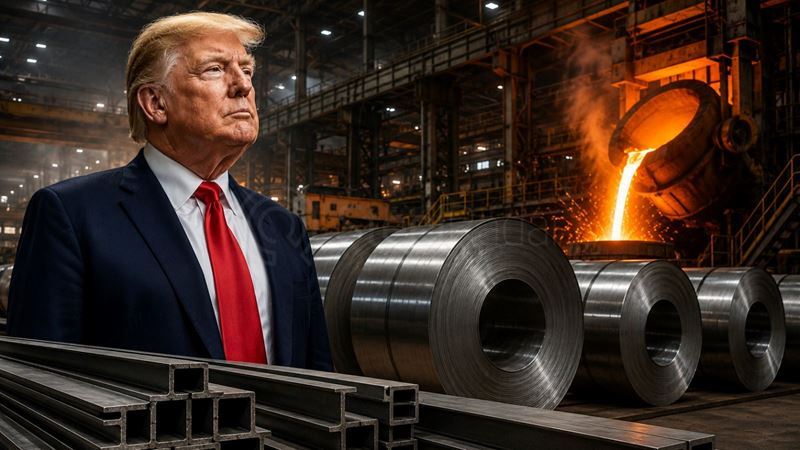
According to a statement released by the White House, the measure was introduced to support industrial production and encourage short-term investment.
Through an executive order signed by President Trump, certain tariffs imposed under Section 232 on national security grounds have been restructured. Within this framework, the tariff rate applied to certain steel and aluminum derivative products was reduced from 25% to 15%. The tariff reduction is reported to primarily cover agricultural machinery and certain industrial equipment.
Under the new regulation, agricultural equipment such as combines and harvesting machines, as well as heating, ventilation, and air conditioning (HVAC) systems used in residential buildings, have been included in the reduced tariff category. Bulldozers, forklifts, and similar mobile industrial equipment are also among the product groups eligible for the new tariff treatment. Authorities stated that these products will be subject to a 15% tariff rate when imported from countries that have trade agreements with the United States and meet the specified criteria.
Another notable element of the executive order is the provision encouraging the use of domestic inputs. Accordingly, capital equipment containing at least 85% by weight of U.S.-origin melted and poured steel or aluminum will qualify for a lower tariff rate of 10%. The measure is intended to encourage foreign manufacturers to use U.S.-origin steel and aluminum.
The implementation schedule for the new tariff regulation has also been clarified. The changes will apply to products imported or withdrawn from bonded warehouses beginning at midnight between June 8 and June 9. The U.S. administration stated that the measure is temporary and will remain in effect until December 31, 2027.
The White House emphasized that the primary objective of the measure is to strengthen the country’s industrial infrastructure. In particular, the administration aims to support production capacity by encouraging short-term investments. At the same time, the regulation is viewed as an important industrial policy tool because it provides flexibility in trade policy while also incorporating incentives that support domestic production.





Comments
No comment yet.