


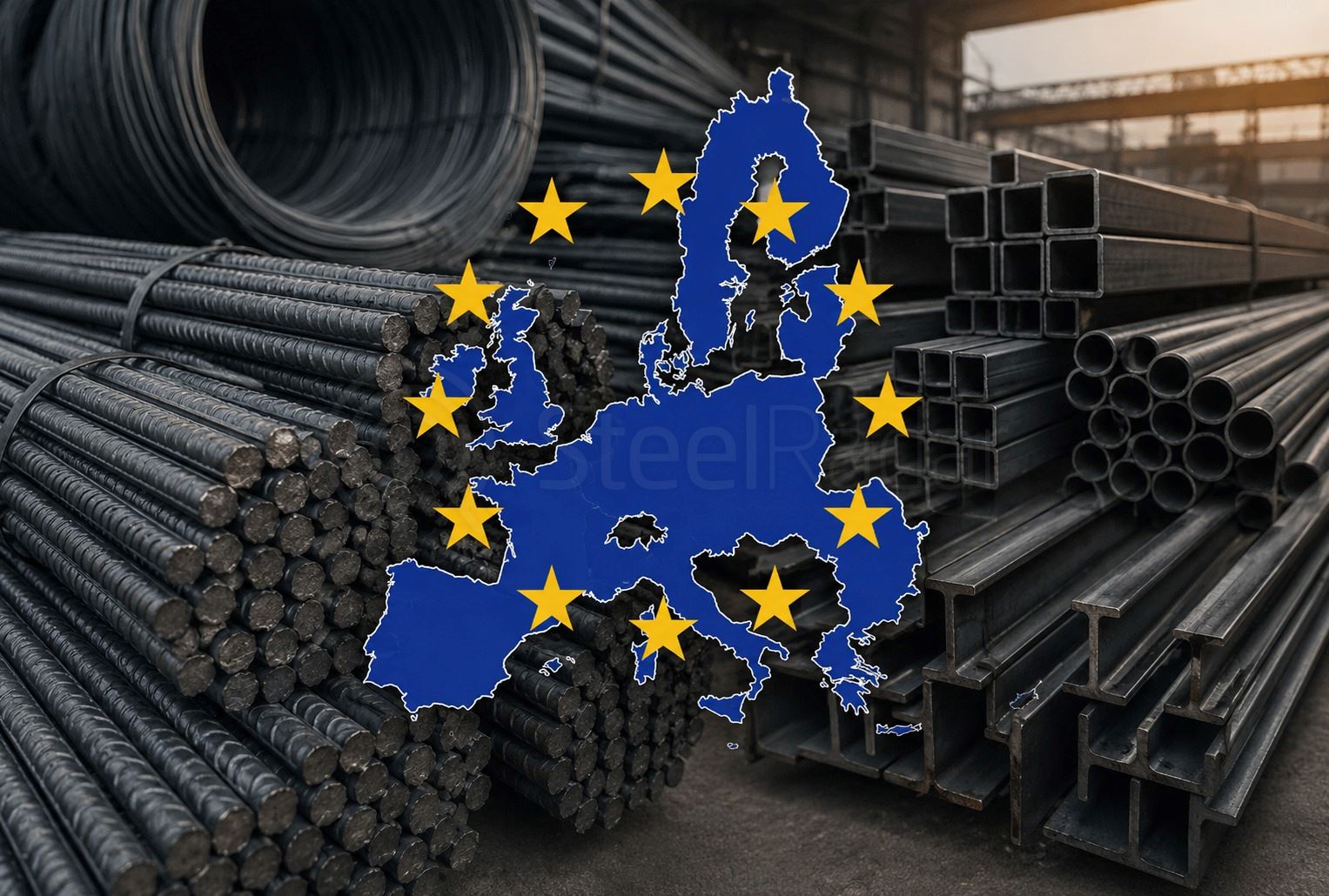
Germany's rebar prices remained stable at EUR 700/mt EXW throughout the week, while Italian producers attempted to increase offers to EUR 720–760/mt EXW. However, market sources noted that these price levels have yet to gain acceptance from buyers due to the current weak demand conditions. With construction activity remaining subdued in Italy, end-user demand continues to be limited, while producers are striving to maintain price discipline in anticipation of a seasonal market recovery in September.In the flat steel segment, hot-rolled coil (HRC) prices were observed at EUR 680/mt EXW in Germany and EUR 670/mt EXW in Italy. Meanwhile, cold-rolled coil (CRC) prices stood at EUR 790/mt EXW in Germany and EUR 780/mt EXW in Italy.
According to industry sources, Italian steelmakers are currently operating at approximately 50% capacity utilization and may further reduce production in the coming months due to maintenance outages or similar operational measures. As a result, the relatively full order books seen at some mills are considered to reflect lower production volumes rather than stronger underlying demand.
Market participants expect the EU's new steel import measures to provide only limited support to European steel producers, while placing a more noticeable cost burden on downstream industries. Current estimates suggest that capacity utilization rates could increase to a maximum of around 75%. Despite the 50% reduction in import quotas, actual steel imports are expected to decline by only around 30%, as quotas have historically not been fully utilized and several countries continue to benefit from exemptions. Consequently, the measures are expected to deliver only modest improvements in domestic production and producers' profitability.
Under the new quota regime, countries with Free Trade Agreements (FTAs) with the EU including the United Kingdom, Türkiye, South Korea, Indonesia, Egypt, Brazil, Switzerland, North Macedonia, South Africa, Argentina, Ukraine, and Singapore have been subject to an average quota reduction of 33%, while other non-EU supplier countries face an average cut of 47%. Owing to the ongoing war, Ukraine remains one of the most advantaged suppliers with a quota of 1.05 million tonnes, whereas China has experienced one of the steepest restrictions, with its duty-free quota reduced from 2.4 million tonnes to 800,000 tonnes.




Comments
No comment yet.