


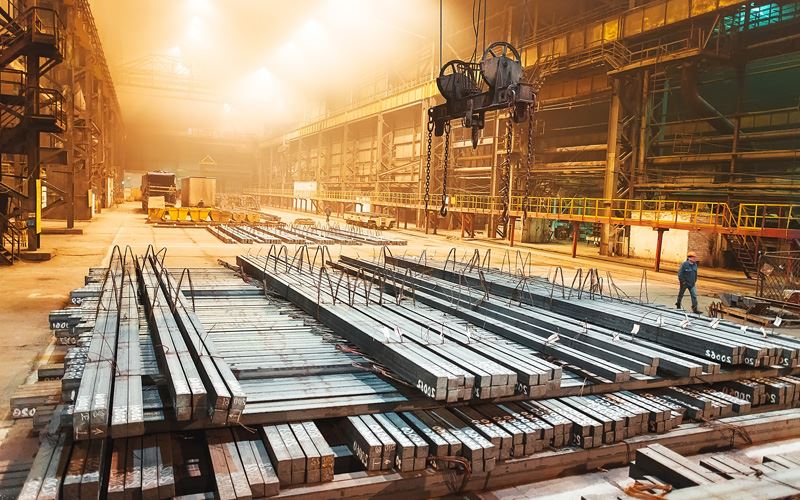
HRC imports from the Gulf Cooperation Council increased this week due to higher sea freight costs in Far East countries, which contribute to a significant portion of the world's steel production. HRC prices originating from the Far East increased by USD 5-10 on a weekly basis. Sea freight rates have risen by USD 8-10 over the past two weeks, excluding factories in India. For shipments to Jeddah, USD 8 was added to the rates. A top factory in China raised its offer for 2mm SAE 1006 grade to 600 USD.
Looking at the Far East countries one by one, important developments were recorded this week.
In China, the Tangshan billet market has gained momentum on the back of post-holiday futures and the return of workers to the mills after Labor Day. Despite these positive developments, some buyers decided to wait, citing tight margins. Tangshan spot billet prices settled at 3,580 Yuan (505 USD) per ton, up 50 Yuan per ton on the week, while the SHFE October rebar contract settled at 3,735 Yuan (527 USD) per ton, up 60 Yuan per ton.
Steel pipe prices, on the other hand, have been stable recently. Ex-mill prices at major pipe mills remained unchanged last week. For 4-inch welded pipes, the price was stable at around 3,800 yuan (USD 525), and for galvanized pipes at around 4,470 yuan (USD 617). Despite fluctuations in raw material prices, traders in the market are seeing steady demand. However, limited buying activity continues in the market and traders prefer to keep their stocks low. A similar stability is expected to continue in the coming days, as there is no significant change in the factors influencing prices.
At a symposium held at the end of April, China's iron and steel sector was discussed. According to industry experts, the recent sluggish real estate market and slowdown in infrastructure spending have led to a pause in the iron and steel industry, which has been growing rapidly for a long time. Steel prices continue to fall and some companies are limiting production. In China, the industry's recovery is seen as dependent on supply-demand balance and strategic guidance.
In India, hot rolled and cold rolled coil activities remained subdued in the April-June quarter. Maintenance works and impending monsoon rains led to a limited increase in production at plants, while the need to replenish stocks pushed prices higher. Weak demand and the EU's quota issues are also contributing to the sluggish market. The EU's quota measures are expected to expire on June 30, while the next customs clearance date for shipments from India to the EU is set for October 1.
The price differential between offers is reported to be around USD 40 per tonne, with European buyers asking for USD 615-620 per tonne CFR.
In comparison, Korean offers were closer to European domestic prices at EUR630 per tonne (USD674.7 per tonne) CFR, while Japanese offers were at USD630 per tonne CFR.
Similar to the HRC market, no new offers were heard for CRC this week. Last week, CRC offers were at USD 760-770 per tonne Antwerp CFR or USD 710-720 per tonne FOB India for May/June shipment of DC01 grade.
There were no new offers in the GCC for the second week in a row. The latest Indian HRC offers for SAE1006 grade were at USD 600-610 per tonne CFR Jebel Ali or USD 570-575 per tonne FOB India for May/June delivery.
In the Vietnamese market, initial offers for HRC originating from India were placed at USD 565-575 per tonne CFR Ho Chi Minh City or USD 550 per tonne FOB India for SAE1006 grade re-rolling for May/June delivery.
As for local prices, rebar grade 012-32mm was recorded at USD 609-615 per ton from April 26 to May 7.
HMS 1 scrap was recorded at USD 419-436 and 62% Fe iron ore at USD 109-118.
Looking at the overall picture, India's local prices started to rebound as of May 2. Monsoon rains that lasted until October and stock shortages indicate that prices may continue to rise.
In Taiwan, Feng Hsin Steel, the country's leading rebar producer, cut its prices in response to global market trends. Reflecting lower demand and declines in scrap prices, the company cut its rebar and scrap prices by TWD 300 (around USD 9.2) per ton for May 6-10.
Feng Hsin lowered its rebar price for 13 mm diameter rebar to TWD 19,400 (approx. USD 599) EXW per ton and local scrap to TWD 10,800 (approx. USD 333) per ton. Profile prices were kept unchanged at TWD 26,700 (USD 827.70) per tonne.
Feng Hsin has not raised its prices since April. This could be attributed to the supply-demand imbalance or the lack of offers from other countries. Nevertheless, the company continues to adapt to market dynamics and remain competitive.
South Korea's steel industry is competing with low-priced steel products from China and Japan. These products are available in the market at lower prices than domestic products, leaving domestic steel companies facing serious competition. For example, HRC products are sold at prices 5% to 10% lower than imported products.
Recently, the price of SS275 HRC was recorded around 700,000 won (USD 514) per ton. With the high exchange rate difference between the won and the dollar driving up costs in the steel industry, the sector is suffering. The industry aims to overcome this crisis with large-scale plant investments and repairs. Major companies are planning to increase steel competitiveness by focusing on renovating old plants and improving performance.
In Vietnam, many traders and agents in Hanoi and Ho Chi Minh City are negotiating with buyers for Chinese HRC prices. However, there are no firm offers on the market due to the holiday.
A trader in Hanoi offered a Vietnamese price of around USD 560 per ton CFR Vietnam for SAE 1006 HRC from China. Other sources said that Q235 grade hot rolled coil from China was priced at around USD 545 CFR. However, there are no concrete offers in the market due to the holiday.
In addition, some suppliers are offering lower prices for 3-12 mm Q235 grade hot rolled coil shipments at around USD 532 CFR Vietnam.
Hoa Phat announced the price of SAE1006 or SS400 grades, which it plans to deliver in July, at around USD 577 South Vietnam CFR excluding VAT.
Market analysts predict that Hoa Phat's prices will be benchmarked against those in China on Monday, influencing local buyers' purchasing decisions.
In sum, the Vietnamese HRC market remains uncertain until Monday. Clarity on prices and supply is expected to emerge when the Chinese market resumes operations at the beginning of the week.





Comments
No comment yet.