


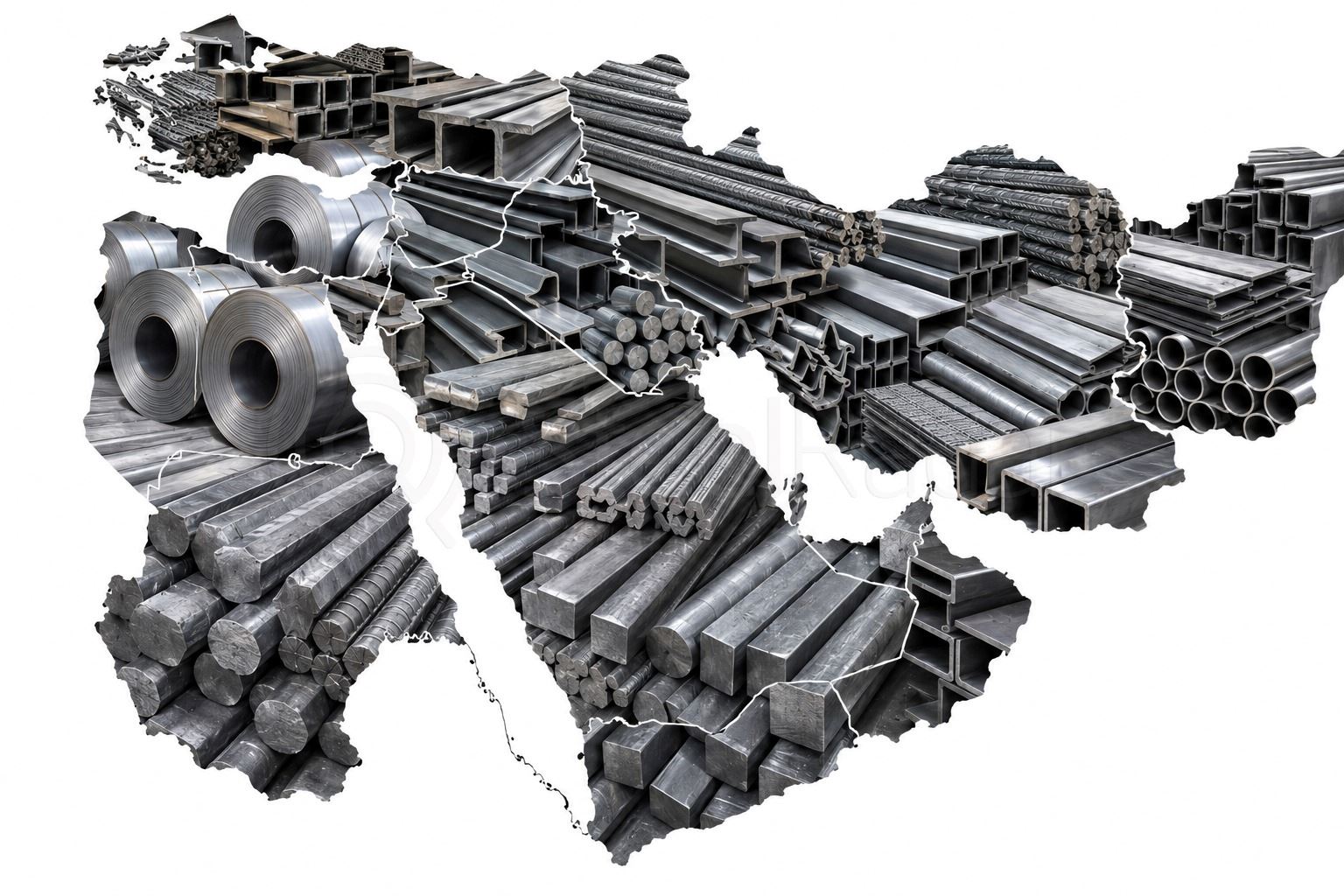
Freight costs, supply constraints, and evolving trade policies remain the key factors influencing steel pricing across the MENA and African markets. While distinct market dynamics are emerging in countries such as Iran, Saudi Arabia, South Africa, and across East Africa, the overall regional sentiment remains cautious.
In Iran, following the recent increase in freight costs, billet export offers are currently assessed at approximately $415-420/mt FOB, while wire rod export prices stand at $465-475/mt EXW. Direct Reduced Iron (DRI) prices are estimated at $320/mt FOB, while iron ore pellet prices are hovering around $95-105/mt FOB.
The slab market, meanwhile, remains in a transitional phase. Although Iran’s leading steelmakers have regained their slab export permits, production activities have yet to fully stabilize. Market sources indicate that current export shipments are largely tied to previously signed contracts and existing delivery commitments, while new sales activity remains limited. Consequently, Iranian slab export prices are currently assessed within the range of $430-468/mt FOB. Market participants expect a clearer pricing direction to emerge once producers resume regular export sales.
In Saudi Arabia, the rebar market continues to face downward pressure amid weak demand. Hadeed, one of the country's major producers, has maintained its rebar price for 12-32 mm material at SAR 2,930/mt (approximately $781/mt), while wire rod prices are assessed at around $800/mt. However, sluggish demand has prompted some producers to lower their offers to as low as SAR 2,800/mt (approximately $747/mt), reflecting an average market decline of $30-35/mt.
Logistics costs also remain volatile. Breakbulk freight rates to Jeddah, which climbed to $50-60/mt in April, have recently eased to $40-50/mt. Nevertheless, inland transportation costs on certain routes can still reach $80/mt. Regional sources note that although conditions around the Strait of Hormuz have gradually normalized, it will take time for logistics flows to fully return to pre-disruption levels. As a result, freight rates and delivery schedules are expected to remain volatile in the short term. At the same time, sources believe that once logistics operations fully normalize and market conditions stabilize, freight-related pressure could ease significantly, potentially leading to a 10% decline in steel prices.
In South Africa, rebar prices are currently assessed within the range of $700-850/mt following recent increases, while pipe prices stand at $1,620-1,760/mt. Domestic scrap prices remain largely stable at around $260/mt. The flat steel market continues to display strength, supported by CRC prices of approximately $956/mt, HRC prices of $872/mt, and standard plate prices of $969/mt. Furthermore, the recent decision by the International Trade Administration Commission of South Africa (ITAC) to impose a three-year phased safeguard duty on certain corrosion-resistant flat steel products is expected to support flat steel prices across the Southern African Customs Union (SACU) region in the coming period.
In East Africa, upward momentum is becoming increasingly evident in Chinese-origin steel offers. Chinese billet offers are currently assessed at $550/mt CIF Djibouti and $546/mt CFR Mombasa, while wire rod offers have reached $585/mt CFR Djibouti. Market participants cite rising coking coal costs and changes in trade regulations as key factors exerting upward pressure on production costs.
In North Africa, HBI prices in Libya have increased slightly to approximately $365/mt, while slab prices offered by LISCO, one of the country's leading steel producers, are currently assessed at around $468/mt. In Jordan, local rebar prices offered by Al-Moasron are reported at approximately $725/mt.
Overall, logistics costs, supply developments in Iran, and regional trade policies continue to be the primary drivers of steel price movements across the MENA and African markets. In particular, the resumption of regular export flows from Iran and ongoing developments in the freight market are expected to remain key factors influencing regional pricing trends in the months ahead.






Comments
No comment yet.