


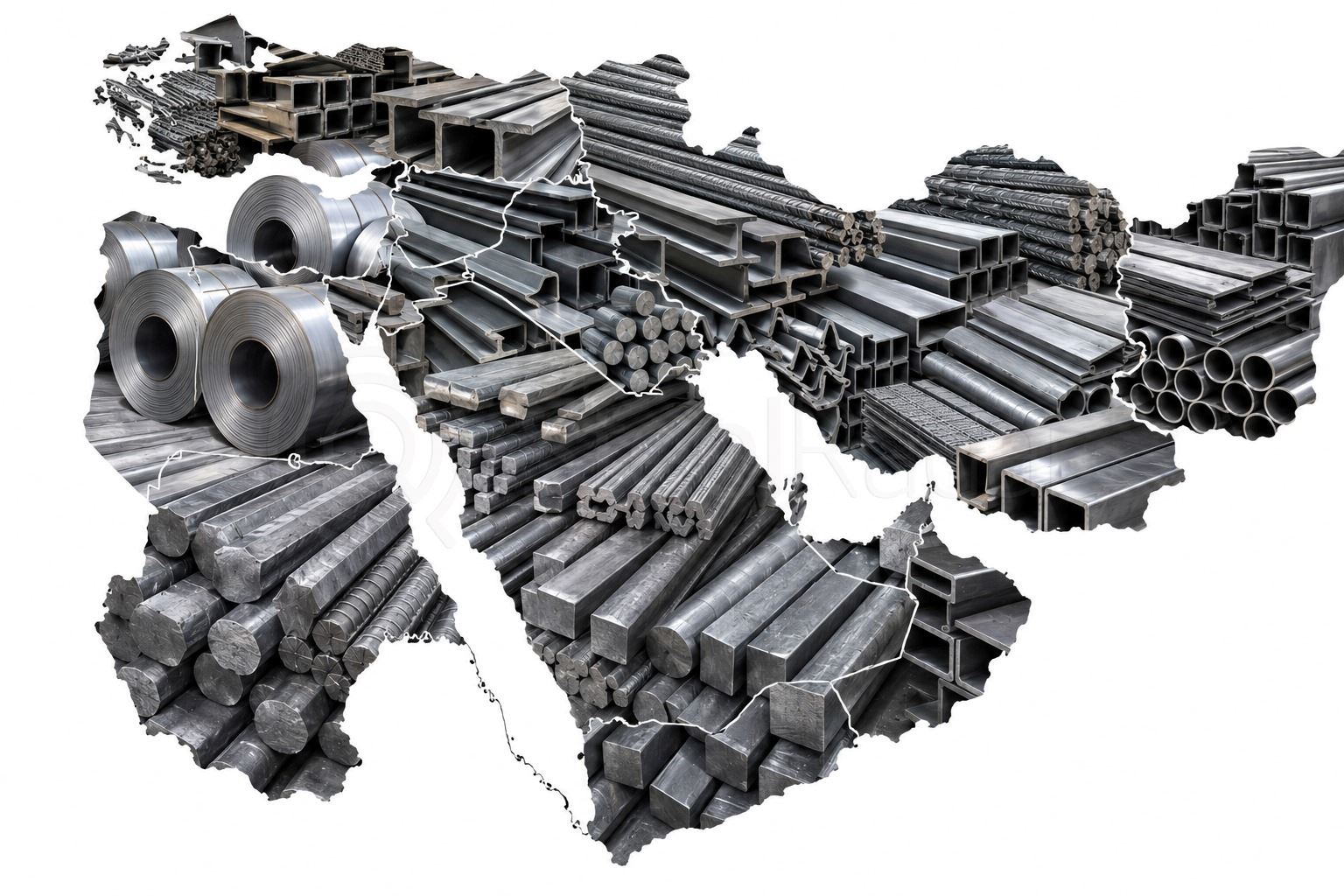
During the week of June 25–July 2, the Middle East and North Africa steel market continues to search for direction amid multiple interrelated risk factors. While energy shortages and raw material constraints are weighing on production across the region, weak global demand and persistent geopolitical uncertainty are prompting buyers to remain cautious. Despite tightening supply, subdued trading activity continues to cap any meaningful upward movement in prices.
Iran remains at the center of these developments. Ongoing electricity consumption restrictions continue to disrupt steel production, while insufficient direct reduced iron (DRI) availability is complicating production planning and increasing cost pressures for steelmakers. Although DRI prices have remained stable at $320-325/t FOB, many producers are choosing to delay sales rather than offer billet due to ongoing difficulties in securing raw materials.
According to market sources, Sirjan Jahan Steel is preparing to offer between 10,000 and 30,000 tonnes of billet through Bandar Abbas Port, while approximately 2,000 tonnes of semi-finished steel remain in stock at Imam Khomeini Port at $410/t FOB. Meanwhile, the recent resumption of commercial vessel traffic through the Strait of Hormuz and the gradual normalization of shipping operations have helped ease immediate logistical concerns. Nevertheless, freight rates have yet to return to pre-crisis levels, and ongoing geopolitical risks continue to keep buyers cautious. Market participants believe that developments in diplomatic talks between Iran and the United States, together with the overall security outlook in the Gulf, will remain key factors influencing freight costs and regional trade flows in the coming months.
Against this backdrop, Iranian billet offers to Sohar, Oman are currently heard at $430-440/t CFR, while offers to the Turkish market stand at $480-500/t DAP. Iran's domestic HBI price remains stable at $350/t EXW, while export offers for hot-rolled coil (HRC) from the Caspian Sea are being heard at $560-570/t FOB.
Another closely watched development for regional producers has been the European Union's latest third-quarter tariff-rate quota utilization results. Producers in Egypt, Algeria, Türkiye and the Gulf countries, all of which maintain significant trade ties with Europe, are assessing the potential impact of quota utilization on their export strategies. Should access to the European market become more restricted, exporters are expected to target the Middle East, North Africa and other alternative destinations more aggressively, potentially intensifying regional competition and adding further downward pressure on prices. Conversely, the availability of unused quotas continues to provide an important export outlet for regional producers, particularly in the flat steel segment.
Overall, a "wait-and-see" approach continues to dominate the market. Market participants believe that if geopolitical tensions ease further, Iranian billet prices could decline by an additional $20-30/t in the short term. This expectation is encouraging buyers to postpone purchasing decisions, resulting in persistently weak trading activity.
Across Africa, price movements continue to diverge between product segments. Chinese-origin billet prices delivered to Djibouti fell by $12/t month-on-month to $533/t CFR, while offers for 0.7 mm HRC from China delivered to Mombasa increased sharply by $88/t to $693/t CFR. The contrasting trends highlight the differing fundamentals currently driving long and flat steel products.
In North Africa, Egypt has maintained its domestic HRC prices at $710/t, while Libya's HBI market has remained balanced, allowing Lisco's HBI export price to increase slightly to $367/t FOB. In South Africa, flat steel products posted modest gains, with HRC reaching $885/t, plate $988/t, and CRC remaining stable at $958/t. In contrast, long products continued to weaken, with rebar declining to $725/t and scrap falling to $240/t, reflecting softer demand.
Elsewhere in the region, domestic market dynamics continue to reflect both cost pressures and weakening demand. In Saudi Arabia, seasonal slowdowns in construction activity during the summer have reduced rebar demand, prompting leading producer Hadeed to cut prices for rebar and wire rod by SAR 130/t effective July 1, marking its first price reduction in four months. Following the adjustment, Hadeed's domestic (EXW) prices stand at $746/t (SAR 2,800) for 12-32 mm rebar and $773/t (SAR 2,900) for 10 mm rebar, while wire rod prices range between $760-773/t (SAR 2,850-2,900) depending on grade.
In Algeria, domestic rebar prices remain stable at $870-880/t, while wire rod export offers continue to be heard at $585-600/t FOB. Meanwhile, Morocco's domestic rebar prices have climbed to approximately $900/t, excluding VAT, making them among the highest in the region.
Iraq's domestic market continues to display significant price disparities among producers. Mass Steel offers the highest rebar price at $630/t, followed by Van Steel at $590/t, FF Steel at $580/t, and Darin Steel at $540/t. Overall, the Iraqi market remains balanced within the $525-545/t range.
Across West and East Africa, domestic markets remain relatively stable. Mixed scrap in Nigeria is trading at $590/t, while rebar stands at $750/t. In Tanzania, HMS scrap prices have stabilized at $423/t.
Overall, supply-side constraints alone have not been sufficient to lift steel prices across the MENA region. While energy shortages and raw material constraints continue to limit production, weak global demand and persistent geopolitical uncertainty are keeping buyers on the sidelines. Under current market conditions, low trading volumes and limited price movements are expected to persist in the near term.





Comments
No comment yet.