


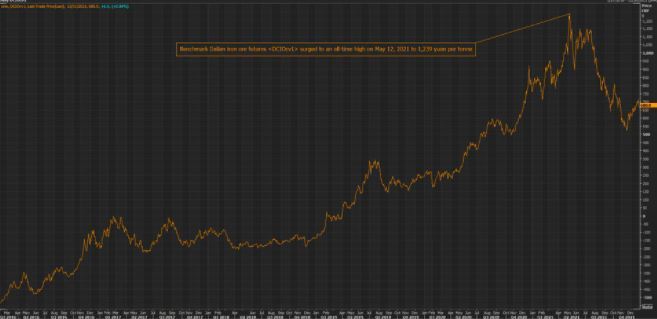
China's benchmark iron ore futures posted their first annual decline in three years, amid a roller coaster year in which prices hit record highs before nearly halving amid Beijing's strict production restrictions to meet climate change targets.
The most actively traded iron ore futures contract for May delivery on the Dalian Commodity Exchange ended Friday, up 0.9% at 680 yuan ($106.71) per tonne after falling 12% in 2021.
Major component prices, which nearly quadrupled in 2019 and tripled in 2020, rose to 1,239 yuan per tonne on May 12, supported by strong steelmaking demand.
As China relies on imports for more than 80% of its iron ore, mainly from Australia and Brazil, the relevant authorities.
To increase its iron ore pricing power, China changed trading rules on exchanges, encouraged more steel scrap inflows, boosted domestic production, and explored overseas assets.
However, prices only started to fall in the second half of the year when the government ordered the cuts in steel mills to reduce carbon emissions and other pollutants from the ferrous sector.
China's iron ore imports decreased by 9.6 percent in the June-November period compared to the same period of the previous year. Product prices on the Dalian exchange fell 42% in these months.
China's iron ore futures posted their first annual decline in three years in 2021.
OTHER RAW MATERIALS
Dalian coking coal and coke futures reported double-digit annual growth this year, despite a record decline earlier this year.
Raw material prices were also suppressed by a widespread power outage in September-October and government interventions to alleviate the problem, in addition to easing downward demand.
Dalian coking coal and coke futures prices rose in 2021, while iron ore futures fell 12%.
Meanwhile, the continued restriction of coal imports from Australia and the unstable pandemic situation in Mongolia have left the supply side of metallurgical coal unstable.
Coking coal futures rose 1.6% to 2,229 yuan a tonne at the close on Friday, pushing annual gains more than 60%.
Coke prices stood at 2,934 yuan per tonne at the close, up about 23% in 2021.
STEEL PRICES
China has pledged to keep its 2021 crude steel production below the record 1.065 billion tons it set last year, and this was seen as impossible by the industry amid the construction boom and manufacturing frenzy. This helped steel prices rise during the first three quarters of 2021.
However, an unexpected debt crisis in real estate companies in the last quarter also spilled over into the moored sector, raising concerns about future demand should China try to forego construction incentives.
Steel rebar futures used in the construction industry on the Shanghai Futures Exchange fell 0.1% to 4,315 yuan a tonne on Friday, but rose 4.8% this year.
Shanghai steel futures prices for 2021 rose amid strong demand and production controls.
Hot rolled coils used in cars and household appliances ended up at 4,411 yuan per ton. They gained 7% in 2021.
Shanghai stainless steel futures rose 0.4% to yuan 17,125 per tonne at market close, and are up more than 50% this year, supported by raw material nickel prices.
Chinese financial markets will be closed on January 3 for the New Year holiday. Markets will resume trading on January 4th.



Comments
No comment yet.