


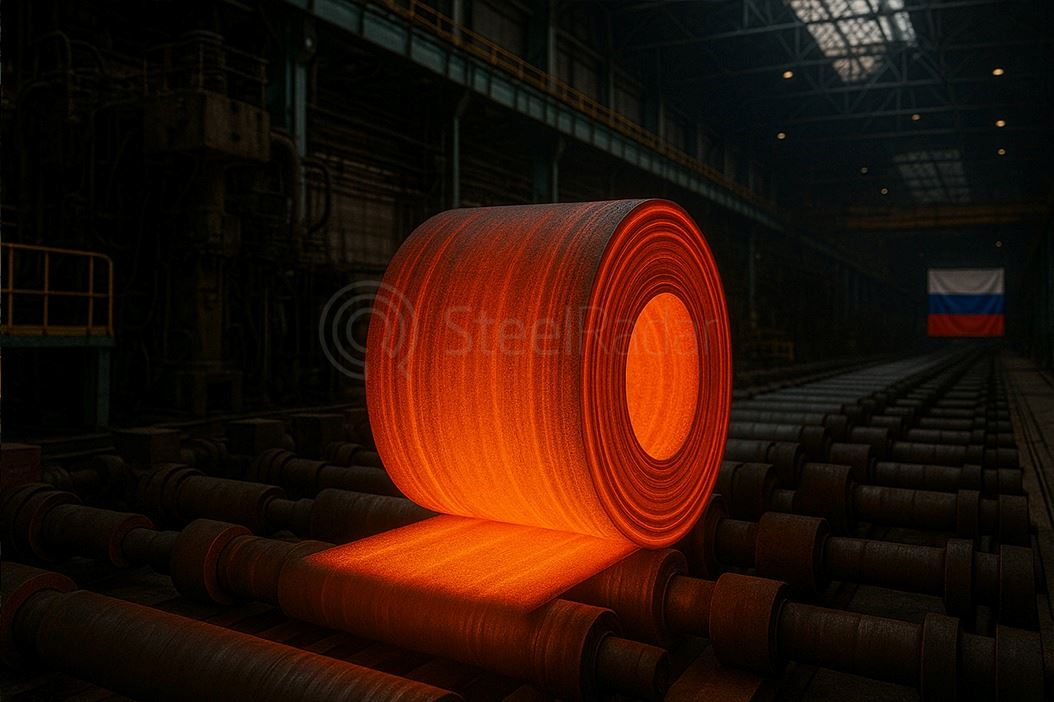
Russian Export Market Supported by Tight Supply
Russian HRC export prices remain relatively firm as export availability continues to be limited. Most producers are prioritizing domestic sales and nearby export destinations, reducing the volume of material available for the wider international market.
A large share of July production has already been sold, and market participants expect prices to remain broadly stable in the coming weeks. Tight supply continues to support the market, particularly as domestic demand remains healthy.
Iran remains one of the most active buyers of Russian steel products. Demand for both hot-rolled and cold-rolled materials has increased, with purchasing activity for July production gaining momentum.
A non-sanctioned Russian producer is currently offering July-produced HRC at $535-550/t FOB Black Sea and has reportedly sold most of its approximately 30,000-ton export allocation. Market participants indicate that any additional export sales will likely come from August production as available July volumes become increasingly limited.
Meanwhile, a sanctioned supplier is offering HRC to Iranian buyers at $563-565/t FOB Astrakhan, with roughly 75% of its July export quota already sold. Demand from Iran extends beyond HRC, with cold-rolled coil accounting for an estimated 15-20% of total orders.
Russian CRC export prices are currently assessed at around $635/t FOB Black Sea.
Overall, the Russian export market remains supported by limited export availability, strong domestic demand, and continued buying interest from Iran.
Turkish HRC Market Remains Under Pressure
The Turkish HRC market continues to face demand-related challenges despite relatively stable pricing.
Domestic HRC prices were heard at $630-645/t EXW, around $10/t lower than previous weeks. However, privately negotiated discounts continue to make actual transaction levels difficult to determine. Most mills are offering July deliveries, while some producers have already shifted to August shipment schedules.
Current cost structures continue to pressure mill margins, making significant price reductions unlikely. At the same time, weak domestic demand and slow export activity continue to weigh on market sentiment.
Market participants report that some traders, particularly in the Mediterranean region, have reduced prices to move inventory and improve cash flow, resulting in offers below the national average.
Purchasing activity from service centers and end-users remains limited, keeping spot market transactions at relatively low levels. Although producers have offered more competitive quotations to support order intake, official price levels have remained relatively stable due to the limited visibility of discounted transactions.
Accepted local spot flat steel prices in Türkiye were reported at:
- HRC: $670/t
- CRC: $705-710/t
- HDG: $800-810/t
Turkish HRC export prices were reported at $615-620/t FOB, with market participants considering variations of around $10/t acceptable depending on order size and destination.
Chinese export offers continue to pressure global markets, while buyers in Europe and the Mediterranean region remain largely in wait-and-see mode until clearer pricing trends emerge.
CRC, HDG and PPGI Markets Show Limited Movement
The Turkish CRC market remains relatively stable despite weak demand conditions. Domestic CRC prices were heard at $700-730/t EXW, with the market average settling near $720/t. Some mills attempted increases of around $10/t during the second week of June, although demand remains insufficient to support a stronger upward trend.
CRC export prices were reported at $680-690/t FOB, levels generally considered acceptable by market participants.
In the galvanized steel market, 0.50 mm HDG prices were heard at $790-810/t EXW. Producers continued testing daily price adjustments of around $20/t, although the most widely accepted market level remained close to $800/t.
HDG export prices were reported at $760-770/t FOB. While rumors of additional discounts circulated due to weak buyer interest, mills continued to defend prevailing price levels.
The PPGI market also remained cautious. Accepted domestic prices were heard at $925-935/t, with average discounts of approximately $5/t available. Market rumors suggested that prices as low as $910/t may have been offered for large-volume inquiries, although these levels could not be confirmed.
PPGI export prices were reported at $850-860/t FOB.
Overall, low transaction volumes and cautious buyer sentiment continue to shape pricing across the Turkish flat steel market.
European Green Steel Demand Remains Weak
Interest in low-carbon flat steel products across Europe continues to lag behind producers' expectations.
Although steelmakers are gradually introducing more green steel products to support carbon reduction goals, buyers remain highly focused on controlling costs. Weak industrial activity and uncertain economic conditions have made it difficult for many consumers to justify paying a premium for sustainable steel products.
As a result, purchasing activity remains concentrated among large industrial companies pursuing long-term sustainability strategies, while distributors and service centers maintain a cautious approach due to difficulties passing additional costs through the supply chain.
Market participants generally agree that the transition toward green steel is inevitable over the long term. However, a meaningful increase in demand will likely require stronger economic conditions and additional incentives supporting the adoption of low-carbon steel products.
U.S. HRC Prices Continue to Rise
Unlike many international markets, the U.S. HRC market continues to receive support from both strong construction activity and trade protection measures.
Nucor raised its Consumer Spot Price (CSP) for hot-rolled coil to $1,125/st for the week of June 15, while the CSP for CSI was increased to $1,175/st. Spot lead times remain at approximately three to five weeks, reflecting continued confidence among domestic producers.
Construction activity has emerged as one of the strongest drivers of steel demand in the U.S., with some indicators showing growth of more than 33% compared to the previous year. At the same time, inflation has reached its highest level in roughly three years, adding further cost pressure throughout the supply chain.
Another key factor supporting domestic pricing is the continued impact of Section 232 trade measures. These restrictions continue to limit import competition and strengthen the pricing position of domestic mills. As a result, producers have been able to advance prices even in an environment where global steel markets remain under pressure.
The combination of stronger construction demand and trade protection has created a more supportive environment for U.S. steel prices. However, the key question for the third quarter remains whether demand can continue to support current price levels once seasonal factors begin to fade.
Outlook
The global HRC market remains caught between weak demand and supportive supply fundamentals. Russian export prices continue to benefit from limited availability and strong Iranian demand, while Turkish and European markets remain constrained by cautious purchasing behavior and slow industrial activity.
At the same time, the U.S. market continues to outperform many other regions, supported by rising construction demand, higher domestic prices, and ongoing trade protection measures.
Looking ahead, demand trends will remain the primary factor influencing market direction. While tight supply and elevated production costs continue to support prices, a broader recovery in steel consumption will be necessary to sustain upward momentum across global flat steel markets.





Comments
No comment yet.