


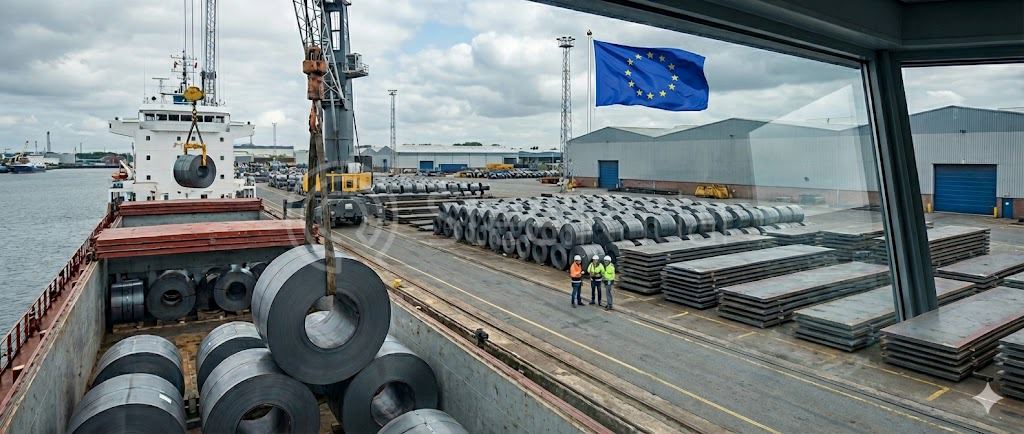
European HRC prices continue to trend upward amid long lead times and limited competitive pressure from imports. Market participants say pricing is shaped less by demand conditions than by expectations of further increases in import costs. At the center of these expectations are the Carbon Border Adjustment Mechanism and existing trade protection measures. Rising regulatory risks are making imports more expensive and uncertain, strengthening domestic producers’ pricing power.
Indicative price levels stand at €700–720/t in Germany and around €750/t in Iberia, with €690/t largely limited to smaller-volume transactions. Tata Steel is positioned near €675/t, while NLMK is reported to have stepped back from the market around €650/t, leaving its current offer levels unclear. Sheet prices struggling to move beyond €700–730/t have reinforced buyer resistance near the €690/t band, with competition remaining strong.
In Italy, May-delivery HRC is reported at €720/t CPT (approximately €705/t EXW) from Arvedi and €700/t EXW from Metinvest. Limited April-delivery volumes are still available, with a market floor forming around €660/t EXW. thyssenkrupp is heard offering near €680/t following a modest upward revision. Overall market activity remains subdued, and import offers are limited.
In Southern Europe, Turkish material is quoted at approximately €640–650/t DDP, while Asian HRC offers — including CBAM and anti-dumping duties — are reported at €660–670/t DDP. Material from Algeria is heard around €630/t across both northern and southern markets. India may have concluded limited sales into Southern Europe last week, though pricing remains unclear. Imports continue to provide a reference point for the market, but their competitiveness has weakened under mounting cost pressures.
According to data from All Steel Trading, steel prices in the United Kingdom have risen by £40–50 per tonne across product categories over the past four months. Rapid exhaustion of first-quarter 2026 import quotas has increased tariff exposure for importers. Market expectations point to significantly tougher trade measures after June 2026, potentially including a 50% quota reduction and a 50% tariff increase.
Supply tightness is not driven solely by policy. In addition to higher global input costs, operational disruptions at major producers have further constrained availability. Technical issues at Tata Steel and British Steel facilities, combined with the exhaustion of quotas for Turkish material, have materially reduced physical supply in the European market.
Overall, Europe’s steel prices are being shaped less by demand growth than by cost inflation, regulatory expectations and supply constraints. Unless demand shows a clear recovery, price gains are likely to remain fragile, while tightening trade policy is set to remain the key driver of market direction.





Comments
No comment yet.