


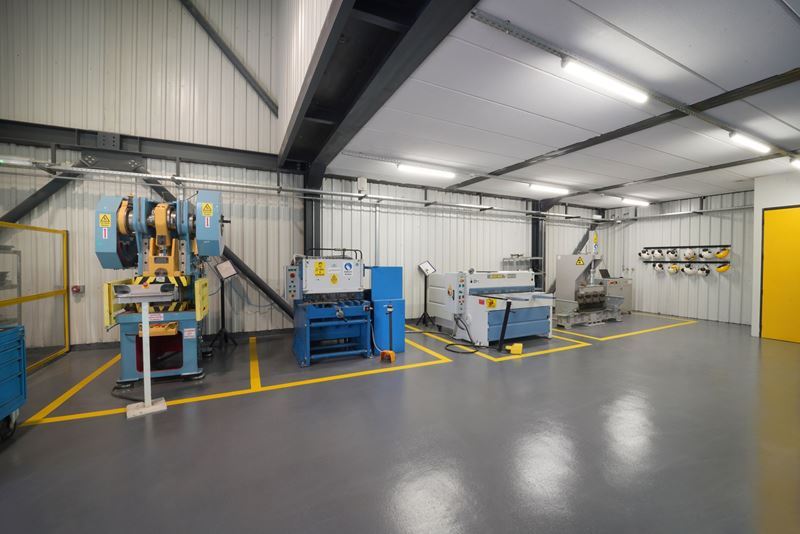
Borçelik R&D Test Center, part of Borusan Group, has been accredited by the Turkish Accreditation Agency (TÜRKAK) under the TS EN ISO/IEC 17025:2017 standard. Registered under accreditation number AB-2215-T, the center has begun offering its testing and analysis capabilities to external customers.
With this accreditation, Borçelik R&D Test Center has evolved beyond an internal laboratory serving the company’s production processes, becoming an accredited testing center whose technical competence, impartiality and reliability of results have been verified through independent assessment. The center provides accredited services in four areas: tensile testing and Vickers hardness testing of metallic and welded materials, coating thickness measurements using Scanning Electron Microscopy (SEM) on metallic materials, and salt spray corrosion testing of coated or painted materials.
Reliable results supporting international acceptance processes
The TS EN ISO/IEC 17025 standard, internationally recognized for the competence, impartiality and consistent operation of testing and calibration laboratories, is an important reference for the technical validity and reliability of test results. The accreditation of Borçelik R&D Test Center demonstrates that the technical competence of tests, analyses and reporting conducted by Borçelik has been independently verified.
Under the multilateral recognition agreements signed by TÜRKAK with the European co-operation for Accreditation (EA) and the International Laboratory Accreditation Cooperation (ILAC), test results covered by the accreditation also support international acceptance processes. In this context, Borçelik R&D Test Center provides technical support in line with international standards to companies operating in various sectors, particularly automotive, white goods, construction, manufacturing and metals, supporting product development, quality assurance, failure analysis and export processes.
Accredited testing services help companies meet technical requirements more effectively and manage product acceptance processes.
Accredited services in four testing areas
The accreditation scope of Borçelik R&D Test Center covers tensile and Vickers hardness testing of metallic and welded materials, SEM-based coating thickness measurements on metallic materials, and salt spray corrosion testing of coated or painted materials.
Tensile tests conducted in accordance with TS EN ISO 6892-1 determine the mechanical strength, yield and tensile strength, and elongation properties of steel and other metallic materials at room temperature. Vickers hardness tests under TS EN ISO 6507-1 enable precise measurement of the surface and internal hardness of materials.
SEM analyses in accordance with ASTM B748 examine the thickness of metallic coatings on material cross-sections with sub-micron precision, while salt spray tests conducted in accordance with ASTM B117-19 evaluate the corrosion resistance of coated and painted materials under accelerated aging conditions.
End-to-end approach to quality assurance
In line with accreditation requirements, Borçelik R&D Test Center operates a quality assurance infrastructure based on traceability and continuous verification across its testing and measurement processes. Test and measurement equipment used at the center is regularly calibrated by authorized organizations with traceability to the International System of Units (SI).
Test methods and equipment performance are regularly verified using certified reference materials and standard control specimens. The center also monitors measurement quality through national and international Interlaboratory Comparison programs for external verification, while conducting Personnel Comparison studies to ensure consistency in internal practices.
By incorporating measurement uncertainty calculations into test reports in accordance with international norms, the center provides customers with transparent, verifiable and reliable technical data.
With its accredited infrastructure and expertise, Borçelik R&D Test Center will continue to strengthen quality assurance across its own production processes while providing solutions to the industry’s needs in material development, quality control, product validation and failure analysis.





Comments
No comment yet.