


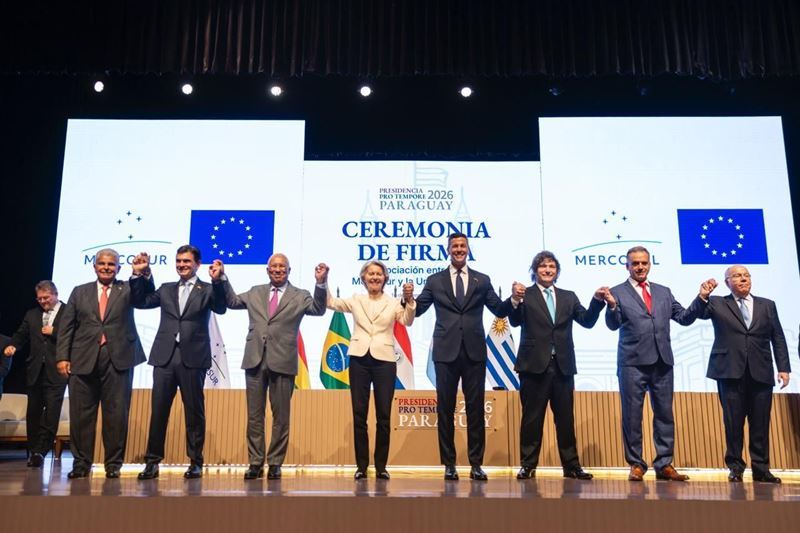
The signing ceremony was attended by European Commission President Ursula von der Leyen, European Council President António Costa, and the leaders of MERCOSUR member countries. Brazilian President Luiz Inácio Lula da Silva was represented at the ceremony by his foreign minister.
Speaking at the signing ceremony, von der Leyen said the agreement represents “a new partnership between MERCOSUR and Europe,” noting that the deal was concluded after 25 years of preparation. She stated that the EU and MERCOSUR countries will form the world’s largest free trade area, accounting for nearly 20% of global GDP and creating new opportunities for a combined population of around 700 million people. She added that the agreement will remove tariffs and other trade barriers, open public procurement markets, and provide a rules-based framework to encourage investment and trade flows.
Under the agreement, tariff advantages will be granted for various agricultural products, including beef, poultry, and dairy products. In return, MERCOSUR members Argentina, Brazil, Paraguay, and Uruguay will expand market access for industrial goods from Europe. EU exports to the region are expected to increase by up to 40% annually. Covering nearly 700 million consumers, the new trade area is expected to generate significant commercial opportunities for EU companies.
The agreement also includes safeguard measures allowing market access restrictions for sensitive agricultural products from MERCOSUR to the EU when deemed necessary.
For the agreement to enter into force, it must be approved by the European Parliament and the EU Council. Brussels views the deal as a major geopolitical gain that could strengthen the EU’s influence in the Latin American market. However, several EU countries and European farmers’ organizations oppose the agreement, arguing that the entry of low-cost agricultural and livestock products produced under lower standards could put pressure on domestic producers. While Germany and Spain support the agreement, countries including France, Poland, and Hungary have voiced opposition.



Comments
No comment yet.