


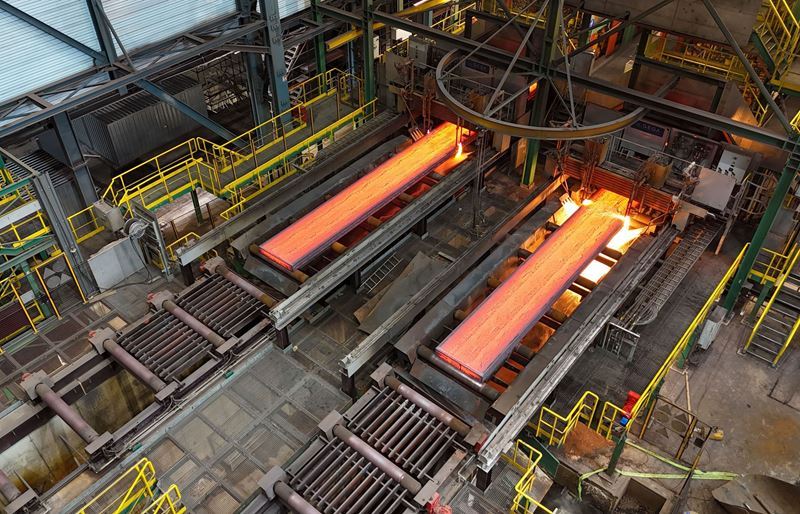
thyssenkrupp Steel has completed the modernization of No. 4 continuous slab caster at its Duisburg plant. The final acceptance certificate for the project, carried out by Primetals Technologies, was issued in April 2026.
As part of the project, the previously integrated casting and rolling line was converted into two separate units: the modernized continuous caster and the hot strip mill. Separating the casting and rolling operations is intended to increase steelmaking capacity utilization, process efficiency, slab logistics and flexibility in process control.
Chris Lindner, Head of Upstream Operations at thyssenkrupp Steel, said the quality advantages of the new system and its potential to produce new steel grades had become evident during the commissioning phase.
Production for e-mobility and automotive steels
The modernized facility enables the production of advanced steel grades for e-mobility applications, as well as multiphase and high-strength steels.
The facility has also been configured to meet the production requirements for silicon electrical steels used in e-mobility, motor and generator applications, as well as high-strength steels for the automotive sector.
The project was carried out according to a defined schedule to minimize the impact on ongoing production. Up to 1,000 workers were present on site simultaneously during the most intensive phases of the work.
Olaf Meininghaus, responsible for sales and business development activities with thyssenkrupp at Primetals Technologies, said the long-standing cooperation between the two companies played a role in completing the project.
To shorten the implementation period, some of the main equipment underwent pre-assembly and testing before installation. Selected components of the existing facility were also integrated into the new system with minimal downtime.
Energy consumption to be reduced through direct rolling
The modernized two-strand No. 4 continuous slab caster is equipped with mechanical and automation systems. The DynaWidth mold width adjustment system enables changes in slab widths, while the DynaFlex hydraulic oscillator system allows mold oscillation parameters to be adjusted to control strand surface quality.
The plant’s Level 2 automation system, CC Optimizer, also includes the Dynacs 3D module, which controls the secondary cooling process.
EcoStar Spiral rollers enable Dry Casting in the curved and horizontal sections of the caster. Spray cooling is completely eliminated in the horizontal section, while secondary cooling in the casting curve can be reduced or switched off entirely.
The combined use of these technologies is intended to keep slabs within the temperature range required for direct rolling and eliminate the need for reheating furnaces. The system is particularly designed to maintain high-strength and high-silicon steels at suitable rolling temperatures, reducing the risk of cracking caused by temperature fluctuations.
Eliminating secondary cooling in the horizontal strand section is also expected to reduce maintenance requirements and operating expenses (OPEX).
Project forms part of thyssenkrupp Steel’s modernization program
The work in Duisburg forms part of thyssenkrupp Steel’s broader modernization program. In 2021, the company ordered a reversing cold rolling mill, a hot strip mill and two heavy slab continuous casters from Primetals Technologies.
thyssenkrupp Steel has an annual crude steel production volume of approximately 11 million tons and employs around 26,000 people worldwide.
The company aims to produce 5 million tons of CO₂-neutral steel annually by 2030 and achieve full climate neutrality across its production activities by 2045.



Comments
No comment yet.