


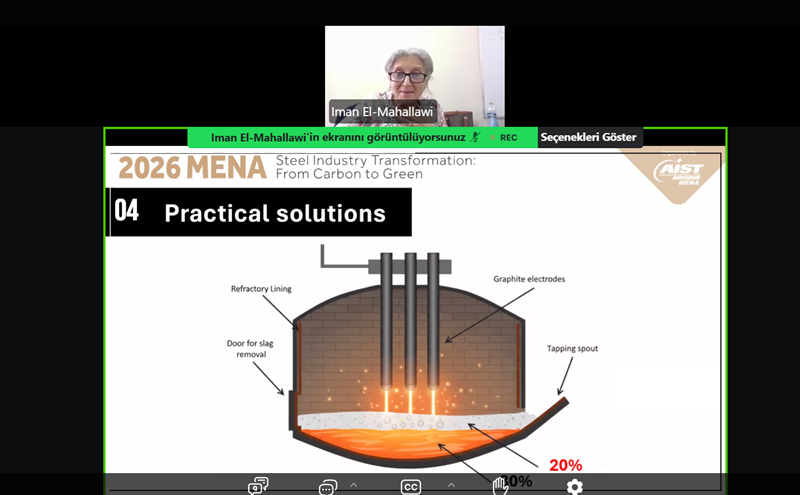
El-Mahallawi stated that carbon emissions can be significantly reduced by improving existing production technologies, and that steel production waste can be reintegrated into the economy, providing both environmental and economic benefits.
At the beginning of her presentation, El-Mahallawi emphasized that sustainability does not only mean reducing carbon emissions. She noted that environmental protection, combating climate change, economic growth, and social equity are fundamental components of a sustainable industry. She added that sustainable transformation in the steel sector requires addressing multiple aspects together, including energy use, raw material consumption, environment and occupational safety, emissions, economics, and social acceptance.
Referring to the historical development of the steel industry, El-Mahallawi noted that some studies indicate that the earliest iron smelting and production activities may have taken place around 3500 BC in Egypt. She also stated that, according to Encyclopaedia Britannica and sources on the history of steel technology, blast furnace technology was developed in China around the 5th century BC, and that during the early Han Dynasty, blast furnaces enabling cast iron production began to be used.
A significant part of her presentation focused on industrial circularity and circular economy practices. El-Mahallawi stated that the linear production model should be replaced by a circular economy approach that includes not only recycling but also maintenance, reuse, refurbishment, and remanufacturing. She emphasized that reintegrating steel production waste into the economy reduces natural resource consumption and also contributes to lower carbon emissions.
In this context, she shared data on steel slag recovery, stating that 6.2 million tons of crude steel slag have been recycled to date, resulting in the recovery of 450,000 tons of metal and the production of 5.7 million tons of slag aggregates. She noted that these recovered materials are used in road construction and various building applications, creating economic value.
She also stated that electric arc furnaces (EAF) generate approximately 800,000 tons of slag annually, accounting for about 18–20% of liquid steel production. She explained that slag cooled by natural air and water spraying can be separated and used both for metal recovery and slag aggregate production.
El-Mahallawi also highlighted applications of steel slag in the construction sector, noting that in asphalt applications it offers higher abrasion resistance compared to natural limestone. According to the data presented, in the Los Angeles abrasion test, natural limestone shows a wear loss of 22%, while steel slag records 15%.
Regarding cement production, she stated that slag utilization provides significant environmental benefits. Slag-based cement increases 28-day compressive strength to 105–110% compared to conventional cement, reduces hydration heat by 75–80%, and lowers the carbon footprint by approximately 70%.
The presentation also included research on earthquake-resistant steel production from scrap. El-Mahallawi stated that through deep desulfurization, the addition of 0.30–0.35% silicon or nickel, controlled manganese content, and optimized process parameters, earthquake-resistant steel containing 0.6% copper scrap can be successfully produced. She noted that manganese addition was reduced from approximately 1.5% to 0.95% without compromising mechanical properties, resulting in an alloy cost saving of about 8 USD/ton and a total cost advantage of approximately 11 USD/ton including energy savings.
El-Mahallawi also presented studies on a BF-IF-BOF approach applicable to existing blast furnace–basic oxygen furnace plants. She stated that this method can be implemented without requiring emerging hydrogen-based direct reduction technologies. She explained that integrating liquid scrap with hot metal significantly increases scrap usage rates, improves energy efficiency, enhances process control, and can be applied in existing blast furnace facilities with low modification costs.
According to the presented research, increasing scrap usage from a traditional level of 19% up to 90% leads to significant reductions in carbon emissions. It was noted that CO₂ emissions can be reduced by 0.309 to 1.685 tons per ton of steel, with minimum emissions decreasing from 0.673 tons CO₂/ton steel to 0.108 tons CO₂/ton steel.
At the end of her presentation, El-Mahallawi emphasized that the green transformation of the steel industry is not limited to investment in new technologies. She highlighted that modernization of existing facilities, wider adoption of circular economy practices, more efficient utilization of slag and scrap, and improved resource efficiency all play a critical role in transitioning toward low-carbon steel production.



Comments
No comment yet.