13,092.93 TRY BIST 100 BIST 100
50.60 EUR EUR EUR
44.19 USD USD USD
6.44 CNY CNY CNY
0.13 CNY CNY/EUR CNY/EUR
39.82 TRY Interest Interest
104.37 USD Fossil Oil Fossil Oil
5.77 USD Copper Copper
113.97 USD Silver Silver
107.52 USD Iron Ore Iron Ore
369.00 USD Shipbreaking Scrap Shipbreaking Scrap
7,128.76 TRY Gold (gr) Gold (gr)
109.00 USD Iron Ore 61% Fe Iron Ore 61% Fe

Steel’s green revolution: EAF vs. Blast furnaces

In 2023, a groundbreaking analysis highlighted stark differences in carbon emissions between traditional blast furnace methods and modern electric arc furnaces (EAF), reshaping perspectives in the steel industry and environmental discourse.

Steel’s green revolution: EAF vs. Blast furnaces

In a groundbreaking analysis conducted in 2023, researchers unveiled a stark contrast in carbon emissions between traditional blast furnace techniques and more modern electric arc furnaces (EAF). These findings have significant implications for the steel industry and the environment.

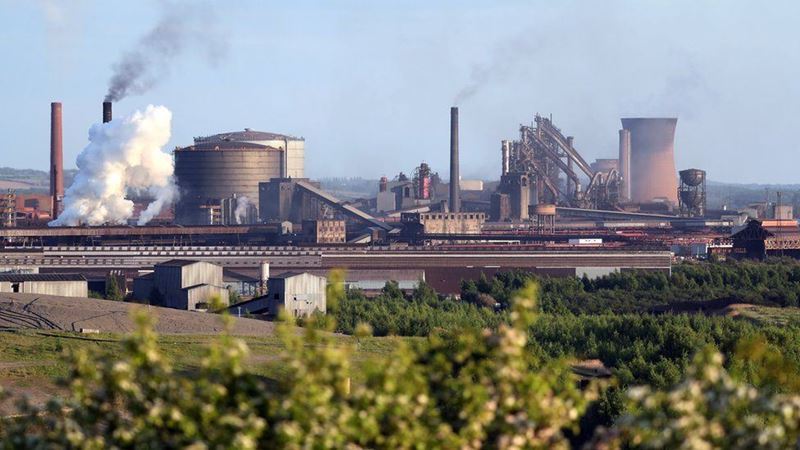
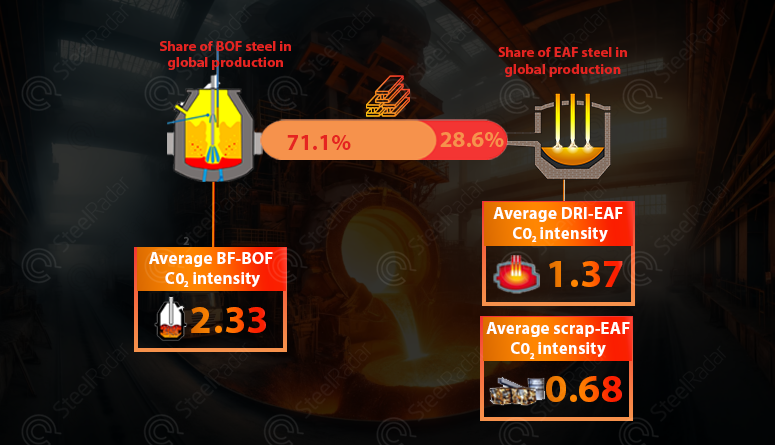
Blast furnaces accounted for a whopping 71.1% of global steel production in 2023. These iconic structures have long been the workhorses of the industry. However, there’s a trade-off. For every ton of steel produced via blast furnaces, approximately 2.33 tons of carbon dioxide (CO2) are emitted. The high-intensity process relies on coke (derived from coal) to extract iron from ore, releasing substantial greenhouse gases.

EAF, representing 28.6% of global production, offer an alternative. They use electricity to melt scrap steel, bypassing the need for coke.
The average CO2 intensity for EAF using direct reduced iron (DRI) methods is 1.37 tons per ton of steel. But the true environment-friendly is the full scrap charge approach, which slashes emissions to a mere 0.68 tons per ton of steel. EAFs are nimble, adaptable, and less resource-intensive. They’re particularly suited for recycling and minimizing environmental impact.

These statistics underscore the need for industry-wide shifts toward greener practices. As climate concerns mount globally, steelmakers must embrace innovation, invest in cleaner technologies, and reduce their carbon footprint.

Remember, the future of steel lies not only in its strength but also in its sustainability. Let’s forge a path toward a cleaner, more resilient world!

Comments

No comment yet.

Only +plus subscribers can access this content.

SUBSCRIBE now to share your thoughts on the markets and get more comments.
SUBSCRIBE If you already have an account Sign In

Most read news

Ukraine launches anti-dumping investigation into steel bars and angles of Turkish origin

Monday, March 16, 2026

Ekinciler is preparing for 180 tons of production per hour with the new Danieli K-Welding system

Monday, March 16, 2026

UK imposes new anti-dumping measure on tin products imported from China

Monday, March 16, 2026

Chinese economy gets off to a strong start in 2026

Monday, March 16, 2026

British Steel public spending reached GBP 377 million

Monday, March 16, 2026
Follow List
Expand
Your watch list is empty

Add your favorite commodities for quick access and don't miss the latest price change news.


There are no news categories you follow
Edit Notification Preferences
E-bulletin subscription
Sign up to receive the latest news and daily iron prices by e-mail and sms
Become a Plus Subscriber Now!
Try it free for 3 days!
Subscribe Now
Neutral Prices
Be informed
Provincial Iron Prices
Comments and Analysis
Subscribe Now