


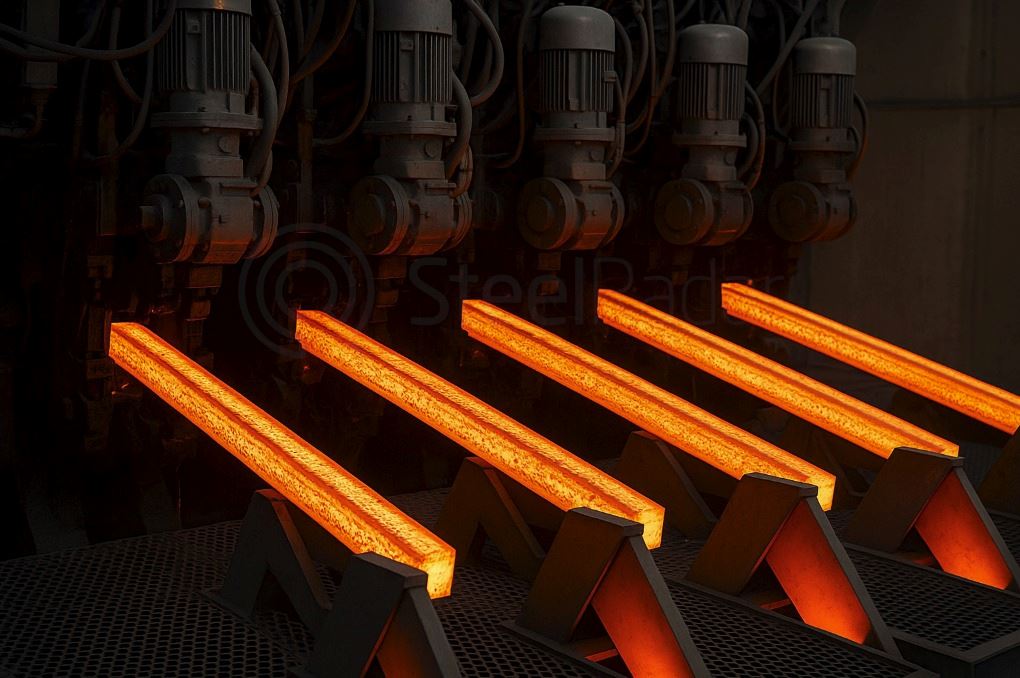
Russian billet exporters are continuing to test higher price levels across different markets, supported by firm demand and rising cost pressures. Offers to the Turkish market are currently heard at $480–485/t CFR, while cargoes from Novorossiysk to Damietta have been indicated in a wider range of $495–508/t. In Asia, a recent transaction to Taiwan was concluded at $490/t CFR, confirming that buyers are still accepting elevated levels. For May shipment, FOB Black Sea offers are reported at $457–463/t. The overall upward movement is largely driven by the sharp increase in scrap prices, developments in the Turkish rebar and billet markets, and higher freight costs. Meanwhile, despite a recent decline in the ruble, suppliers are not offering discounts and are holding firm on their current pricing.
Geopolitical tensions in the Middle East have pushed oil prices higher, which in turn has supported Chinese futures and lifted domestic billet prices. Chinese producers are currently offering 3SP billet for May–June shipment at $465–470/t FOB. However, rising raw material and freight costs have led many Chinese producers to withdraw from the market or revise their prices. Export prices for Chinese billet are around $455/t, while billet import prices in Southeast Asia are close to $490/t. Indian billet export prices are also at similar levels, around $465/t. Since mid-March, Dexin’s billet prices have increased by about $5/t, rising from $490/t to $495/t FOB for June shipment, and have since been moving on a relatively stable trend.
In the Turkish market, although producers have raised their offers to $530–540/t EXW due to cost pressures, actual transactions are still being concluded in the range of $505–520/t EXW, showing that the market has not fully accepted these price increases. The March average of $538/t EXW also confirms this divergence. Domestically, Kardemir has drawn attention by selling around 39,500 mt at $540–550/t depending on quality, in an effort to support higher price levels. However, overall weak demand and strong buyer resistance continue to keep most deals at lower levels. On the other hand, recent attacks on major steel facilities in Iran and disruptions in production have created uncertainty on the regional supply side. While this situation supports producers’ attempts to push prices higher, weak end-user demand continues to limit the market’s ability to sustain these increases.






Comments
No comment yet.