


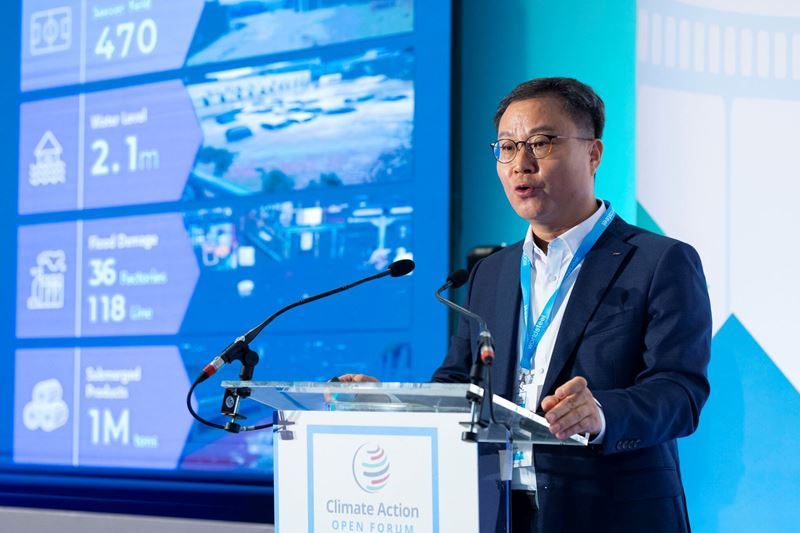
In his presentation titled “Climate Risk Resilience in Steelmaking: The 135-Day Miracle”, Lim shared with global steel industry stakeholders the successful struggle they waged against Super Typhoon Hinnamnor, which hit the company’s Pohang facilities in September 2022 and was described as the largest in the past 500 years, as well as the story of the factory’s rebirth from the ashes.
A historic decision prevented disaster
Jeewoo Lim stated that Typhoon Hinnamnor, which affected the region with rainfall of 110 millimeters per hour and wind speeds of 56 meters per second, led to an unstoppable disaster at the facility as rivers overflowed and reservoir gates were opened. Lim noted that one-third of the steelworks was submerged, more than 1 million tons of finished products were damaged, and 118 production lines were covered in mud, and explained the historic decision behind the fact that not a single loss of life or explosion occurred at the facility despite this. Emphasizing that, for the first time in POSCO’s 54-year history, they cut power to all plants at the Pohang facilities and stopped gas supplies before the typhoon, completely shutting down operations, Lim stated that this move was a strategic turning point that protected the facility from much greater and irreversible climate disasters.
Return to full capacity in 135 days and new systems
Describing the restoration process that began after the disaster as a major race against time, Lim noted that they restored essential infrastructure services such as electricity, water, gas, and steam within the first six critical days. Stating that approximately 68 kilometers of underground culverts were covered with mud at depths ranging from 3 to 10 meters and that under normal circumstances the procurement period for only the main drive motors and PLC boards would exceed one year, Lim explained that global and local cooperation came into play during this process. Lim said that local South Korean competitors provided torpedo ladle cars, shipyards sent high-capacity pumps, and thanks to the generous support of their India-based partner JSW, they reduced the procurement period for parts, which would normally take one year, to three months, demonstrating an example of global solidarity.
Following intensive drainage, cleaning and on-site electronic board repair works carried out with the participation of an average of 15,000 people per day and a total of 1.4 million people over a period of 30 days, Lim announced that the Pohang facilities returned to full capacity across all operations in exactly 135 days. Lim also introduced POSCO’s climate resilience system developed for the future. Explaining that they established a three-tier defense system consisting of flood barriers, five new pumping stations, 36 drainage channels and 250 high-capacity drainage pumps, Lim stated that they duplicated power lines and put 10-megawatt generators into operation for emergencies. Stating that they succeeded in recovering 35% of the total damage cost through this holistic transformation, super-disaster protocols and dual production systems, Lim emphasized that ESG and climate resilience management are a necessity for future projects in the steel industry.




Comments
No comment yet.