


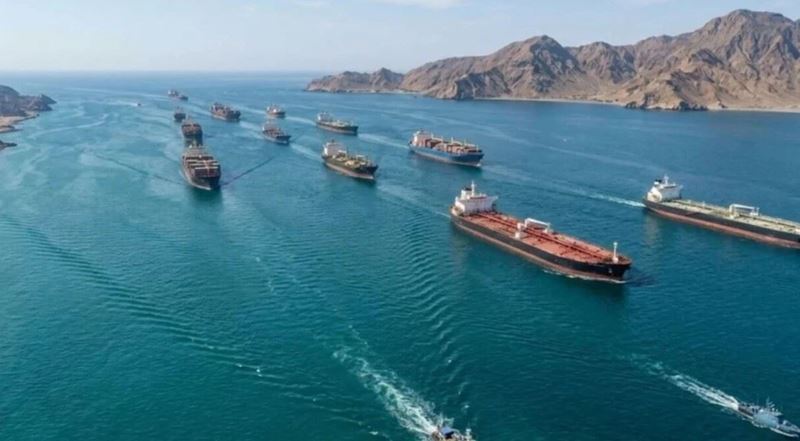
Brent crude oil futures rose 0.54% to $96.80 per barrel, while U.S. West Texas Intermediate (WTI) crude gained 0.72% to $92.14 per barrel.
The rally in oil prices also accelerated last week, with Brent gaining 7.8% and WTI rising nearly 10%. The resumption of attacks by the U.S. and Iran, coupled with reduced tanker traffic through the Strait of Hormuz, a key transit route for a significant share of global oil supplies, contributed to the price increases.
Tanker traffic declines in the Strait of Hormuz
U.S. Central Command said on Saturday that U.S. forces had struck three Iranian oil tankers. One of the tankers was reportedly targeted off Khark Island, one of Iran’s key oil export hubs.
The naval forces of Iran’s Islamic Revolutionary Guard Corps also said on the same day that they had targeted three oil tankers traveling along unauthorized routes in the Strait of Hormuz. The statement added that attacks had also been carried out against three U.S. vessels in different locations.
Maritime intelligence company Marisks described the developments as a significant escalation in the maritime conflict. The company noted that the use of commercial tankers as a tool of mutual economic pressure is increasingly blurring the distinction between military conflict and commercial maritime shipping.
According to data from Kpler, an average of just 10 commodity vessels per day passed through the Strait of Hormuz over the past 10 days. This marked the lowest level recorded since May.
According to reports carried by Iranian state media, Mohsen Rezaei, Secretary of Iran’s Supreme National Security Council, said on Sunday that a restricted zone would be established outside the Strait of Hormuz in the coming days.
OPEC+ maintains its production policy
The closely watched OPEC+ meeting resulted in a decision to leave the group’s existing production policy unchanged. Producers kept their October production policy unchanged, while stating that an agreement on quotas would be required before any new production measures could be introduced.
ANZ analysts said that a prolonged standoff involving controlled military interventions between the U.S. and Iran is currently the most likely scenario. According to the analysts, such a situation could delay the normalization of oil supplies from the Middle East.
ANZ expects exports to remain constrained for the rest of 2026, with a gradual recovery beginning toward the end of the fourth quarter. A full return to pre-war oil flow levels is considered unlikely before late Q1 or early Q2 2027.






Comments
No comment yet.