


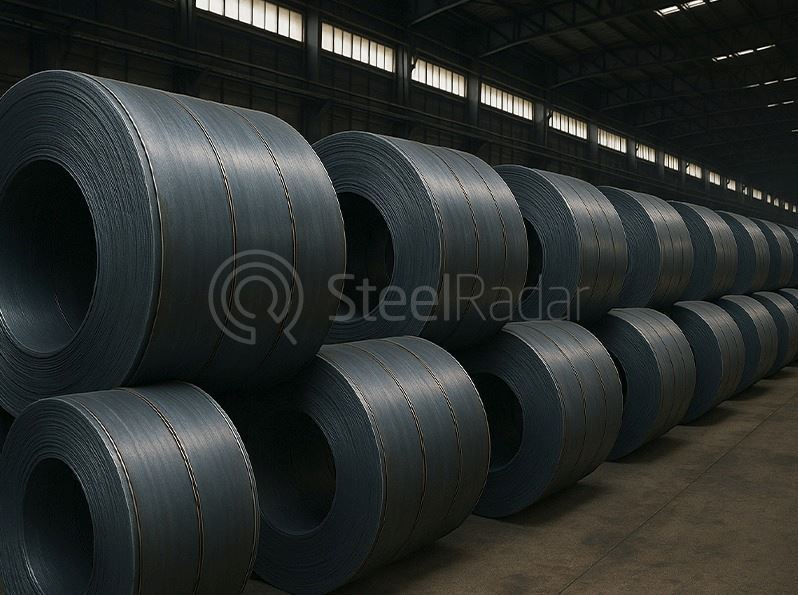
The move continues a pattern of incremental price increases implemented by Nucor over recent weeks. In early February 2026, the company’s CSP HRC base price stood at around $970/t, while CSI was offering material at $1,020/t. By late February, the price had climbed to $990/t for most mills and $1,040/t at CSI. The next step followed in early March when Nucor raised the base price to $1,005/t, accompanied by a $1,055/t level at CSI. The latest increase to $1,010/t therefore represents another deliberate step higher, reinforcing a gradual but persistent rally in the U.S. sheet steel market.
Although the most recent increase of $5/t appears modest, such incremental moves are strategically important in the steel industry. Rather than introducing large, sudden price hikes that could provoke resistance from buyers, mills often raise prices in small steps to steadily shift market expectations upward. In this case, Nucor’s pricing strategy signals confidence in the durability of current demand conditions while maintaining pressure on spot buyers to secure material before further increases occur.
Demand conditions in the United States are showing signs of improvement, particularly within the manufacturing sector. The ISM Manufacturing PMI for February 2026 came in at 52.4, marking the second consecutive month of expansion after a prolonged period of weaker activity. Subindices within the report point to strengthening industrial momentum, with new orders at 55.8, production at 53.5, and the backlog of orders rising sharply to 56.6. These indicators suggest that manufacturers are not only increasing output but are also building future work pipelines, a dynamic that typically supports stronger demand for flat steel products.
For steel producers, improving manufacturing activity translates directly into stronger consumption across key sectors such as machinery, fabricated metal products, electrical equipment, and transportation equipment. When order books expand and production lines run at higher utilization rates, manufacturers require larger volumes of steel inputs. Under such circumstances, mills gain greater confidence in their ability to push prices higher without risking significant demand destruction.
Nucor’s pricing decisions are also influenced by developments in the broader global steel market. Industry observers have noted that global steel supply has tightened compared with previous years, partly due to slower production growth in several major producing regions. At the same time, imports into the United States have been relatively limited, reducing competitive pressure on domestic producers. When import volumes decline or foreign offers become less attractive due to freight costs or trade barriers, U.S. mills are better positioned to defend higher price levels.
Regional supply dynamics further reinforce this trend, particularly on the West Coast. California Steel Industries, jointly owned by Nucor and Japan’s JFE Steel, consistently prices its hot-rolled coil above the company’s other mills. The West Coast market has fewer local flat-rolled producers than the Midwest, and logistical costs often limit the competitiveness of imported material. As a result, CSI has been able to maintain a premium of roughly $50/t over Nucor’s interior mills, a pattern that continues with the current $1,060/t CSP HRC base price.
From a market perspective, Nucor’s latest price increase places its published CSP level slightly above prevailing U.S. HRC spot benchmarks. In late February, industry price assessments generally placed U.S. hot-rolled coil values in the range of $975-990/t, meaning Nucor’s current $1,010/t base price sits at the upper edge of the market. This positioning is consistent with the company’s role as one of the leading price setters in the U.S. sheet steel industry. By publishing a higher base price, Nucor effectively attempts to pull broader market indexes upward.
Looking back to late 2025 highlights how rapidly the market has shifted. In December, U.S. HRC prices were generally reported in the $870-885/t range. The current price levels therefore represent an increase of more than $100/t within a single quarter, reflecting a combination of recovering demand, tighter supply conditions, and stronger pricing discipline among domestic mills.
For buyers such as service centers, manufacturers, and fabricators, the upward trend in sheet steel prices presents both opportunities and risks. Companies that purchased material earlier in the cycle at lower prices may benefit from improved margins as replacement costs rise. However, those needing to replenish inventory now face significantly higher input costs, forcing them to decide whether to build stocks in anticipation of further increases or maintain lean inventories in case the market stabilizes.
Lead times also provide important signals about market direction. Nucor’s indication of three to five week lead times suggests steady but not overheated demand. If lead times begin to extend further, it could indicate tightening supply and provide mills with additional leverage to push prices higher. Conversely, stable or shortening lead times could signal that the market is approaching a plateau.
Beyond immediate supply and demand dynamics, the steel market in 2026 is also shaped by broader macroeconomic and geopolitical uncertainties. Global economic fragmentation, shifting trade patterns, and ongoing geopolitical tensions have introduced new layers of volatility into commodity markets. These factors can influence steel prices indirectly by affecting energy costs, freight availability, currency movements, and industrial investment decisions.
For steel producers and buyers alike, this environment makes long-term planning more complex. Companies increasingly rely on flexible purchasing strategies, shorter contract durations, and index-linked pricing mechanisms to manage risk. While these approaches provide some protection against sudden price swings, they also make budgeting and cost forecasting more challenging.
Despite these uncertainties, current indicators suggest that the U.S. steel market remains on relatively firm footing. The expansion in manufacturing activity, combined with tighter import supply and disciplined pricing strategies among domestic mills, has supported the recent rally in sheet steel prices. In this context, Nucor’s decision to lift its CSP HRC base price to $1,010/t appears less like an isolated move and more like a continuation of a broader upward trend in the U.S. flat-rolled steel market.
Whether the market continues climbing from here will largely depend on the trajectory of U.S. manufacturing activity, the evolution of global trade flows, and the willingness of buyers to accept higher replacement costs. For now, however, the latest price increase underscores Nucor’s confidence in demand conditions and its continuing role in shaping steel price formation across the United States.



Comments
No comment yet.