


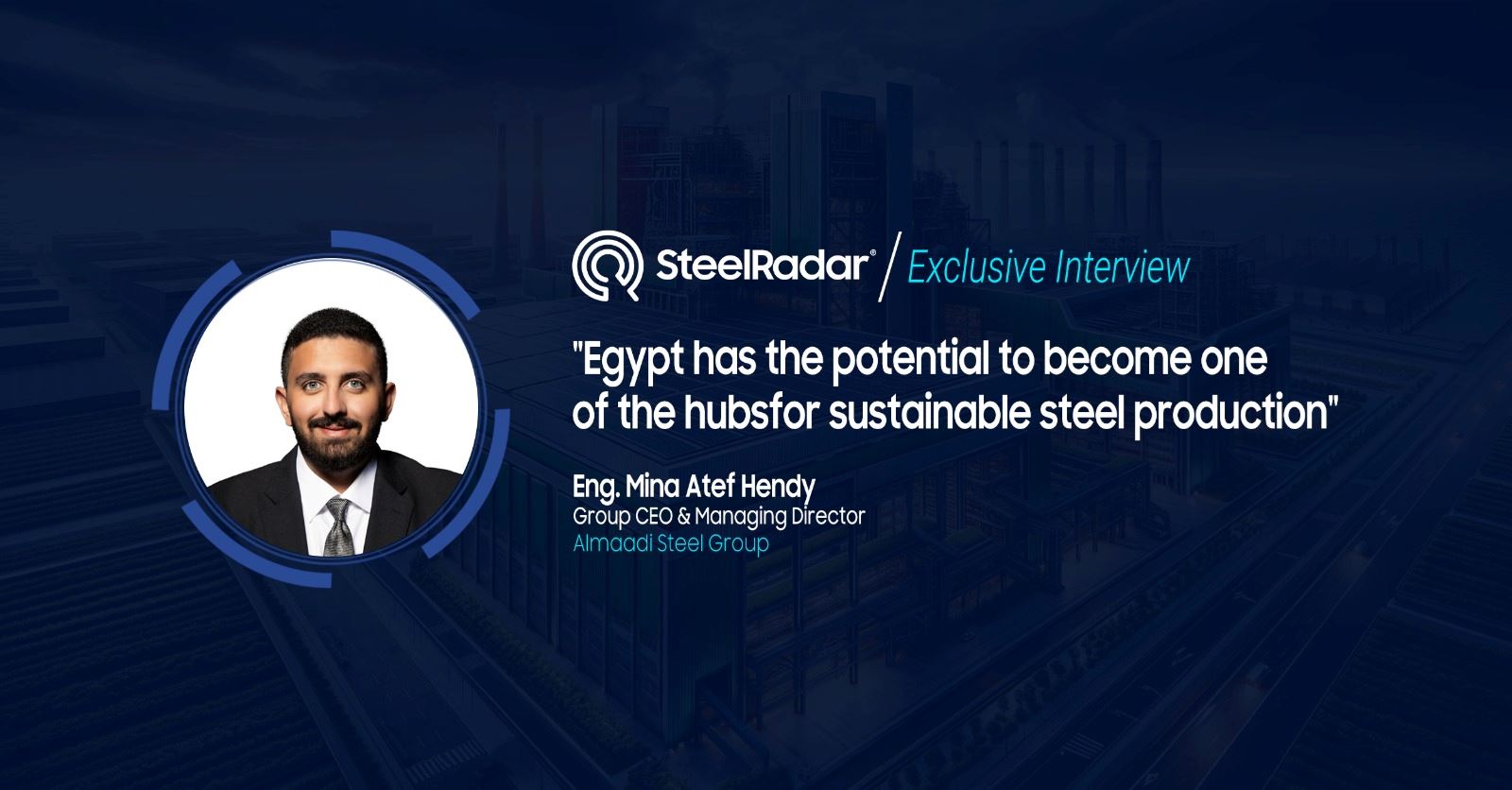
Almaadi Steel became a member of the World Steel Association (worldsteel) in April 2026. Evaluating this membership as a significant step for both the company and the stronger representation of the Egyptian steel industry on global platforms, Hendy answered SteelRadar's questions on various issues, including the green transition, CBAM, technological investments, and Türkiye-Egypt cooperation.
Almaadi Steel's admission to the World Steel Association (worldsteel) in April 2026 marked an important milestone for your company. How do you think this membership will benefit not only Almaadi Steel but also the Egyptian steel industry as a whole?
For us, joining the World Steel Association was never simply about obtaining membership in a prestigious organization. It represents our commitment to becoming an active contributor to the future of the global steel industry.
The steel sector is entering a transformative period, driven by decarbonization, digitalization, and changing industrial value chains. To successfully navigate this transition, steel companies must be connected to the global ecosystem of knowledge, innovation, and leadership.
Our worldsteel membership gives Almaadi Steel access to that ecosystem. More importantly, it provides an opportunity for Egypt to strengthen its voice within international steel discussions. We believe Egypt has all the ingredients necessary to become one of the leading industrial and steel production hubs across Africa and the Middle East.
At Almaadi Steel, we do not view ourselves only as steel producers. We see ourselves as contributors to industrial ecosystems, human capital, and cyclic economic development.
"Egyptian steel sector approaches a critical turning point"
In recent years, Egypt has been moving toward becoming a regional steel production hub through both capacity expansions and export growth. In your opinion, what will be the biggest opportunities and the most significant challenges for the Egyptian steel industry over the next five years?
I believe the Egyptian steel industry is approaching an inflection point.
Egypt possesses strategic advantages that very few countries can offer simultaneously: geographical location, access to regional markets, industrial capabilities, infrastructure investment momentum, and a growing manufacturing base.
However, the next phase of growth we believe cannot rely solely on expanding production capacity. The future belongs to industries that create value through technology, sustainability, efficiency, and talent development.
The greatest opportunity for Egypt is to become the industrial gateway connecting Africa, Europe, and the Middle East. The greatest challenge will be ensuring that our industry remains globally competitive while adapting to increasingly demanding environmental and economic requirements.
Those who invest today in technology, decarbonization, operational excellence, and people will define the future industrial leadership of our region.
“Our goal is to be part of the global solution for sustainable steel production"
The European Union's Carbon Border Adjustment Mechanism (CBAM) and the global transition toward green steel are reshaping investment strategies across the industry. How is Almaadi Steel preparing for this transition, and what investments has the company made or planned in this area?
We believe that decarbonization represents the greatest industrial transformation opportunity of our generation.
At Almaadi Steel, we have adopted a strategic approach based on four pillars: operational excellence, emissions transparency, circular economy principles, and technological modernization.
We are actively investing in measurement, reporting, and verification systems, process optimization, increased utilization of recycled materials and energy efficiency improvements aligning with international sustainability frameworks.
At the same time, we recognize that emerging economies require realistic and inclusive transition pathways. The global green transition cannot succeed if developing countries are excluded from the conversation.
Our objective is not to merely comply with future regulations but to become a part of the global solution for sustainable steel production.
Almaadi Steel is recognized for producing high-strength reinforcing steel with superior seismic performance. Do you plan to increase the share of value-added products in your overall production in the coming years? Are there any new product developments or investment plans on your agenda?
The future of steel manufacturing will not be defined by volume alone; it will be defined by value.
Our strategy focuses on increasing the share of high-performance steel products capable of meeting the evolving demands of infrastructure, construction, and industrial markets.
We have established a strong position in high-strength and seismic-grade reinforcement products, and we intend to further strengthen our capabilities through investments in technology for process optimization, and product innovation.
Ultimately, our objective is to position Almaadi Steel as a regional benchmark for quality, reliability and excellence.
China's steel exports, trade protection measures, and geopolitical developments continue to have a significant impact on the global steel market. In your view, which factors are likely to have the greatest influence on the global steel industry during the second half of 2026?
The global steel industry is no longer influenced solely by supply and demand fundamentals.
Today, industrial competitiveness is increasingly shaped by geopolitics, energy security, carbon regulation, supply chain resilience, and technological transformation.
China’s export strategy, international trade protection measures, energy markets, infrastructure spending, and sustainability regulations will all continue to influence global markets. However, I believe the defining factor will be the industry’s ability to balance economic competitiveness with environmental responsibility.
The steel companies that successfully integrate sustainability, efficiency, and innovation into their core business models will become the leaders of the next industrial era.
“Cooperation between Turkey and Egypt offers promising industrial opportunities”
How do you assess the trade relations between Türkiye and Egypt, particularly in the steel industry? Looking ahead, what potential do you see for increased trade, investment, or joint projects between the two countries?
I believe that cooperation between Türkiye and Egypt represents one of the most promising industrial opportunities in our region.
Both countries possess strong manufacturing capabilities, strategic geographic advantages, skilled workforces, and extensive regional market access. Rather than viewing one another solely through a competitive lens, there is significant potential for strategic partnerships.
By strengthening industrial cooperation, Türkiye and Egypt can contribute to building a globally competitive steel ecosystem connecting Europe, Africa, and the Middle East.
“We maintain investments targeting an annual crude steel capacity of nearly 500,000 tonnes”
In recent years, Almaadi Steel has played an important role in supplying major infrastructure and housing projects in the domestic market. In response to growing demand, are you planning any capacity expansions, new production facilities, or modernization investments?
Our vision extends far beyond becoming a larger steel producer. We aspire to build one of the most respected, technologically advanced, and sustainable steel companies in the Middle East and Africa.
This vision also inspired our initiative, “Generations of Steel,” which aims to bridge industry, academia, and future talent development.
I firmly believe that the future leaders of the steel industry will not be defined merely by their production capacity. They will be defined by their ability to innovate, collaborate, educate, and lead industrial transformation responsibly.
Furthermore, as part of our long-term strategic vision, Almaadi Steel is actively pursuing investments to expand its crude steel production capabilities, with the objective of reaching an annual production capacity of approximately 500,000 tonnes per year. This strategic investment represents a major step toward strengthening our vertical integration.
Our ambition is to build a globally competitive steel platform capable of serving the growing needs of Egypt, Africa, the Middle East, and international markets. We believe that investments in crude steel production, technological modernization, and human capital development will play a critical role in positioning Egypt as a leading industrial and sustainable steel hub in the decades ahead.
Our ambition is not simply to expand steel production capacity. Our ambition is to help position Egypt as a main industrial and sustainable steel hub, while developing the next generation of steel industry leaders. We believe that the future of steel will be built not only through investment in plants and technologies, but through investment in people, partnerships, and purpose.




Comments
No comment yet.