


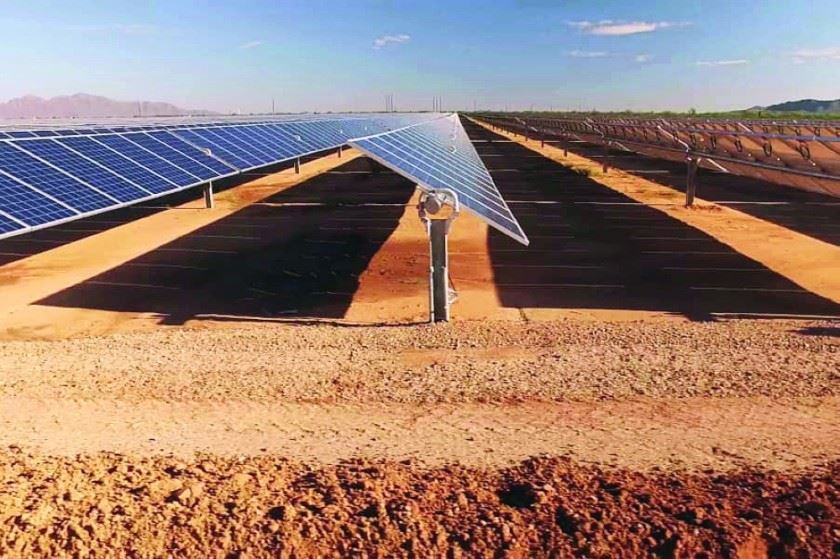
Renewable energy capacity in the Middle East has witnessed a remarkable surge, more than doubling over the past decade.
Despite this remarkable progress, a new report reveals that the region continues to fall behind global advancements in renewable energy adoption. According to the International Renewable Energy Agency (Irena), the Middle East’s capacity soared from just under 16 gigawatts (GW) to over 35 GW between 2014 and 2023. This significant leap reflects the region’s commitment to cleaner energy sources, with solar leading the charge. The United Arab Emirates (UAE) and Iran have been at the forefront of this transformation.
The UAE’s renewable energy capacity skyrocketed from a modest 133 megawatts (MW) in 2014 to an impressive 6 GW last year. The Shams Solar Power Station in Abu Dhabi stands as a testament to the nation’s solar ambitions.
While Iran boasts the largest capacity in the region, its growth has been relatively gradual, adding less than 2 GW during the review period.
Yet, despite these gains, the Middle East’s share of global capacity remains meager. It accounts for less than 1 percent of the world’s total renewable capacity. Only the Central America and Caribbean region lags behind, emphasizing the need for accelerated progress.
Asia, with over half of global renewables capacity, generates nearly 2,000 GW. Europe and North America follow with 787 GW and 530 GW, respectively. Asia’s recent surge added 328 GW in 2023, primarily driven by China.
The Middle East’s renewable share of total electricity capacity has risen from 5.9 percent to just below 10 percent over the decade. Saudi Arabia, Jordan, and Israel have also witnessed accelerated growth. However, Iraq’s capacity declined, and Bahrain and Kuwait lag behind, contributing less than 200 MW combined last year.



Comments
No comment yet.