


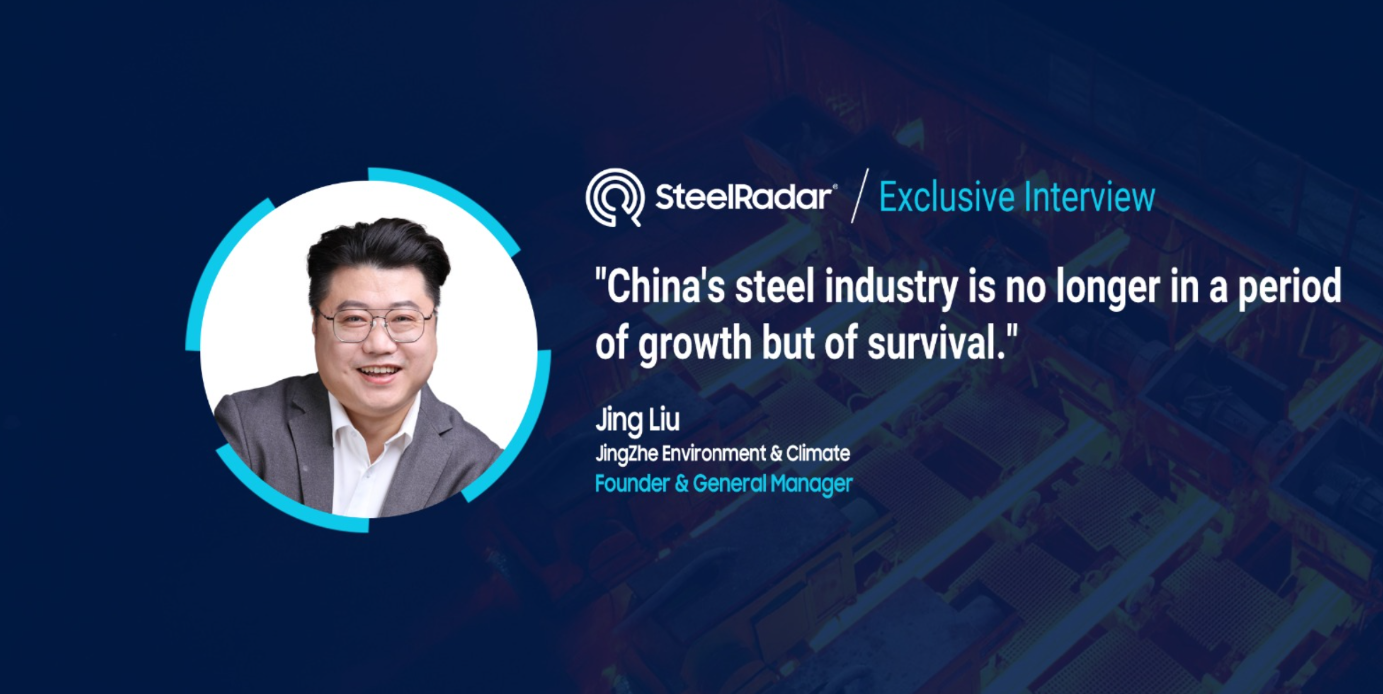
Liu emphasized that Chinese producers can no longer compete in international markets solely through price advantages and stated that export strategies need to be reshaped around risk management, regulatory compliance and supply chain transparency. Liu answered SteelRadar's questions on a wide range of topics, from the current outlook for China's steel market and the impact of CBAM to global trade tensions and expectations for 2027.
What do you see as the most important development in China's steel market in 2026? How do you assess the impact of weak domestic demand, export pressure and excess capacity on the overall performance of the industry?
In my view, the most important change in China's steel market in 2026 is that the industry has shifted from a growth driven model to one focused on survival and redistribution. Weak domestic demand remains the primary source of pressure on the industry. The real estate sector has not returned to its role as the main driver of steel consumption, while demand from infrastructure and manufacturing is still insufficient to fully offset this structural decline. As a result, many steel producers continue to face low profit margins, inventory risks and unstable order volumes.
Exports have therefore become an important channel for reducing pressure on China's steel industry. However, increasing exports do not mean the industry is healthy. In many cases, exports are driven by the need to absorb excess supply in the domestic market rather than generate higher profitability. This creates a challenging situation. Although Chinese steel still has significant advantages in terms of price and production capacity, overseas markets are becoming increasingly less tolerant of high volume, low priced steel products.
Excess capacity remains the core issue. Even though China continues to keep crude steel production under control, its existing production capacity remains extremely high. As a result, market differentiation is accelerating. Large integrated steel producers with strong product quality, diversified customer portfolios, export experience and regulatory compliance capabilities remain in a more advantageous position. In contrast, smaller producers and trading companies that rely on low value added production and compete solely on price will face much greater pressure.
For this reason, I describe 2026 as a year characterized by structural pressure rather than a simple industry slowdown. China's steel industry is not collapsing. However, the traditional growth model based on economies of scale, domestic construction demand and export volumes is becoming increasingly unsustainable.
"The cost of China's access to international markets will continue to increase"
Many countries have recently introduced anti dumping measures and stricter trade policies against Chinese steel products. How do you think these developments will affect the export strategies of Chinese steel producers and global trade flows?
Increasing anti dumping measures and stricter trade policies will force Chinese steel producers to adjust their export strategies. In the past, many companies were able to enter overseas markets with relative ease thanks to cost advantages, high production capacity and flexible trading networks. However, this model is becoming much more difficult.
First, China's steel exports will become more fragmented. Some exporters may shift from direct exports to processing in third countries, regional distribution hubs or more complex supply chain models. However, this will not fully solve the problem. Trade authorities in many countries are now paying much closer attention to product origin, attempts to circumvent trade measures, melt and pour rules and supply chain traceability.
Second, product structure will become increasingly important. Low value added and standardized steel products will face stronger trade barriers. In contrast, high value added, customized products designed for stable industrial customers may find greater opportunities. However, this also requires strong technical support, quality control and regulatory compliance capabilities.
Third, the role of steel traders will change. Traditional trading companies that simply connect buyers and sellers will become less valuable. Importers will need partners that can explain production methods, verify product origin, manage the required documentation and reduce regulatory risks. From the CBAM perspective in particular, traditional steel traders are in a highly vulnerable position.
In terms of global trade flows, I expect competition to intensify further across Asia, the Middle East, North Africa and Latin America. Some Chinese steel products that can no longer enter Europe and North America as easily as before will seek new markets. However, these regions are also becoming increasingly protectionist. Although Chinese steel exports will remain important, the cost of accessing international markets will continue to increase.
"Chinese steel companies are not yet fully prepared for CBAM"
What does the European Union's Carbon Border Adjustment Mechanism (CBAM) and increasingly stringent sustainability regulations mean for Chinese steel producers? Do you think Chinese companies are sufficiently prepared for this new regulatory environment?
CBAM means that carbon data has become an integral part of international steel trade. Carbon is no longer just an environmental issue. It has become a commercial document, a purchasing criterion and, in some cases, one of the key factors determining whether a supplier can continue selling to European customers.
For Chinese steel producers, CBAM requires much more than simply completing a form. Companies must be able to disclose their production processes, energy consumption, raw material inputs, precursor emissions, electricity data, allocation methodologies and the evidence supporting them. More importantly, this data must be consistent with actual production conditions and capable of successfully passing verification procedures. In other words, CBAM is becoming a new entry ticket to the European market.
To be frank, I don't believe Chinese steel companies are fully prepared for this process. Some large steel groups and export oriented producers have started to understand CBAM and are working with international certification bodies on carbon data calculations and pre verification procedures. However, much of this work is still being carried out simply to satisfy customer requirements. Many companies have not yet systematically evaluated their data infrastructure, production boundaries, data scope or evidence chain.
For this reason, I don't assume these companies will pass official verification processes smoothly once the requirements become more stringent. Many companies are not yet genuinely ready to obtain this new entry ticket. Even more concerning is that the impact will not be limited to China. Downstream industrial companies and steel traders operating in countries such as Türkiye and Egypt, which maintain close steel trade relations with Europe, could also face significant losses.
Geopolitical developments, trade tensions and global uncertainties have had a significant impact on the steel industry. How do you think these developments will shape China's steel exports and the competitive landscape in Asia?
Geopolitical developments and trade tensions will make the export environment for Chinese steel more complex and less predictable. The issue is no longer just about price. Trade defence measures, carbon regulations, supply chain security, industrial policies and political trust are all becoming decisive factors at the same time.
For China, this means more difficult access to some markets and more intense competition in others. As Europe, the United States and other regions adopt stricter measures, a larger share of Chinese steel exports may be redirected to Asia, the Middle East, Africa and Latin America. However, these regions also have their own domestic steel industries and political pressures. As a result, trade disputes are likely to continue spreading.
Competition in Asia will become more intense. Although Chinese steel will maintain its advantages in terms of cost and supply, other countries will compete through better market access, stronger regional relationships, lower regulatory risks and, in some cases, greater acceptance by Western buyers. India, Vietnam, South Korea, Japan, Türkiye and several ASEAN producers will assume different roles as trade flows continue to evolve. In the future, competitiveness will no longer depend solely on production costs. A supplier's ability to ensure stable deliveries, clearly demonstrate product origin, provide reliable carbon data and reduce regulatory risks for buyers will also become decisive.
For Chinese exporters, this represents both pressure and opportunity. Companies that compete solely on low prices will face increasing restrictions and may eventually be forced to exit the market. In contrast, companies that combine manufacturing capability with technical services, regulatory compliance and supply chain transparency will continue to find strong opportunities in international markets.
"Chinese steel producers need to shift from volume driven exports to risk driven exports"
Looking ahead to 2027, what do you see as the most important changes shaping China's steel industry? Among production policy, export strategy and the green transition, which factors will determine international competitiveness?
As we move toward 2027, I believe three major changes will shape China's steel industry.
The first is production discipline. China will need to balance production controls with employment, local economic interests and the profitability of steel producers. If domestic demand remains weak, simply reducing output will not solve the industry's structural problems. The sector requires deeper structural transformation through capacity optimization, product upgrading and industry consolidation.
The second is the transformation of exports. Although exports will remain important, the traditional export model will face increasing challenges. Chinese steel producers need to shift from volume driven exports to risk driven exports. This means more selective customer targeting, stronger document management, greater transparency in origin traceability and closer cooperation with overseas importers that place greater emphasis on regulatory compliance.
The third is the green transition, which is accelerating under the influence of CBAM and similar regulations. For many companies, the green transition is no longer just a long term policy objective but a direct requirement for market access. Low carbon production methods, scrap management, electricity sources, the quality of emissions data and readiness for verification will all have a direct impact on competitiveness.
By 2027, I believe European buyers will become far more selective. They will no longer evaluate suppliers based only on price and quality. They will also assess whether suppliers can provide reliable CBAM data and reduce the risks associated with default emission values. This will create new opportunities for well prepared Chinese steel companies while placing significant pressure on smaller suppliers, downstream processing companies and traditional steel traders. In my view, the key factor determining future international competitiveness will be a company's ability to combine industrial reality with regulatory compliance.
Steel companies will no longer need only to produce steel efficiently. They will also need to demonstrate how the steel was produced, where the raw materials came from, how emissions were calculated and whether the data provided is reliable enough to successfully pass verification procedures.




Comments
No comment yet.