


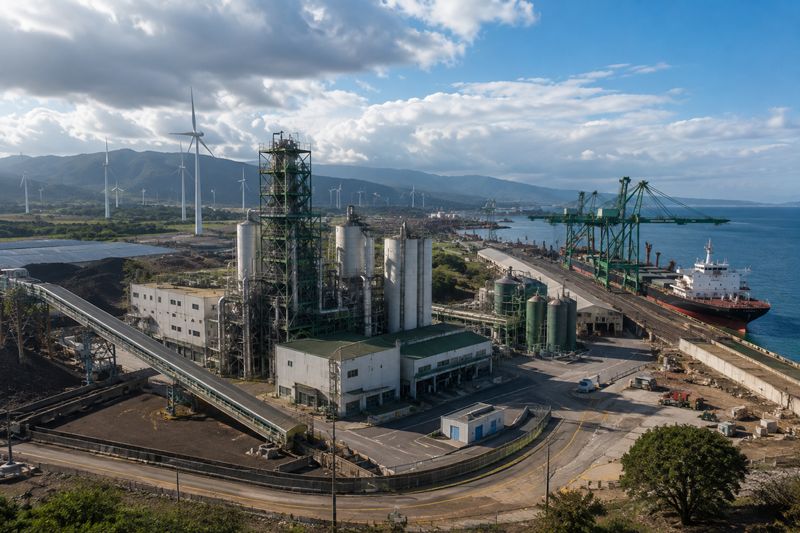
The Institute for Energy Economics and Financial Analysis (IEEFA) Australia has published new research examining the scale of investment Australia will need to build a green iron export industry by benefiting from the global transition toward low carbon steel production.
According to the study titled "Scale of investment needed for Australia's green iron ambition," the annual investment required to replace Australia's metallurgical coal exports with an equivalent amount of green iron is expected to reach AUD 170 billion. The report noted that this level of investment would be close to the peak of the mining investment boom experienced in the 2000s.
Based on estimates from the federal government, Australia's annual revenue from green iron exports could reach AUD 96 billion by 2040. However, reaching this level will require large scale and continuous investment over the next 14 years.
Lachlan Wright, IEEFA Global Steel Energy Finance Analyst and author of the study, stated that green iron production is a capital intensive activity. Wright noted that each production facility will require iron production furnaces as well as electrolyzers, while solar and wind power, battery storage and transmission infrastructure will also need to be developed to meet the clean electricity requirements.
In addition, investment in rail and port infrastructure will be required to transport iron ore to the facilities and export the green iron produced. According to the research, the scale of investment required means that infrastructure development in mining, logistics and clean electricity supply will need to be coordinated.
AUD 7-10 billion investment required for 1 million tons of capacity
According to IEEFA's calculations, the capital cost of establishing 1 million tons of green iron production capacity in Australia at current prices is between AUD 7 billion and AUD 10 billion. This amount covers iron production facilities, electrolyzers, solar and wind power capacity and battery investments.
Renewable energy investments are estimated to account for approximately half of the total capital expenditure required for a green iron project in Australia.
The report highlighted that even South Australia, one of the country's leading regions for renewable energy, would need to more than double its large scale solar and battery capacity to meet the energy requirements of the Whyalla green iron project.
270 million tons of green iron against 150 million tons of metallurgical coal exports
Australia currently exports approximately 150 million tons of metallurgical coal annually. According to IEEFA's calculations, this corresponds to approximately 270 million tons of green iron. The calculation assumes that approximately 0.55 tons of metallurgical coal are used to produce one ton of iron.
The federal government's projection of AUD 96 billion in annual green iron export revenue by 2040, included in its Green Iron Investment Fund announcement, is also based on replacing metallurgical coal exports with an equivalent volume of green iron exports.
The research indicated that demand for green iron is increasing as the global steel industry decarbonizes, while exports of coal and natural gas, among Australia's major export commodities, are expected to decline over the same period.
According to IEEFA, green iron exports could not only contribute to reducing global emissions but also create an alternative export sector for Australia against potential future declines in traditional fossil fuel exports.
Green iron is not yet cost competitive
The research stated that although green iron can command a price premium in the market, it is not yet cost competitive due to its energy intensive production process.
IEEFA noted that emerging demand for green iron among trading partners and carbon pricing mechanisms are unlikely to provide a sufficiently strong and sustainable price signal in the short term to stimulate the investment required.
Therefore, public policies will need to be introduced to attract the large scale private capital required by the sector.
IEEFA recommends adapting renewable energy policies to green iron
IEEFA stated that Australia could benefit from support models previously applied in the renewable energy sector. Wright said mechanisms such as renewable portfolio standards, contracts for difference and feed in tariffs, which are used to create price premiums for renewable energy investments, could be adapted to the green iron sector.
Wright stated that Australia needs a policy capable of creating a price premium for green iron exports, adding that the mechanism should be implemented at a scale that provides long term investment certainty and be backed by financing guarantees.
IEEFA stated that without support mechanisms offering sufficient scale and financing certainty, it will be difficult for Australia to attract the large amount of capital required to achieve its green iron targets.



Comments
No comment yet.