


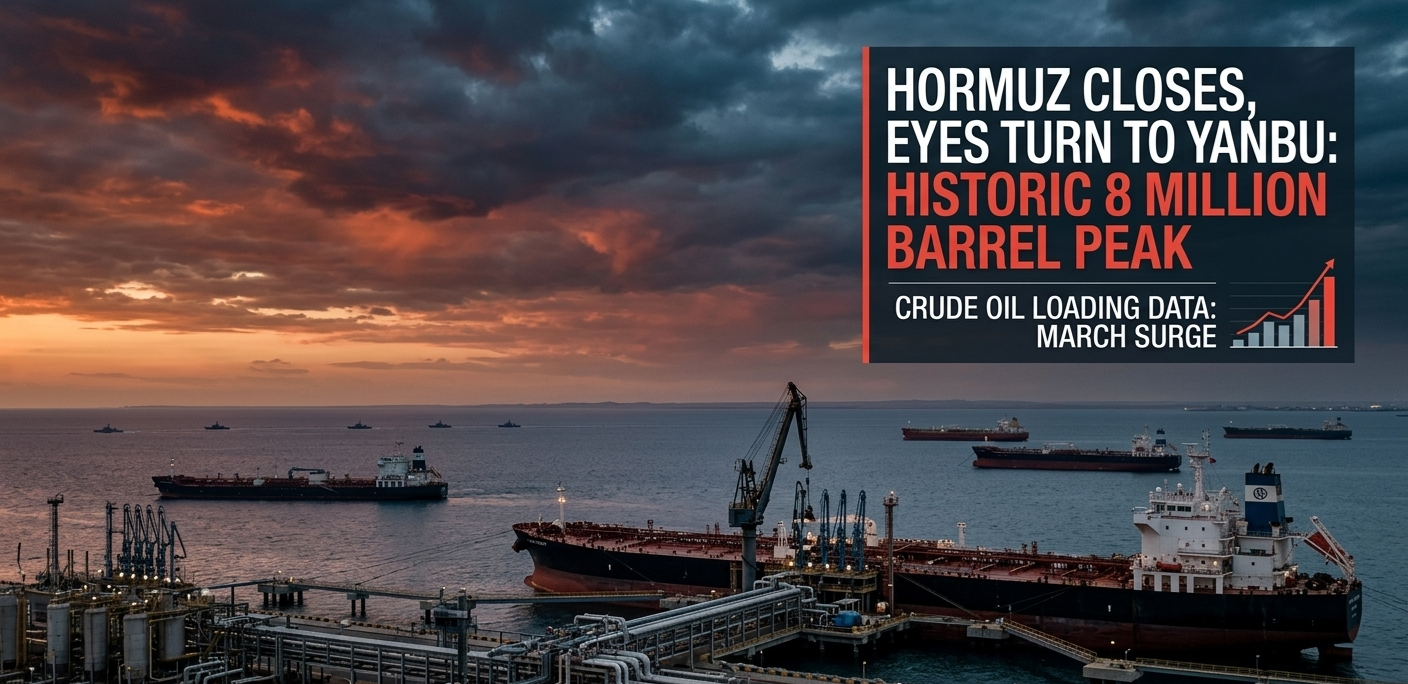
The escalation of Middle East tensions into active conflict is reshaping global energy logistics. Recent data from S&P Global Platts and Commodities at Sea confirms that Saudi Arabia’s "Plan B" the Port of Yanbu has now effectively become its primary export hub.
Loadings at Yanbu, which fluctuated between 2-4 million barrels daily in late February, entered an aggressive upward trend starting in mid-March. Notably, shipments gained significant momentum after March 20, testing a historical peak of over 8 million barrels around March 25. This serves as the most concrete evidence that Saudi Arabia has shifted its entire export volume to the Red Sea route following the closure of the Strait of Hormuz.
The surge from a baseline of roughly 100,000 barrels per day to millions in March is a direct consequence of geopolitical necessity. Security risks in the Strait of Hormuz have forced the Saudi administration to rely on this strategic point on the Red Sea coast as its primary "exit gate." However, this shift brings its own set of risks.The war risk insurance premiums have risen up to 3% of the cargo value, while additional charges of $1,500 to $4,000 per container have started to be applied.
The flow of Saudi exports through Yanbu means this massive volume must now pass through the Bab al-Mandab Strait. Given the Houthi presence in the Red Sea and the recent uptick in vessel attacks, energy markets are left with a critical question: Will the oil that escaped Hormuz now get caught in the Bab al-Mandab pincer?
It is not just crude oil at stake; the lack of recorded jet fuel and diesel imports since the onset of the conflict highlights the depth of the regional logistical paralysis. If safe passage through the Bab al-Mandab cannot be guaranteed, a global supply chain crisis extending from LNG to agricultural commodities will be inevitable. While Yanbu currently acts as a "lifeline" for the Saudi economy, the increasing militarization of the Red Sea suggests this lifeline remains extremely fragile.




Comments
No comment yet.