


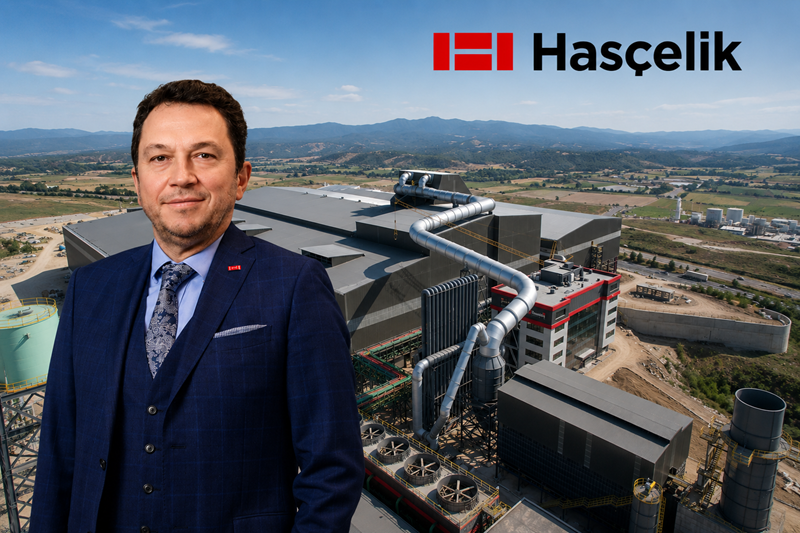
Hasçelik has published its 2025 Sustainability Report covering its environmental, social, and governance activities. Prepared in accordance with the GRI Standards, the report addresses the company’s sustainability approach, production activities, energy and emissions performance, resource management, employee-related practices, and sustainability targets.
Osmaneli Steel Mill commissioned in 2025
One of Hasçelik’s prominent investments in 2025 was the Osmaneli Steel Mill. Commissioned in 2025 with an investment of approximately EUR 150 million, the facility was highlighted in the report as one of the key transformation steps supporting the company’s low-carbon production approach.
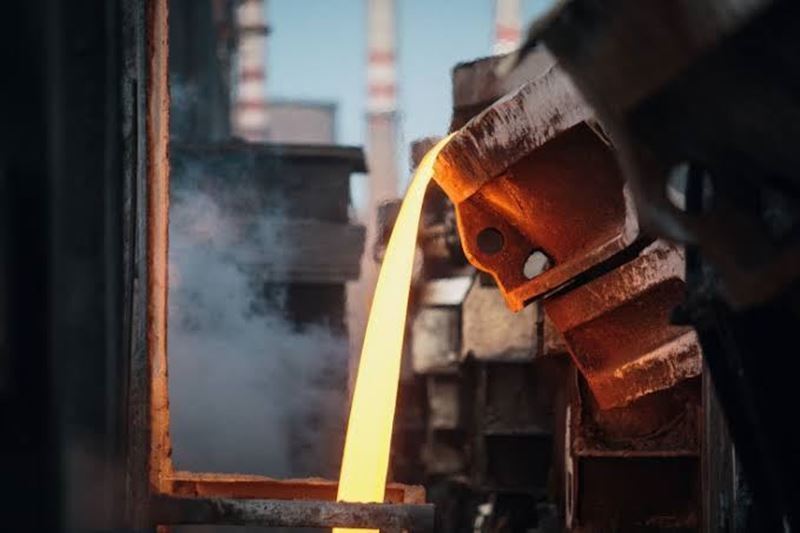
The facility uses an Electric Arc Furnace (EAF), a Consteel continuous charging system, and energy-efficiency-focused technologies. The reuse of waste hot air in the scrap preheating process is intended to optimize energy consumption.
163,957 tons produced at Osmaneli facility
According to the report, 163,957 tons of finished products were produced at the Osmaneli Steel Mill in 2025.
At Hasçelik’s other production facilities, approximately 190,000 tons were produced at Hasçelik 1 and approximately 86,000 tons at Hasçelik 2 in 2025.
85% emissions reduction target for 2030
As part of its sustainability targets, Hasçelik aims to reduce its Scope 1 and Scope 2 emissions by 85% by 2030 compared with the 2024 baseline year. The company also aims to achieve net-zero emissions by 2050 at the latest.
The report also includes a commitment to increase energy efficiency at production facilities by 30% by 2030.
The company’s 2026 targets include sourcing 35% of its electricity from solar power plants (SPP) and reducing electricity consumption per ton by 35%.
35 MW SPP investment
Hasçelik continues its Solar Power Plant (SPP) investments as part of its energy transition. The report includes a 35 MW SPP investment, noting that these investments are aimed at reducing energy costs and carbon emissions.
The company also continues to improve its energy performance in line with the ISO 50001 Energy Management System approach and to plan its new investments with a focus on energy efficiency.
Improvement in emissions performance in 2025
The report states that a decline was recorded in Scope 3 emissions in 2025 as a result of emissions reduction efforts, efficiency practices in production processes, and operational improvements.
Scope 3 emissions at Hasçelik 1 were approximately 196,000 tCO₂e in 2025, while Scope 3 emissions at Hasçelik 2 were approximately 85,000 tCO₂e. The report stated that Scope 1 and Scope 2 emissions also changed depending on developments in operational activities, and that an overall improvement in emissions performance was achieved compared with 2024.
Decline recorded in sales volumes
According to Hasçelik’s sales data for the 2021-2025 period, the company’s domestic market sales stood at 324,278 tons in 2021, 303,901 tons in 2022, 311,375 tons in 2023, and 274,367 tons in 2024. Domestic market sales declined to 259,887 tons in 2025.
Export sales also declined during the period in question. Export sales, which stood at 71,885 tons in 2021, reached their highest level of the period at 81,286 tons in 2022. Export sales then declined to 61,498 tons in 2023, 54,376 tons in 2024, and 45,539 tons in 2025.
Accordingly, Hasçelik’s total domestic market and export sales amounted to 305,426 tons in 2025.
Faydasıçok: We see sustainability as a fundamental element of our responsibility
Hasçelik Chairman of the Board Adnan Naci Faydasıçok stated that they see sustainability as one of the fundamental elements of their responsibility toward future generations, and noted that they continue their investments in low-carbon production, energy efficiency, resource management, and digital transformation. Faydasıçok stated that the next-generation steel mill investment completed in Bilecik represents a strategic transformation step supporting a low-emission production approach.



Comments
No comment yet.