


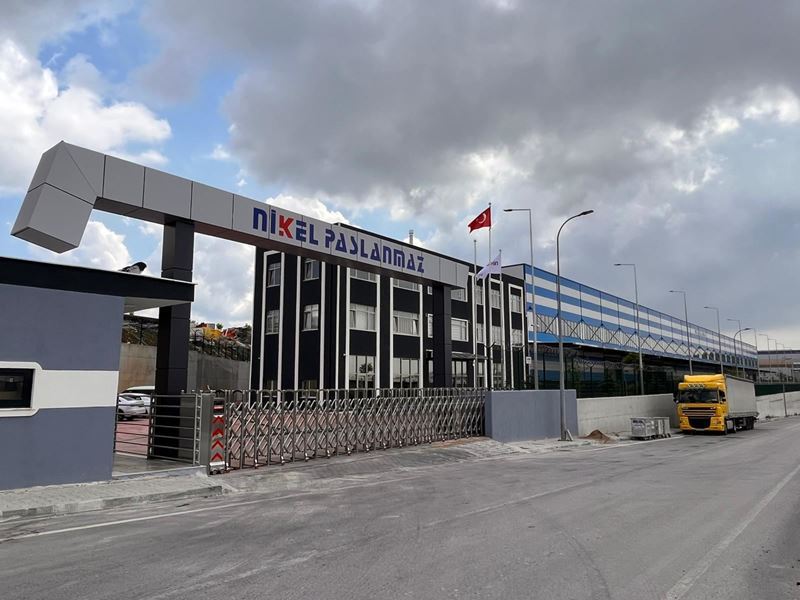
Nikel Paslanmaz is preparing to increase its production capacity through three major investments exceeding a total of USD 150 million. The company states that these investments aim to strengthen Türkiye’s domestic production capabilities while expanding its international service network.
Board Member Kemal Yalgın announced that despite challenging economic conditions, the company is targeting 30% growth in 2026. He noted that customs duties and anti-dumping measures in the stainless steel sector have increased costs, with a 12% import duty on raw materials creating a significant burden. Yalgın emphasized that integrated stainless steel production in Türkiye has now become a strategic necessity.
Highlighting that Türkiye ranks as the 9th largest consumer of stainless steel globally, Yalgın stated that if annual imports, currently around 700,000 tons, reach 1 million tons, establishing an integrated stainless steel production facility would become economically viable.
Operating with two plants in Dilovası (Kocaeli) and Sivas, Nikel Paslanmaz Çelik is the second-largest stainless steel service center and exporter in Türkiye. With its new investments, the company aims to expand both its production capacity and its global footprint.
The company reported approximately $200 million in consolidated revenue and USD 70 million in exports in 2025, with a 30% growth target set for 2026.
Investment Plans in Türkiye
As part of its investment program, a fully integrated stainless steel bar production facility will be established in Ferizli, Sakarya, with an investment of approximately USD 100 million. The plant will cover all processes from melting and casting to hot and cold processing and surface treatment, and is scheduled to become operational by the end of 2028.
In Dilovası, Kocaeli, a flat stainless steel cold rolling mill with an annual capacity of 40,000–50,000 tons will be built with an investment of approximately USD 50 million. This facility is expected to start operations by the end of 2027.
International Investments and Markets
Abroad, a stainless steel service center with a capacity of 50,000 tons will be established in the Manchester/Burnley region of the United Kingdom with an investment of approximately USD 4 million. The company also operates through warehouses and sales networks in London, Baku, Almaty, and Skopje, and plans to expand its service center investments in these regions.
The company stated that it has significantly reduced imports in stainless steel pipe and profile production, preventing approximately $60 million worth of imports, while directing surplus production toward exports.
Exports are currently driven by the Balkans, North Africa, and South America, while the European market has contracted due to quotas and tariffs, reducing its share in exports from 80% to around 20%.
The United States, Brazil, and West Africa have been identified as new target markets, with a particular focus on increasing exports to the Americas.
Sector Outlook and Financing
Kemal Yalgın noted that Türkiye imports approximately 700,000 tons of stainless steel annually, and that reaching 1 million tons would make integrated production investments economically feasible. He emphasized that stainless steel is not yet produced in an integrated manner in Türkiye, making such investments critical for the sector.
He also pointed out that difficulties in accessing financing, high borrowing costs, and rising labor expenses are putting pressure on the industry. Labor costs have increased by approximately 40% in dollar terms. While there have been cost increases in freight and raw materials, he added that there has been no significant disruption in the supply chain.




Comments
No comment yet.