


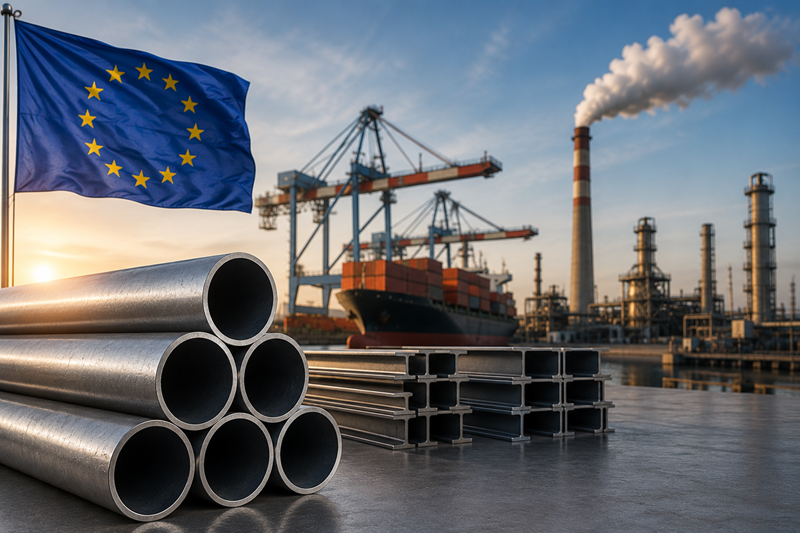
UNESID recalled that large-diameter steel pipes have been declared as "steel structures" in some EU member states. However, under the European Union's Binding Tariff Information (EBTI) decision, which has been in force since August 2025, these products should be classified as "large-diameter welded steel pipes." The association also noted that similar classification issues had previously been identified for steel pipes used in solar tracking systems and that it had already raised its concerns with the relevant authorities.
Incorrect classification may significantly increase CBAM liabilities
According to UNESID, correct customs classification is not only a legal requirement but also essential for ensuring the proper functioning of the EU internal market, maintaining legal certainty, and preserving fair competition among importers. The association therefore stressed that customs rules must be applied consistently across all EU member states.
The statement noted that the economic impact of incorrect classification has become even more significant with the implementation of CBAM. Based on the European Commission's default emission values, the emission intensity assigned to "steel structures" is considerably higher than that of certain steel pipe products.
UNESID stated that the default emission values for steel structures originating from China or Türkiye are approximately 4 mt of CO₂ higher than those for steel pipes imported from the same countries. Assuming a carbon price of EUR 80/mt of CO₂, the association estimated that an incorrect tariff classification alone could increase CBAM costs by approximately EUR 300/mt.
Verified emissions data still presents major challenges
The association pointed out that although the CBAM legislation allows the use of verified emissions data instead of default values, significant practical challenges remain.
According to UNESID, the European authorities have not yet finalized the accreditation system required to verify 2026 emissions. In addition, steel pipe manufacturers are required not only to verify emissions from their own production processes but also to obtain verified emissions data for the steel used as raw material, making the process considerably more complex.
UNESID: Rules must be applied consistently across all EU member states
UNESID's Economic Director, Alfonso Hidalgo de Calcerrada, stated that correct product classification is a fundamental requirement for the uniform application of European legislation. He added that, with CBAM entering into force, the consistent application of the EU's tariff classification criteria across all member states would strengthen legal certainty and ensure a level playing field.
Steel structures under EU trade defense review
UNESID also announced that the European Commission is considering extending trade defense measures to additional processed steel products under the European Steel Instrument.
Among the products under review are steel structures classified under customs code NC 73089098. According to Eurostat COMEXT data, EU imports of these products reached approximately 1.6 million mt in 2025, representing a 2.5-fold increase compared to 2019 and nearly double the volume recorded in 2021.
UNESID emphasized that this rapid increase in imports further highlights the importance of correct customs classification and the consistent application of legislation across all EU member states.
The association stated that it will continue cooperating with the Spanish authorities and EU institutions to support the proper implementation of the existing legislation and safeguard fair competition in the European steel market.
UNESID also clarified that the estimated additional CBAM cost of approximately EUR 300/mt is provided for illustrative purposes only. The calculation is based on the European Commission's default CBAM emission values and an assumed carbon price of EUR 80/mt of CO₂, while the actual cost will depend on the product's verified emissions data and the prevailing carbon price at the time of import.





Comments
No comment yet.