


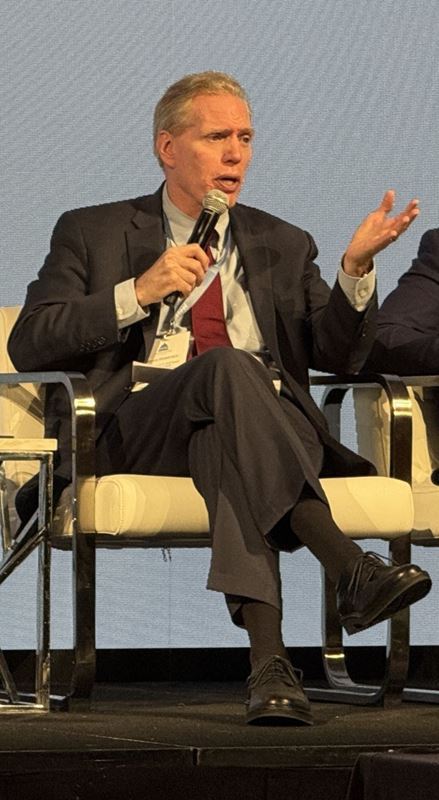
AISI President and CEO Kevin Dempsey stated that global overcapacity in the steel industry is not a myth, but a well documented issue that has been repeatedly confirmed by data from the Organisation for Economic Co operation and Development (OECD).
Dempsey said the OECD's latest analysis projects that global excess steelmaking capacity will increase from 640 million tons in 2025 to 745 million tons by 2028, adding that this trend continues to pose a serious threat to the US steel industry.
"China is one of the main sources of global overcapacity"
According to AISI, China remains one of the primary sources of global excess steelmaking capacity, while several other countries also contribute to the problem. The institute stated that China's steelmaking capacity in 2025 accounts for approximately half of global capacity and is more than double the combined steelmaking capacity of Brazil, Canada, the European Union, Mexico, Japan, and the United States.
AISI also pointed out that despite China's domestic steel demand declining for several years, the country's steel exports accelerated to 131 million tons in 2025, a volume roughly equal to total steel consumption in North America.
OECD: Chinese steelmakers receive 15 times more subsidies than the global average
Dempsey argued that the excess capacity created by China's heavily subsidized steel industry cannot be resolved simply by increasing domestic demand. Citing OECD data, AISI stated that in 2024 Chinese steel producers received government support equivalent to 15 times that of steelmakers in the rest of the world relative to company assets.
The institute added that the level of subsidies provided to China's steel sector has nearly doubled since 2019, encouraging both excess production capacity and the rapid increase in steel exports.
"State intervention is at the core of the problem"
AISI stated that the fundamental problem within China's steel industry is extensive state intervention, arguing that government subsidies and non market policies are the root cause of the issue. Dempsey said the Chinese Ministry of Commerce's report frequently references five year development plans and government directives guiding the industry, demonstrating that little room is left for market forces.
According to AISI, China's steel policies are designed to weaken the competitiveness of steel industries operating under market economy principles, particularly in the United States.
AISI highlights Sections 232 and 301
AISI stated that it will continue to support the strong enforcement of US trade laws, noting that the Section 232 steel tariffs introduced during President Donald Trump's administration have encouraged investment and created a more competitive environment for US steel producers.
The institute added that the tariffs support the long term sustainability of the US steel industry, which is critical to both the country's defense sector and broader economy. AISI also stated that it will continue working closely with the US administration to pursue additional measures under Section 301 of the Trade Act of 1974 to address structural excess capacity in China and other countries.




Comments
No comment yet.