


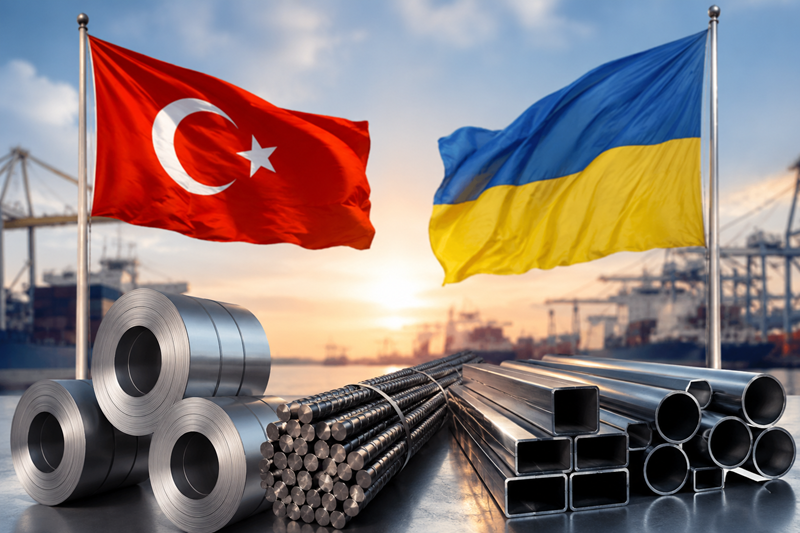
With the entry into force of the Türkiye–Ukraine Free Trade Agreement (FTA), signed on 3 February 2022 and ratified by the Ukrainian Parliament on 14 July 2026, most customs duties on steel trade between the two countries will be eliminated. However, Türkiye will continue to apply tariff quotas and phased tariff reductions for certain steel products.
Over the past three years, steel trade between the two countries has remained relatively stable, with bilateral shipments accounting for only around 5–6% of each country's total steel exports. Due to its significantly larger export base, Türkiye's steel exports to Ukraine were approximately three times higher than Ukraine's exports to Türkiye. While Türkiye exported a broad range of steel products, Ukraine's shipments to Türkiye consisted primarily of flat steel products and, above all, steel billet.
Flat products dominate Türkiye's steel exports to Ukraine
Türkiye exported 785,600 mt of steel to Ukraine in 2025, including 255,400 mt of hot-rolled flat products (HRC), 287,800 mt of coated flat products, 98,200 mt of sections, 34,700 mt of welded pipes, and 15,700 mt of rebar.
During January–May 2026, Türkiye's steel exports to Ukraine totaled 326,600 mt, consisting of 111,900 mt of hot-rolled flat products, 93,900 mt of coated flat products, 44,100 mt of sections, 30,700 mt of cold-rolled flat products (CRC), and 20,900 mt of alloy flat products.
Billet remains Ukraine's leading export to Türkiye
Ukraine's steel exports to Türkiye continued to be dominated by semi-finished products. In 2025, Ukraine shipped 247,900 mt of steel to Türkiye, including 216,100 mt of billet and 28,600 mt of hot-rolled flat products.
In the first half of 2026, exports totaled 116,700 mt, of which 113,400 mt consisted of billet and 3,100 mt of hot-rolled flat products.
Türkiye to maintain protection for selected steel products
Ukraine did not include steel products under HS Chapters 72 and 73 in the list of goods subject to partial liberalization or transitional arrangements. As a result, import duties on Turkish-origin steel products will be eliminated immediately once the agreement enters into force.
Türkiye, however, will retain protective measures for a number of Ukrainian steel products. While some products will be subject to tariff-rate quotas (TRQs), others will benefit from gradual tariff reductions.
Annual tariff-rate quotas have been established for the following Ukrainian steel products:
- Hot-rolled flat products: 120,000 mt
- Cold-rolled flat products: 70,000 mt
- Wire rod: 50,000 mt
- Rebar: 100,000 mt
- Stainless steel semi-finished products: 1,000 mt
- Other stainless steel products: 15,000 mt
- Stainless cold-rolled flat products: 10,000 mt
- Alloy steel semi-finished products: 15,000 mt
- Alloy flat products: 20,000 mt
- Other alloy steel products: 10,000 mt
The current 22.4% import duty on billet will be reduced to approximately 15.7%, while import duties on hot-rolled and cold-rolled flat products will be eliminated within the TRQ volumes. Duties on wire rod and rebar will remain at 10%, while tariffs on various alloy steel products will also be reduced. The total annual TRQ volume has been set at 411,000 mt.
HRC and CRC expected to benefit the most
The agreement is expected to have the strongest impact on Ukraine's exports of billet and hot-rolled coil (HRC).
Although the lower import duty on billet will improve Ukrainian producers' export margins, it is not expected to result in a significant increase in shipment volumes. In contrast, the elimination of 9–10% import duties on hot-rolled and cold-rolled flat products is expected to substantially improve competitiveness. As a result, Ukraine's HRC exports to Türkiye could increase by four to five times, while CRC exports could rise by 15–20 times.
Among the main beneficiaries are expected to be Metinvest, which operates Zaporizhstal, Ukraine's only active flat steel producer, as well as Kamet Steel, another Metinvest asset that exports significant volumes of billet. ArcelorMittal Kryvyi Rih is also expected to benefit from improved conditions for semi-finished steel exports. For other Ukrainian producers, however, the agreement is not expected to generate a significant increase in export volumes.
Reconstruction could create opportunities for Turkish producers
Ukraine's reconstruction is expected to significantly increase domestic steel demand. At the same time, the country's steel production capacity has been severely reduced by the war, making continued imports essential.
With most import duties removed under the FTA, Turkish steel producers are expected to benefit from improved access to the Ukrainian market and more favorable trading conditions during the country's reconstruction phase.
Anti-dumping measures remain possible
The agreement does not prevent either side from initiating future anti-dumping investigations. While customs duties will largely be eliminated, anti-dumping and countervailing duties remain outside the scope of the FTA.
Ukraine will therefore retain the right to launch anti-dumping investigations against Turkish steel products when justified. The agreement also provides for Türkiye to recognize Ukraine as a market economy in anti-dumping investigations and to apply the Lesser Duty Rule.
A Joint Committee established under the agreement will oversee the implementation of tariff-rate quotas, monitor bilateral trade statistics, and conduct negotiations on further trade liberalization where appropriate. The long-term development of Türkiye–Ukraine steel trade is expected to depend largely on the end of the war and the pace of Ukraine's reconstruction efforts.



Comments
No comment yet.