


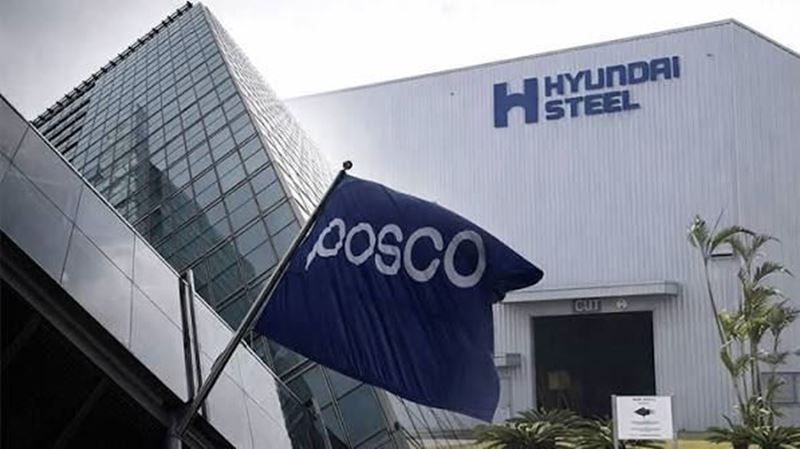
South Korean steelmaker POSCO has taken action against the provisional antidumping measures imposed by Japan on imports of hot dip galvanized steel sheets and strips. The company submitted its objection to Japan’s Ministry of Finance on August 7, arguing that the %29.2 duty rate determined for POSCO is too high.
Annual hot dip galvanized steel exports from South Korea to Japan are estimated at between 300,000 and 400,000 mt, with the value of this trade estimated at approximately KRW 300 billion (USD 212 million).
Japan imposes duties of %29.2 to %38 on companies
Japan’s Ministry of Economy, Trade and Industry and Ministry of Finance issued a preliminary determination on July 30, finding that low priced sales of hot dip galvanized products imported from South Korea and China had caused injury to the Japanese steel industry.
Following the decision, POSCO was subject to an antidumping duty of %29.2, while the rate for Hyundai Steel, Dongkuk Steel and KG Steel was set at %38.
SeAH Coated Metal and Dongkuk Coated Metal were subject to a %30.6 duty, while Hanwha, Hyundai Group, STINKO and Korea JFE Shoji were subject to a %38 duty. Other South Korean companies not included in the list were also subject to the general rate of %38.
The provisional measures entered into force on August 8 and are scheduled to remain in effect until December 7. The final determination is expected to be announced in December.
POSCO stated that its submission to the Japanese authorities was prepared based on detailed explanations of the facts and the World Trade Organization’s (WTO) Antidumping Agreement. The company expects the calculated dumping margin to be revised.
Calculation of dumping margin becomes a point of dispute
Another area of disagreement concerns Japan’s method of calculating the dumping margin.
At the beginning of the investigation, the dumping margins claimed by the Japanese companies that filed the application, including Nippon Steel, Kobe Steel, Nippon Steel Coated Sheet and Yodogawa Steel Works, were reportedly in the range of %10 to %20.
During the preliminary review, the calculated margin reached as high as %42.69. In the provisional antidumping duties ultimately announced, the highest rate was set at %38.
There has also been criticism within the South Korean steel industry that transaction and cost documents submitted by the companies were not sufficiently taken into account and that the Japanese authorities relied on the method known as “Facts Available.”
Investigation into hot and cold rolled products also continues
While the antidumping process involving galvanized products is ongoing, Japanese authorities are also conducting a separate investigation into other steel products.
Japan’s Ministry of Economy, Trade and Industry and Ministry of Finance launched an investigation in June into hot and cold rolled steel sheets and strips imported from South Korea, China and Taiwan.
The investigation is examining whether the products were sold in the Japanese market at low prices. South Korea, China and Taiwan account for the majority of Japan’s imports of these products.



Comments
No comment yet.