


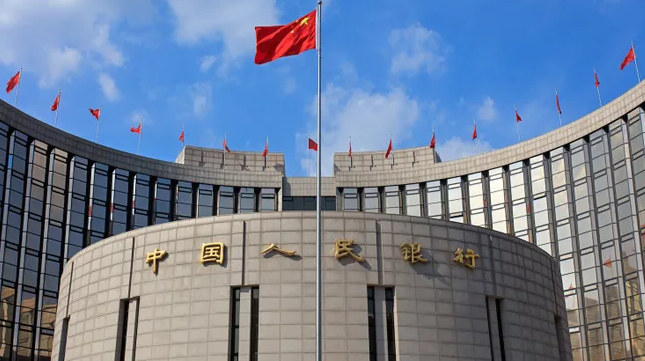
Widening outbreaks of the Delta variant across the country, torrential rains and flooding, and slowing economic growth momentum suggested by recent data, analysts say, require further easing measures to soften the slowdown.
The People's Bank of China (PBOC) kept the rate of one-year medium-term lending facility loans worth 600 billion yuan ($92.64 billion) to some financial institutions at 2.95 percent from previous operations.
The central bank said the loan operation aims to "fully meet the liquidity demand of financial institutions" and to keep funding conditions "reasonably adequate".
The PBOC added that the move "could use some of the funds released from the reserve requirement ratio of financial institutions in July to repay medium-term borrowing loans that are due this month."
Frances Cheung, interest rate strategist at OCBC Bank, pointed out that the rollover amount was larger than expected and added, “Relying on the liquidity of the previous RRR cut to cover the balance is a slight disappointment for the market, as even short-term open market operations (APOs) are not used. Going forward, the PBOC may choose to allow banks to pass lower funding costs to their customers instead of directly cutting interest, and therefore a reserve rate cut cannot be ruled out due to the intense medium-term borrowing maturity profile that persists, particularly over the next 4 months.”
According to Reuters' official data-based calculations, MLF loans totaling 3.05 trillion yuan will expire in the fourth quarter of this year.
The central bank said Monday's operation is for rolling over 700 billion yuan of MLF loans due on Tuesday.
The PBOC made a surprise cut in banks' reserve requirement ratios in July, while in its second-quarter monetary policy report it highlighted policy stability and dampened market expectations for more aggressive monetary easing, including interest rate cuts.
"Unless the prudent monetary policy stance changes, the MLF rate will not be easily adjusted," said Wang Yifeng, senior analyst at Everbright Securities, adding that lowering the cost of medium-term borrowing could encourage financial institutions to finance leveraged positions.
Louis Kuijs, head of Asian Economics at Oxford Economics, said: "We do not think policymakers already have an appetite for a significant loosening in the overall macro policy stance. But we expect policymakers to be willing to avoid a sharp slowdown and be more willing to support growth in H2 than in H1." said.
The bank is expected to fix its benchmark lending prime rate in August, which is loosely pegged to the medium-term borrowing rate on Friday.






Comments
No comment yet.